Search This Blog

Showing posts with label COVID-19. Show all posts

Friday, November 01, 2024

Vote No on Trump

Donald Trump notoriously refused to have a second debate against Kamala Harris -- perhaps because polls and critics overwhelmingly thought he lost the September debate. His verbal mistakes and ridiculous claims during that performance have given way to physical stumbles this week. The guy is 78 years old and his supporters spent months attacking the apparent decline of an aging opponent earlier this year. The electorate obviously absorbed that and Joe Biden was supplanted as the Democratic nominee as a result of the fear of a geriatric president. I don't think Trump wanted America to see another contest highlighting the stark contrast between him and the far more vigorous and quick 60 year old Harris. 

However, anyone can watch video of Trump campaigning in 2016 and it is quite evident that he is a shadow of his former self. His messages are less coherent, he rambles, and he misspeaks with great regularity. Those are links to articles, but just search YouTube for old footage of him from 2015 until 2020.

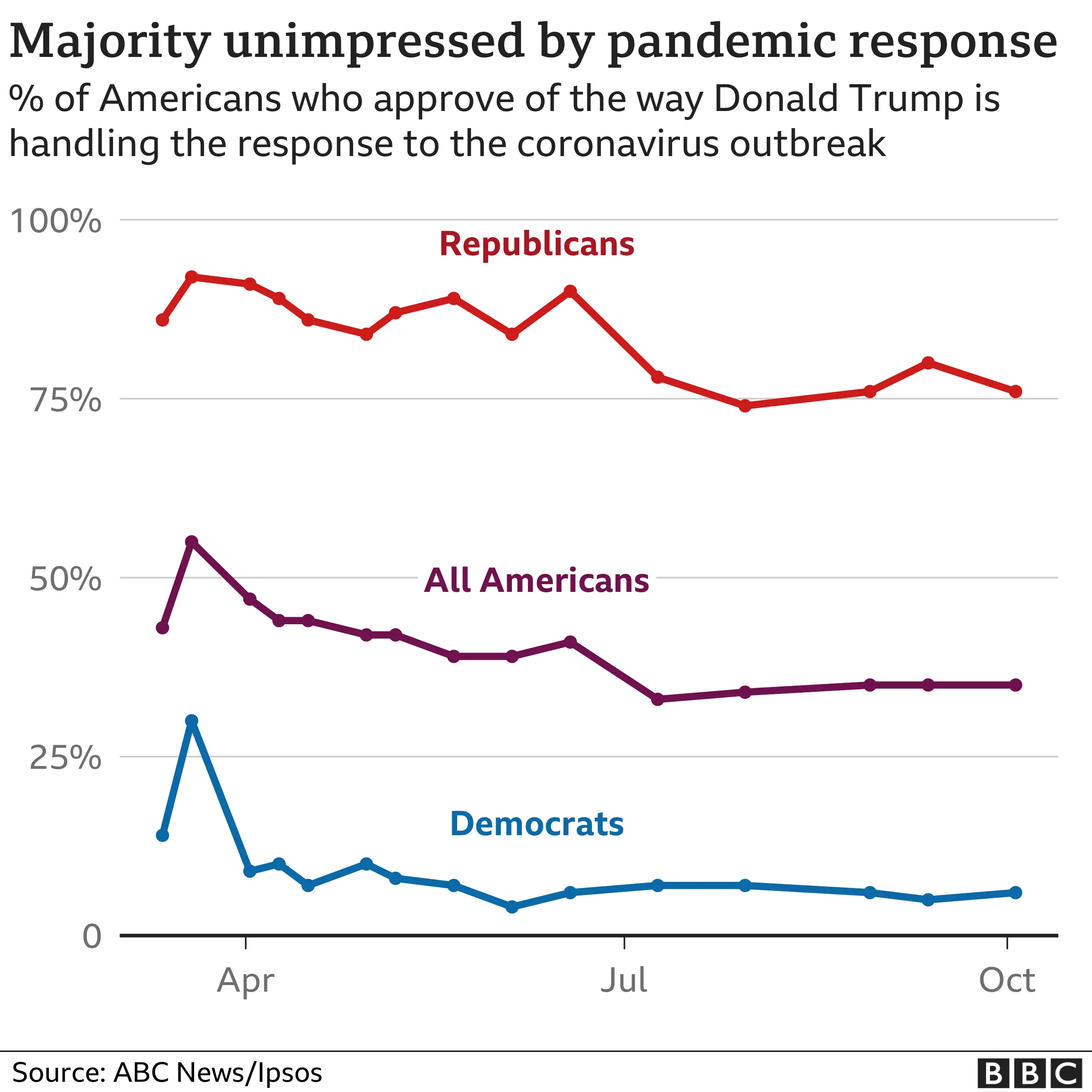
Through 2020, America became increasingly unimpressed with Trump and his daily COVID TV show. Many analysts say that the 2020 election was a referendum on Trump's handling of the pandemic -- and he lost. Biden won by 7 million votes nationally. 


In any case, despite the lack of a second debate to highlight the contrasts between the candidates, there is still time for the Harris campaign to emphasize the stark differences in their views of America. I intend to make another post highlighting why Harris is the far superior candidate -- not only in temperament, but also because of her pro-choice stance, climate change policy, the importance of Supreme Court nominations, her plans to restore higher and fairer tax rates on the richest Americans, the survival of the Affordable Care Act, etc. Trump is far worse on all those points. 

In this post I'm going to pick some choice Trump remarks that highlight some horrific stances the former President has taken regarding his plans for those opposed to his ideas and policies.

Before I begin, however, I would note that this clip from the 2016 campaign would have been disqualifying for someone seeking to be a junior high school assistant principal let alone President of the United States. I'm not sure new young voters are familiar with it:


Indeed, I've seen credible claims that the youngest voters don't really know anything about Trump's notorious Access Hollywood video footage. This also seemed disqualifying at the time -- and many Republicans said so:


Those words, which Trump and his followers dismissed as "locker room talk," were seemingly very accurate as reflected in Trump's civil defamation trial where a jury found that the former playboy committed "sexual abuse" and even "rape" against a female journalist -- and then denied it. 

I have not even mentioned the 34 felony convictions for business fraud that were again returned after a jury trial. Average Americans, not partisan competitors, heard the evidence presented by prosecutors in NY and decided he filed fraudulent documents concerning his under-the-table payments to porn star Stormy Daniels. Basically, instead of using personal funds to buy her silence, which might have been legal, Trump used business funds and recorded that the payments were for legal services. All of this was in an attempt to hide the facts of his tryst from a voting public in 2016. In other circumstances we'd call that "hush money." 

As I've blogged previously, some of my greatest concerns about Donald Trump center on the fact that the former President regularly makes the kinds of claims and threats that people associate with dictators and tyrants -- he fantasizes about not relinquishing power (and sought to remain in power after losing an election), describes his political opponents as "vermin" or enemies of the people, and threatens to turn the powerful US military against those enemies. 

Just this week, Trump discussed having Republican Liz Cheney, who co-chaired the January 6 investigation in Congress, face a firing squad for her political opinions. 

This is on top of Trump expressing open admiration for non-democratic rule in March 2018 -- and the press reported that the Republican donors in attendance applauded!

Chinese President Xi Jinping recently consolidated power. Trump told the gathering: “He’s now president for life. President for life. And he’s great.” Trump added, “I think it’s great. Maybe we’ll give that a shot someday.”

I know that the Trump campaign has been trying to play up Joe Biden's recent slip of the tongue inadvertently calling Trump supporters "garbage," but Biden is not the candidate, he clarified his remark to make clear he was talking about specific speakers at the Trump rally in Madison Square Garden, AND Trump himself makes similar comments all the time. For example, on Veterans Day in November 2023, Trump called his political opponents "vermin" and an "enemy within" that his administration would persecute: 

“We pledge to you that we will root out the communists, Marxists, fascists and the radical left thugs that live like vermin within the confines of our country that lie and steal and cheat on elections,” Trump said toward the end of his speech, repeating his false claims that the 2020 election was stolen. “They’ll do anything, whether legally or illegally, to destroy America and to destroy the American Dream.”

It is clear from the speech context that Trump was not talking about some small slice of people who actually identify as communists or Marxists (though a new round of McCarthyism would be horrible). He imagined that this collective group is more dangerous than China or Russia. It's a lot of people.

Trump went on further to state: “the threat from outside forces is far less sinister, dangerous and grave than the threat from within. Our threat is from within. Because if you have a capable, competent, smart, tough leader, Russia, China, North Korea, they’re not going to want to play with us.”

Trump has called Kamala Harris supporters garbage and scum. Just about a week ago, he called the US the "garbage can for the world." 

While words matter and these words are especially concerning, all voters should be frightened about how a new Trump presidency would address the so-called vermin/scum/garbage enemy within. Trump himself claims his response would involve setting the National Guard and military on these foes. Consider his words from an interview on Fox in mid-October 2024:

"I think the bigger problem is the enemy from within,” Trump said. He added: “We have some very bad people. We have some sick people, radical left lunatics. And I think they’re the big — and it should be very easily handled by, if necessary, by National Guard, or if really necessary, by the military, because they can’t let that happen.”

Now circle back to that quote about Cheney above -- and the many documented times Trump has encouraged political violence. Former top national security and political aids who worked for Trump have warned that he is a dangerous wannabe fascist who should not be anywhere near the presidency again. I believe them. 

Visit this blog's homepage.

For 280 character IR and foreign policy talk, follow me on twitter.

Or for basketball, baseball, movies or other stuff, follow this personal twitter account.

Saturday, July 16, 2022

COVID Update: Omicron Edition

Readers of this blog are most likely vaccinated to some extent against COVID-19 -- a big majority of Americans are. Of course, the level of vaccination varies greatly. The CDC says that about 78% of the US population has had one dose of vaccine and 67% has had the "complete initial protocol." Only about 38% of Americans have received the booster even though almost everyone 5 or older can get one dose. FYI: The CDC officially recommends that everyone eligible should get boosted. Below I reference some research suggesting the booster might save your life. 

A second booster shot (also recommended by the CDC for those eligible) is available for people aged 50 and above, plus the immunocompromised -- basically, the people facing the greatest risks during the pandemic.

Unfortunately, the virus keeps mutating and so neither the vaccines nor previous infection have been especially effective at preventing transmission of the latest version of the disease. They are doing a much better job at preventing hospitalization and death, as the rates for those outcomes have been lower in the US in 2022 than they were in 2020. 

The Washington Post reported in late April that the most recent variants have primarily been  killing peopled aged 75 and up: "nearly two-thirds of the people who died during the omicron surge were 75 and older." However, there are differences among the victims:
the bulk of vaccinated deaths are among people who did not get a booster shot, according to state data provided to The Post. In two of the states, California and Mississippi, three-quarters of the vaccinated senior citizens who died in January and February did not have booster doses.
A new study also finds that it is dangerous to become infected with the virus multiple times: 
The constellation of findings show that reinfection adds non-trivial risks of all-cause mortality, hospitalization, and adverse health outcomes in the acute and post-acute phase of the reinfection. Reducing overall burden of death and disease due to SARS-CoV-2 will require strategies for reinfection prevention.
This is likely already be baked into that data, but experts say about 1 to 5% of COVID patients develop what is commonly called "long COVID"
The percentage of people with severely debilitating symptoms is probably between 1 and 5 percent — amounting to millions of people in this country, according to Harlan Krumholz, a Yale University professor of medicine.
The April information referenced above is now a bit out of date as it is primarily discussing the Omicron variant that was then dominant -- version BA.2. The new BA.5 variant is seemingly much more contagious. Indeed, from Alpha to Delta and then through the several Omicron variants, virtually ever wave of the virus has been propelled by an ever more contagious version of the disease. 

There is some good news: While it was recently calculated and reported that the R-naught (or R0) of BA.5 is over 18, making it the most contagious viral infection known to man (worse than measles), that is apparently incorrect and fact-checkers have now corrected the reporting. It is, however, too soon to calculate the R0 precisely. By the time we can calculate it, the new BA.2.75 circulating in India might be dominant. 


Additionally, the current circulating versions of the disease remain deadlier than the seasonal flu -- at least for the unvaccinated. 

In all, the information fairly clearly reveals that the pandemic is not over -- no matter how many unhelpful strangers tell you that it is -- and people should continue to take precautions.

Get boosted. Wear an effective mask (N95 or KN95). Maybe even outdoors (in crowds). 

Practice social distancing. 

The government should be pushing harder to reinstate masks on planes and other forms of public transportation.  Indeed, because of standing room only crowds and poor ventilation, buses might be the most dangerous. 


Visit this blog's homepage.

For 280 character IR and foreign policy talk, follow me on twitter.

Or for basketball, baseball, movies or other stuff, follow
this personal twitter account.

Friday, December 31, 2021

Films of 2021

This is my annual post about the new films I saw over the prior year. Here's a link to last year's list if you want to work backwards through my choices over time. 

I made the following point last year and it remains true thanks to the ongoing COVID-19 pandemic:
I saw nearly all of these films at home rather than at my local multiplex. I think the last movie I saw in the cinema was Little Women in December 2019. On Long Island. I vividly recall the experience and miss it dearly. 
This first group of films is excellent. All that were eligible last year (the top 5) were nominated for Oscars and were worthy of those nominations. The 2020 Oscar competition allowed for films released early in 2021 to be eligible for consideration, which explains why they are included here. 

As for the "new" crop of 2021 films, I found Limbo to be excellent with a potent political (and humanistic) message about the duty to care for refugees. Power of the Dog is a novel western in that it addresses themes not ordinarily present in the genre. 

Tier I
Nomadland
Judas and the Black Messiah
The Father
One Night in Miami
Quo Vadis, Aida?
Limbo
Power of the Dog

These next films were also entertaining, but they were clearly a notch below the selections in the top tier. CODA is earning a lot of awards buzz and may well be worth it. I found it to have predictable "movie of the week" themes, but it is very well done and it reveals a bit of the world unfamiliar to most of us. King Richard was also well done, but it relies upon a number of sport film tropes that will be familiar to viewers. 

Shiva Baby was very hard to watch at times, with extremely awkward situations and an atonal soundtrack. It may make your skin crawl, but it is smart. 

See Rams. 

I really wanted to like Don't Look Up and I very much appreciated its message about science, but I think it may have been overly ambitious with its attacks on media and celebrity culture. It wasn't as funny as it should have been despite the all-star cast and production team. 

By contrast, I Care a Lot is excellent social satire that is quite well written and funny. Its targets are not as ambitious. 

Tier II
I Care A Lot
King Richard
Quiet Place II
Rams
CODA
No Sudden Moves
Don't Look Up
No Time to Die
Shiva Baby
Riders of Justice
Together Together
The White Tiger
Worth

I also saw these new films in 2021:

Tier III
The Kid Detective
Plan B

Oh, also, I saw a few new documentaries in 2021. Summer of Soul was one of the best movies of the year and should earn an Oscar nomination. A Glitch in the Matrix was not worth my time -- or yours. I enjoyed 227 by the same director and they have a similar odd take on pop culture. But no, skip it. 

Summer of Soul
Some Kind of Heaven 
Derek DelGaudio's in & of Itself 
A Glitch in the Matrix

I almost forgot to add a list of Films of 2021 I still plan to see:

About Endlessness, Akilla's Escape, All is Forgiven, Amusement Park, Anne at 13,000 ft, Assassins, Atlantis, Azor, Beginning, Belfast, Belushi, Bergman Island, Card Counter, Censor, The Climb, C'mon C'mon, Come From Away, Come True, Concrete Cowboy, The Courier, Cowboys, Cruella, The Disciple, The Dig, Dream Horse, Dune Part One, First Wave, FTA, Green Knight, Hearts and Bones, Holler, Hope, Human Factor, Human Voice, Identifying Features, I'm Your Man, Inheritance, Karen Dalton, Keep an Eye Out, Killing of Two Lovers, Land, Lapsis, Licorice Pizza, Little Fish, Lost Daughter, Mass, Mitchells vs. The Machines, Memoria, MLK/FBI, Mogul Mowgli, Night of the Kings, Nobody,  Outside Story, Oxygen, Passing, Pieces of a Woman, Pig, The Reason I Jump, Red Rocket, The Rescue, Ride or Die, Rocks, Rose Plays Julie, Saint Maud, Saint-Narcisse, Shadow in the Cloud, Slow Machine, Souvenir Part II, Spencer, Stowaway, Supernova, This Is Not a Burial It's a Resurrection, tick, tick...Boom!, Tina, Tragedy of Macbeth, Truffle Hunters, Two of Us, Undergods, Undine, The Vigil, White Lie, Wild Indian, World to Come, Yellow Rose, Zola. 

And these are Films of 2020 I still need to see:

All In: The Fight for Democracy, Babyteeth, Bacurau, Banana Split, The Beach House, Beanpole, Beats, Bloody Nose Empty Pockets, City Hall, Color out of Space, Come as You Are, David Byrne's American Utopia, Donut King, End of Sentence, Ghost of Peter Sellers,  Half of It, Herself, How to Build a Girl, Lost Girls, Madre, Mangrove, Martin Eden, Miss Juneteenth, Mr. Jones, My Darling Vivian, The Nest, Ordinary Love, Place of No Words, The Platform, Possessor, Premature, Proxima, Relic, the Rental, Selah and the Spades, She Dies Tomorrow, Social Dilemma, Sorry We Missed You, Spaceship Earth, Straight Up, Sugar Daddy, The Surrogate, True History of the Kelly Gang, The Truth, Vitalina Varela, Wander Darkly, The Whistlers, A White, White Day, White Riot.

Visit this blog's homepage.

For 280 character IR and foreign policy talk, follow me on twitter.

Or for basketball, baseball, movies or other stuff, follow this personal twitter account.

Monday, July 20, 2020

TP Wiz

My long-time American League fantasy baseball league decided to set aside our "keeper" squads until spring 2021. Restocking the rosters would require a long all-day auction to establish players salaries. We drafted new teams online Saturday in about 3 hours, using a standard snake draft. 

I had the 5th pick based on my 8th place finish last year (of 12 teams). That was true through all odd-number rounds. In the even numbered rounds, I picked 8th. 

We continued to use AL-only players, agreed to use 5 hitting (R, HR, RBI, SB, and OBA) and 5 pitching (W, 2SV+H, ERA, WHIP, and K) categories.  We only use 4 OFers, but 10-man pitching staffs on our otherwise standard 23 man roster. We also select 3 reserves to make this a 26 round draft. Finally, we require 1000 innnings in a regular year, so 370 are needed in this 60 game season to avoid last place in ERA and WHIP.

Rather than use the moniker Hardy House for the league, I set it up to be the KBO Western Division. If you have followed the KBO, you may know there's a team called the KT Wiz. My team is the Tyler Park Wizards of Armageddon, or TP Wiz. I live in the TP neighborhood and Wizards of Armageddon was a terrific book I read in graduate school about the nuclear scientists who developed the US deterrent force posture. The name seems appropriate for the unusual season and it references my Hardy House league team name, the Bolts from the Blue (which is a nuclear strategy term). 

This is how my draft went, round-by-round:

1. P/DH Ohtani LAA

A stretch, perhaps, but my software had Ohtani as a top tier player when his hitting and pitching dollar values are combined. I hope it is correct. Most draft software said I should have selected 3B Ramirez of CLE, OF Martinez of BOS, or P Justin Verlander of HOU ($38). Ramirez and Martinez are supposed to be worth about $31 in a standard 5x5 roto league. While Ohtani's hitting is only projected to be worth $20, his pitching is forecast at just over $13. That's $33, which is greater than $31. 

I wasn't going to take an old pitcher using that high pick, so Verlander was out for me. Forecasts suggest Ohtani pitching on Sundays will get 10 starts. Verlander in 60 games on 5 day rotation will likely get 12 to 14. And he might be a lot better in that role, but he might not be.

2. OF JD Martinez BOS
3. SS Bichette TOR
4. C Grandal CHX

I didn't really intend to pick Martinez, but had to get him when he was still there as the 20th player picked. After all, my software said he was the hitter I could have picked in round 1.  Bichette was perhaps a reach in round 3, but I really wanted to be strong at key positions -- 2B, SS, and C. 

5. P Paxton NYY
6. OF Verdugo BOS
7. OF Tucker HOU
8. P Puk OAK
9. OF Buxton MIN

I didn't intend to fill my OF so quickly, but I really like these guys for their youth, speed, and potential for a breakout performances. Paxton is a very solid pitcher, if healthy, and I think Puk will be too. Both have had serious injury problems in the past.

10. 2B Chavis BOS
11 OF Calhoun TEX
12. P Canning LAA
13. 2B Madrigal CHX

At this point, I basically decided to go all-in on youth. Chavis is really a corner IF who happens to qualify at 2B. Calhoun is going to mash. Canning has really good upside, especially as a #4 starter. Madrigal is an outstanding potential rookie, especially valuable in a league using OBA. Hopefully I have enough power elsewhere. 

14. 2B Alberto BAL
15. 1B Nunez BAL
16. P Magill SEA
17. 3B Franco KC

I think the Baltimore guys were undervalued because of their team. They are not stars, but it is surprising they lasted this long. Also, at this point in the draft there were many teams drafting young guys with upside, so I reversed my earlier course and zagged when others were zigging. 

Magill supposedly has the inside track to closing for the Mariners, but who knows. All the real closers were gone by this round. Franco was picked as a token Royal at a position I needed to fill, though I ended up with another KC pitcher later.

18. P Ottavino NYY
19 1B Tellez TOR
20. P Lyles TEX
21. P Buttrey LAA

Ottavino and Buttrey are second in line for saves on their current teams. That's true largely because Aroldis Chapman apparently has tested positive for COVID19 and will likely start the year on the injured list. 

Tellez has real power, but was hurt by the decision to move Vlad Guerrero to 1B. Hopefully, he gets plenty of ABs as a DH. Lyles had a fairly good year last season and the new Texas park is supposedly more favorable to pitchers. We'll see.

22. OF Margot TB
23. C McGuire TOR
24. P Singer KC
25. P Andriese LAA
26. P Edwards SEA

Margot provides some needed steals, hopefully, and plays on a team that uses its depth and has a good track record of getting performance out of imported NL players. 

McGuire is a young backup catcher with upside. Brady Singer is KC's top prospect (unless Bobby Witt Jr. has already usurped him) and is likely to get some starts in the majors this year sooner rather than later.  Edwards is insurance on saves, though I suspect he'll have a short leash in my bullpen. 

In all, I have young bats all over my lineup. I have four Angel pitchers in part because they work in one of the AL's better pitcher's parks. Plus, this season they only play against AL West and NL West teams. That's also true of the Mariner and Oakland pitchers I selected. The best pitcher's parks in the AL include Oakland and Seattle and the best in the NL include LA, SD and SF. I'll want to bench my pitchers when they appear in Coors and maybe Arizona. Of course, some of the western teams have great offenses -- especially Houston and the Dodgers -- so this strategy may backfire. We'll see.


Visit this blog's homepage.

For 280 character IR and foreign policy talk, follow me on twitter.

Or for basketball, baseball, movies or other stuff, follow this personal twitter account.

Monday, May 04, 2020

Fall Semester?

The President of my university issued a statement Sunday claiming that we are full steam ahead for fall 2020 semester live on campus:

President Bendapudi made the following announcements:
  • The University of Louisville will have regular campus operations for the Fall semester.
  • This entails students living on campus, learning on campus and online, and faculty and staff working together to advance our mission of teaching, and research, and service. 
Many faculty members have spent part of their day exchanging email and social media messages reflecting unhappiness with this decision. One issue is lack of consultation with faculty and staff. The decision undercut the work of committees that were supposed to meet this week to discuss this issue. The President acted without our input.

If the current situation with COVID-19 does not change, however, then the idea is completely unworkable. And that actually seems kinds of obvious to me. I suspect that University officials realize that public health uncertainty is going to reduce enrollments and tuition revenue, so they are saying something to seem positive and decisive. The latest message is basically PR, appealing to students and parents, as well as potentially gullible media who might report this uncritically. Administrators still have plenty of time to backtrack if the disease prevalence is significant and the case fatality rate (CFR) remains high.

If central administration does not realize this, then I am quite concerned. Universities are kind of like nursing homes, meatpacking plants, ships, and prisons (the 4 places that have suffered the worst outbreaks) in that people are in close proximity to one another for prolonged periods day after day. These are clearly incubators of the disease and some local facilities have suffered outbreaks of half to two-thirds of their populations. If half of the UofL community of 28,000 students and employees gets COVID-19 and the CFR is a fairly conservative 0.35%, then that’s 14,000 infections and nearly 500 fatalities. Even if it’s 0.01%, then that’s 140 deaths.**

No one will risk those lives, I would assume.

Before faculty and students can possibly return to crowded classrooms, the USA needs far more testing for the disease and antibodies, as well as extensive contact tracing --  unless there proves to be some kind of miraculous treatment for the disease in the next few months. The federal government has bungled its response, letting February pass without strong contact tracing and testing in isolated hotspots -- and the problems have only magnified in the subsequent months as testing continues to lag and contact tracing is nearly forgotten.

In short, I’m not optimistic that the situation is going to improve, so I’m not certain how we can possibly plan for anything other than online education.  Given that most faculty in A&S (by far the largest teaching unit) are not paid for work in June and July, any efforts to improve distance education needs to be happening NOW, in May. Exams are over and faculty cannot travel for personal or professional reasons, as many ordinarily would during May.

After performing well in March and April, UofL is botching its ongong COVID-19 response. .


--------------

** Yes, I realize the case fatality rate is unknown, but see this post for an explanation of my use of 0.35.  I also realize that the population of a university community skews young and that's a population that has a lower mortality rate from the disease.  However, I'm also ignoring the probability that students will transmit the virus to family and community members in their jobs and homes. Louisville is a commuter school and most students work -- at least when the economy is functioning.


Visit this blog's homepage.

For 280 character IR and foreign policy talk, follow me on twitter.

Or for basketball, baseball, movies or other stuff, follow this personal twitter account.

Monday, April 20, 2020

Disease updates

A lot of news has been bouncing around my head. Let me start with the most recent information about Kentucky, then I'll say a few things about the US, and finally, compare America to the rest of the world.

Why Kentucky? Aside from the fact I live here, Kentucky has been held up as a bellweather state for its early, decisive, and consistent action to limit the spread of COVID-19 -- as contrasted to neighboring Tennessee, for example.

To begin, these are the latest COVID-19 figures for Kentucky, acording to Newsweek:
With the 273 additional confirmed infections, Kentucky now has 2,960 cases of the novel virus and 1,122 recoveries. [Governor] Beshear also announced four new deaths on Sunday, bringing the total number of fatalities across the state to 148.
If the disease kills 1% of those who have the virus, as has been frequently estimated, that would mean  there are about 15,000 current Kentucky infections. Likewise, if we assume that only the most serious cases are being tested, which still seems to be true, and that prior estimates are correct that about 20% of cases are very serious or critical, then there would be about 15,000 current Kentucky infections.

But 12,000 of those either had mild versions of the disease or are "silent carriers."

Some experts in the medical community estimate that the number of asymptomatic people is likely to be even higher than we think -- and that experience with prior pandemics reveals that case fatality rates (CFR) are almost always overstated in the early stages. Two different credible medical sources suggest the CFR might be closer to 0.35 or 0.37. That's good news, though still much worse than the flu or other illnesses.

If it's accurate, then the number of cases in Kentucky is closer to 50,000 and half probably don't know it at all.

Then again, there seems to be evidence that the COVID-19-related death rate is dramatically undercounted because lots of people are dying at home without ever entering the medical system. The uptick for people over age 65 is particularly dramatic compared to recent years. Some of those deaths are likely from other causes as people stay home despite evidence of heart attack or other illness that eventually proves fatal.

In any case, Kentucky has 4.468 million residents. If 15,000 people have had COVID-19, then that's 0.003% of the population. Obviously, slightly more than triple that (using a lower CFR) and the infection rate is higher -- 0.01%.

Basically, the lower estimate would mean a 15,000 person crowd at a rock concert or ballgame would likely include 45 infected people. With the higher rate, it would mean 150 infected people in that crowd. That assumes the infected are randomly distributed across the state and in attendance at this stadium.

For a 60,000 person football game, just multiple those numbers fourfold -- 180 infectious people in the crowd at the lower rate and 600 at the higher rate.

How long would it take for the virus to spread quickly to many new human hosts under those circumstances?

It's a major problem that up to 80% of those infected don't know it. Even if a substantial chunk of those individuals think they had the disease because of minor symptoms they experienced, half of the carriers are asymptomatic. Plus, some unknown percentage of people have had similar symptoms but did not actually have COVID-19 and are not immune. However, they might think they have had the sickness and erroneously believe they have developed lifesaving antibodies.

US and Comparative data.

The figures for the US as a whole are parallel. As that same Newsweek story providing Kentucky figures reported:
As of Sunday afternoon, more than 764,000 individuals had tested positive for COVID-19 in the U.S., with over 40,500 deaths caused by the new disease and 71,000 recoveries.
If 40,500 deaths reflect a 1% mortality rate, then 4.05 million Americans have been infected by the virus. If the 764K positive test results reflect primarily the worst 20% of cases, then 3.82 million people carry the virus. Both figures suggest about 4 million cases of infection across the country. In a nation of 328 million people, that's a 0.012 infection rate, nearly 4 times the Kentucky rate.

If the case mortality rate is actually at the lower ~0.35 figure mentioned above, then the US would have more like 12 million active cases, in a country of 328 million. That's a 0.037% infection rate, again more than 3 times Kentucky's rate using the same assumption about CFR.

Adjust the stadium figures accordingly. For the two different infection rates, figure 135 or 450 infected people in the smaller concert crowd, or 540 or 1800 in the larger football crowd.

What does this mean in a worldwide context?

Sadly, the US seems to be far behind the rest of the advanced industrial states based on the information available from the millions of tests that have now been conducted.

From month-to-month, March to April, the US positivity rate stayed flat. About 20% of those tested for the virus are positive -- and that many were also positive last month. That's not good compared to other countries and any nation nearing a decision to open its economy should have a much lower rate especially as the number of tests increases:
South Korea—which discovered its first coronavirus case on the same day as the U.S.—has tested more than half a million people, or about 1 percent of its population, and discovered about 10,500 cases. The U.S. has now tested 3.2 million people, which is also about 1 percent of its population, but it has found more than 630,000 cases. So while the U.S. has a 20 percent positivity rate, South Korea’s is only about 2 percent—a full order of magnitude smaller. 
South Korea is not alone in bringing its positivity rate down: America’s figure dwarfs that of almost every other developed country. Canada, Germany and Denmark have positivity rates from 6 to 8 percent. Australia and New Zealand have 2 percent positivity rates. Even Italy—which faced one of the world’s most ravaging outbreaks—has a 15 percent rate. It has found nearly 160,000 cases and conducted more than a million tests. 
I think the only conclusion from all of this is that it is premature to be talking about opening the country on May 1. That link verifies that this understanding is Dr. Fauci's assessment. After about 2 weeks, it seems likely that the infection and death rate would begin to skyrocket again.

We need millions of tests, to find out the actual infection rate and identify the individuals who need to be quarantined and perhaps monitored for the good of public health.

At the same time, we need millions of antibody tests so we can figure out potential blood donors for use to aid the newly sick -- and so we can figure out who might be able to return to more active life sooner rather than later. We simply need much more information to act.

Moreover, "opening up" in its early stages, according to the experts, won't mean the old normal. Social distancing, masks, small crowd sizes, and other limitations would very much be needed. Regular poker games are going to be out for some time:
“What’s the downside to asking people to put on masks or wrap their faces with a shawl?” he [Dr. William Schaffner, professor of preventive medicine and infectious diseases at Vanderbilt University] asked. “It may make some people think they’re bulletproof. Some bozo out there will say, ‘Let’s put on our bandannas and have a poker party tonight.’ 
“That’s what we call, in my family, ‘d-u-m dumb,’” he said.
And dangerous.

In fact, any premature return to the normal of February would apparently mean millions of new cases of the disease and tens of thousands of additional deaths. Hospitals would again face scarcities of PPE and risk collapse from overburden.

The infectiousness of this disease is part of the problem, but so is the prevalance in the USA. Either because the country's leadership reacted too slowly to the outbreak or because people have not been truly careful, the US is far behind other advanced nations.

The only real solution is to continue isolating for the foreseeable future. I know that's economically quite painful, but it's also true that other nations have used superior economic and social welfare policies to ease that pain as well. The US Congress and Trump administration can move on that issue with more political cooperation and leadership.

How about a rally to urge that?


Visit this blog's homepage.

For 280 character IR and foreign policy talk, follow me on twitter.

Or for basketball, baseball, movies or other stuff, follow this personal twitter account.