Search This Blog

Showing posts with label debate. Show all posts

Friday, November 01, 2024

Vote No on Trump

Donald Trump notoriously refused to have a second debate against Kamala Harris -- perhaps because polls and critics overwhelmingly thought he lost the September debate. His verbal mistakes and ridiculous claims during that performance have given way to physical stumbles this week. The guy is 78 years old and his supporters spent months attacking the apparent decline of an aging opponent earlier this year. The electorate obviously absorbed that and Joe Biden was supplanted as the Democratic nominee as a result of the fear of a geriatric president. I don't think Trump wanted America to see another contest highlighting the stark contrast between him and the far more vigorous and quick 60 year old Harris. 

However, anyone can watch video of Trump campaigning in 2016 and it is quite evident that he is a shadow of his former self. His messages are less coherent, he rambles, and he misspeaks with great regularity. Those are links to articles, but just search YouTube for old footage of him from 2015 until 2020.

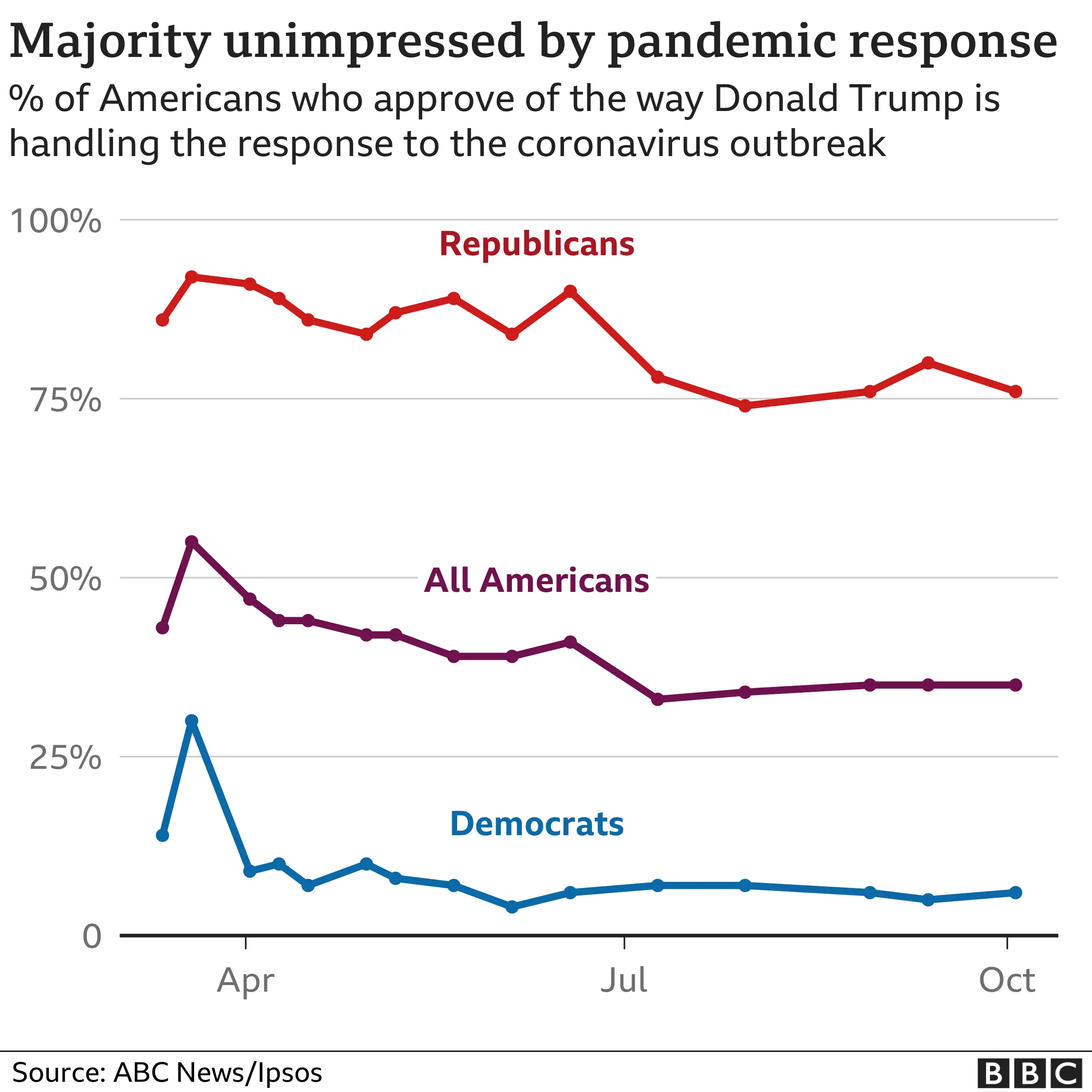
Through 2020, America became increasingly unimpressed with Trump and his daily COVID TV show. Many analysts say that the 2020 election was a referendum on Trump's handling of the pandemic -- and he lost. Biden won by 7 million votes nationally. 


In any case, despite the lack of a second debate to highlight the contrasts between the candidates, there is still time for the Harris campaign to emphasize the stark differences in their views of America. I intend to make another post highlighting why Harris is the far superior candidate -- not only in temperament, but also because of her pro-choice stance, climate change policy, the importance of Supreme Court nominations, her plans to restore higher and fairer tax rates on the richest Americans, the survival of the Affordable Care Act, etc. Trump is far worse on all those points. 

In this post I'm going to pick some choice Trump remarks that highlight some horrific stances the former President has taken regarding his plans for those opposed to his ideas and policies.

Before I begin, however, I would note that this clip from the 2016 campaign would have been disqualifying for someone seeking to be a junior high school assistant principal let alone President of the United States. I'm not sure new young voters are familiar with it:


Indeed, I've seen credible claims that the youngest voters don't really know anything about Trump's notorious Access Hollywood video footage. This also seemed disqualifying at the time -- and many Republicans said so:


Those words, which Trump and his followers dismissed as "locker room talk," were seemingly very accurate as reflected in Trump's civil defamation trial where a jury found that the former playboy committed "sexual abuse" and even "rape" against a female journalist -- and then denied it. 

I have not even mentioned the 34 felony convictions for business fraud that were again returned after a jury trial. Average Americans, not partisan competitors, heard the evidence presented by prosecutors in NY and decided he filed fraudulent documents concerning his under-the-table payments to porn star Stormy Daniels. Basically, instead of using personal funds to buy her silence, which might have been legal, Trump used business funds and recorded that the payments were for legal services. All of this was in an attempt to hide the facts of his tryst from a voting public in 2016. In other circumstances we'd call that "hush money." 

As I've blogged previously, some of my greatest concerns about Donald Trump center on the fact that the former President regularly makes the kinds of claims and threats that people associate with dictators and tyrants -- he fantasizes about not relinquishing power (and sought to remain in power after losing an election), describes his political opponents as "vermin" or enemies of the people, and threatens to turn the powerful US military against those enemies. 

Just this week, Trump discussed having Republican Liz Cheney, who co-chaired the January 6 investigation in Congress, face a firing squad for her political opinions. 

This is on top of Trump expressing open admiration for non-democratic rule in March 2018 -- and the press reported that the Republican donors in attendance applauded!

Chinese President Xi Jinping recently consolidated power. Trump told the gathering: “He’s now president for life. President for life. And he’s great.” Trump added, “I think it’s great. Maybe we’ll give that a shot someday.”

I know that the Trump campaign has been trying to play up Joe Biden's recent slip of the tongue inadvertently calling Trump supporters "garbage," but Biden is not the candidate, he clarified his remark to make clear he was talking about specific speakers at the Trump rally in Madison Square Garden, AND Trump himself makes similar comments all the time. For example, on Veterans Day in November 2023, Trump called his political opponents "vermin" and an "enemy within" that his administration would persecute: 

“We pledge to you that we will root out the communists, Marxists, fascists and the radical left thugs that live like vermin within the confines of our country that lie and steal and cheat on elections,” Trump said toward the end of his speech, repeating his false claims that the 2020 election was stolen. “They’ll do anything, whether legally or illegally, to destroy America and to destroy the American Dream.”

It is clear from the speech context that Trump was not talking about some small slice of people who actually identify as communists or Marxists (though a new round of McCarthyism would be horrible). He imagined that this collective group is more dangerous than China or Russia. It's a lot of people.

Trump went on further to state: “the threat from outside forces is far less sinister, dangerous and grave than the threat from within. Our threat is from within. Because if you have a capable, competent, smart, tough leader, Russia, China, North Korea, they’re not going to want to play with us.”

Trump has called Kamala Harris supporters garbage and scum. Just about a week ago, he called the US the "garbage can for the world." 

While words matter and these words are especially concerning, all voters should be frightened about how a new Trump presidency would address the so-called vermin/scum/garbage enemy within. Trump himself claims his response would involve setting the National Guard and military on these foes. Consider his words from an interview on Fox in mid-October 2024:

"I think the bigger problem is the enemy from within,” Trump said. He added: “We have some very bad people. We have some sick people, radical left lunatics. And I think they’re the big — and it should be very easily handled by, if necessary, by National Guard, or if really necessary, by the military, because they can’t let that happen.”

Now circle back to that quote about Cheney above -- and the many documented times Trump has encouraged political violence. Former top national security and political aids who worked for Trump have warned that he is a dangerous wannabe fascist who should not be anywhere near the presidency again. I believe them. 

Visit this blog's homepage.

For 280 character IR and foreign policy talk, follow me on twitter.

Or for basketball, baseball, movies or other stuff, follow this personal twitter account.

Saturday, September 17, 2022

Debate reunion 2022

Last weekend I traveled back to Lawrence for a University of Kansas debate team reunion. I still have not flown since 2019, so this trip involved a roundtrip drive to St. Louis, an Amtrak across Missouri Friday and Sunday, and then short car trips to/from KU. 

The Friday night registration and banner hanging was on the top floor of a warm academic building. I wandered down to the trophy case on a (much cooler temperature) lower floor and snapped a shot of the national championship trophies on display. 


I found the trophy I helped win in 1983 as well as the others depicted on these bright banners. This is only a taste of all the banners as there are also markers for Final Four teams, top individual speakers, winners of other national tournaments, etc. 


On an sour note, I felt the registration area was overpacked with people. Since I had the sniffles by Sunday, mild fever and body aches by Monday, and a positive COVID test by Tuesday, then I guess my concerns were warranted. Hopefully I was not a superspreader. I masked in some circumstances, but most people were unmasked throughout the weekend. I've only heard of one other person testing positive, but who knows given the state of contact tracing in America? I think my case could have been transmitted from poor ventilation in a hotel. One of my neighbors Friday night was coughing loudly all night. 

The next event was a buffet-style dinner at a local catering venue with plenty of beer and food for everyone. There were some games, but the older alums that I hung out with on the balcony mostly sat around and talked. Lots of fun reminiscing.  


On Saturday morning the debate alumni toured Allen Fieldhouse, home of the Kansas Jayhawks reigning national champion basketball team. They have nearly as many recent victory banners and trophies as debate does:


There was an event remembering some of the KU debaters who have died in recent years (including Frank Cross) and then a cocktail hour and meal at the Eldridge Hotel in downtown Lawrence. I was in a wedding there in May 1983 and may not have been back in all that time. Before dinner, I managed to help organize this photo that includes 5 debaters from the 1976, 1983, 2009, and 2018 champions, plus the two head coaches.

Left to right: Former Coach Donn Parson, Brett Bricker (2009), Robin Rowland (1976), Mark Gidley (1983), Quaram Robinson (2018), coach Scott Harris, and me (1983).


Back in 2013, this photo included 5 of the same victors, plus a member of the 1954 team, Bill Arnold on the extreme left. Others pictured: Robin Rowland (1976), me, Dr. Parson, Brett Bricker (2009), and Mark Gidley (1983).


Visit this blog's homepage.

For 280 character IR and foreign policy talk, follow me on twitter.

Or for basketball, baseball, movies or other stuff, follow this personal twitter account.

Monday, April 29, 2019

RIP: Frank Cross

Sadly, Professor Frank B. Cross of the University of Texas Law and Business Schools has died. Frank was a national debate champion at the University of Kansas (1976), Harvard Law School graduate, former practicing attorney, and long-time professor and scholar in Austin. I will link (here) to his obituary when it is published online. My friend, former KU debater Steve Griffin has posted a short blog entry about Frank's academic contributions -- and briefly notes his long battle with a terrible disease.

Honestly, I didn’t really know Frank all that well, but he was incredibly influential in my life and I am very grateful for the inspiration he provided. Obviously, I should have shared this appreciation with him long before he died.

Frank's influence on my life began when I was a senior in high school. I had debated one semester at El Dorado (KS) High School during my sophomore year -- Kansas high schools only had debate for one semester in those days. Then, I debated my junior year at Charles Page High School in Sand Springs (OK). My father's job had taken us to the Tulsa area and debate allowed me quickly to find a new group of good friends in high school. As it turns out, both El Dorado and Sand Springs were pretty good high school debate programs with young energetic coaches.

Some of my friends at Sand Springs were especially serious about debate. My colleague, for example, was attending the Northwestern University debate institute after our junior year. I wanted to be successful and I'm a competitive guy, so I ended up attending KU debate camp. I had long been a Kansas basketball and football fan and the trip also served as an on-site visit to my preferred college. It made for a reasonable sell to my parents.This would have been summer 1978.

Camp was fun and I really liked the KU campus. I learned a lot, started thinking about debating in college, and met Steve Griffin, who provided some encouragement to me. Most KU debaters, he noted, were former Kansas high school products. Steve had gone to Lawrence High School and would make the semi-finals of the NDT in 1979. That's the Final Four in basketball vernacular.

After the camp, I put my hands on a copy of the Journal of the American Forensics Association article featuring the final national championship debate between the University of Kansas and Georgetown University. That winning Kansas team was comprised of Robert (Robin) Rowland and Frank Cross. They were juniors at the time and followed up their championship with a very successful senior year that ended with a loss in the semi-finals of the National Debate Tournament. Frank and Robin are now members of the University of Kansas debate Hall of Fame. 

For weeks (and months) afterwards, I sometimes practiced reading aloud Frank's second negative constructive speech to figure out if I had the verbal "speed" to debate in college at a nationally-competitive program like Kansas. I also mined Frank's references from the "Malthus was right" argument he made in that debate. His bibliography allowed me to assemble (and understand the complexity of) the argument he was making (against a food aid case) – even though I figured it would not be something I could use in Oklahoma high school debate at the time.

Next, Frank's success as a KU debater shaped who I became as a college debater. As a freshman in Lawrence I took a required debate theory and argumentation class from Robin Rowland, who openly admitted that much of what he knew about developing disadvantages to affirmative plans was learned from years and years and years of debating with Frank Cross. Rowland and Cross were both products of Lawrence High School and had debated together through four years of college. They were friends for decades. Essentially, I learned a tremendous amount of debate skill from Robin, but he had learned a good deal about making attacks on affirmative plans from Frank. Robin also repeatedly emphasized the importance of research and often credited Frank on that front as well.

My ultimate identity as a college debater was largely based on my researching disadvantages to various affirmative plans.

Later, Frank's post-graduate education and career decisions also greatly influenced my life.

From around age 5, I had wanted to be a lawyer. When I discovered that Frank had gone to Harvard Law School after attending KU, I figured that was a viable pathway for me – maybe not Harvard Law specifically, but some excellent (if not elite) law school. It would be wrong to say that it made Kansas a viable choice, because I long intended to attend KU. But it made the pathway thinkable -- Kansas, college debate, good law school, etc.

During my years as a college debater (and then two years as a coach), Frank’s decision to leave private legal practice (and Steve Griffin's parallel decision, I would note) for a career in academia, made me rethink why I thought I wanted to be a lawyer.  Why were these bright guys abandoning the career I thought I wanted -- in favor of academia? In the end, that pathway made sense for me too.

Finally, while I was working on my dissertation in late June 1989, Frank generously allowed me to stay with him in his home while I conducted archival research at the LBJ presidential library in Austin. I remember some wide-ranging conversations with him about politics, academia, law, etc. Most clearly, however, I recall our discussions of how best to assemble a team in fantasy baseball. We were watching the NBA draft on TV and I had discovered his library of  Bill James abstracts in his guest room. Frank could be a very serious scholar and thinker, but he also enjoyed having a drink with friends, talking about sports, and speculating about politics.

In the end, I very much appreciate all of those things too.

RIP, Frank B. Cross.


Visit this blog's homepage.

For 280 character IR and foreign policy talk, follow me on twitter.

Or for basketball, baseball, movies or other stuff, follow this personal twitter account.

Saturday, January 20, 2018

Truth Decay

By Master Steve Rapport (Tax March SF) [CC BY 2.0 (http://creativecommons.org/licenses/by/2.0)], via Wikimedia Commons
Some highly respected scholars are warning that the public sphere is under serious threat -- from the shallow nature of social media, intentional foreign misinformation campaigns, lack of public agreement about basic facts and information, the blurring of the lines between opinion and fact -- and the persistent lying of Donald Trump.

Indeed, the Rand Corporation recently released a report warning that "truth decay," the term they adopt, "poses a direct threat to democracy." Rand authors assert that truth decay can cause "the erosion of political and civil discourse, political paralysis at the federal and state level, and increased risk of individual disengagement from political and civic life."

Next, consider the points recently made by Tom Nichols of the Naval War College, author of The Death of Expertise: The Campaign Against Established Knowledge and Why it Matters. Among other concerns, he sees real trouble in the rise of social media and state actor (especially Russianbots:
“There is always a market for conspiracy theories, and social media reduces the barrier to entry for people who want to peddle them to near zero,” Tom Nichols, a professor at the U.S. Naval War College and author of The Death of Expertise, told ThinkProgress. “Twitter, especially, is amenable to this, because you can mimic expertise in short bursts, and pretend to know things you could not possibly know, in a way you would never be able to sustain — or that would reveal the utter ludicrousness of your argument — if you had to make your points at greater lengths in a coherent, single article.... 
The negative effect here is that cynicism about information sources will increase as each of these waves [of conspiracy theorists] passes through,” Nichols said. “I think that’s actually the goal of some of the state actors dumping misinformation on the net: to exhaust the readers into paralysis, so that they believe nothing.”
Additionally, consider the following claims from Allan Lichtman, an American University History Professor who earned a measure of fame in fall 2016 for predicting that Donald Trump would win the presidency. In 2016, even as he was making his prediction, Lichtman warned that Trump posed a danger to America (and potentially to the accuracy of his prediction system):
[Trump]'s a bit of a maverick, and nobody knows where he stands on policy, because he's constantly shifting. I defy anyone to say what his immigration policy is, what his policy is on banning Muslims, or whoever, from entering the United States, that's certainly a factor. But it's more his history in Trump University, the Trump Institute, his bankruptcies, the charitable foundation, of enriching himself at the expense of others, and all of the lies and dangerous things he's said in this campaign, that could make him a precedent-shattering candidate.
Lichtman noted at the time that "the two candidates have been repeatedly fact-checked by independent sources, and his lies vastly outnumber hers [Hillary Clinton's]." Indeed, Lichtman predicted at the time that Trump would be impeached in office. He has subsequently authored a book The Case for Impeachment outlining 8 possible reasons for Trump's impeachment.

More recently, the scholar has extended his critique: “He [Trump] has shattered reality itself,” said Lichtman, the American University professor. “There is no such thing as reality in the world of Trump.”


Visit this blog's homepage.

For 140 character IR and foreign policy talk, follow me on twitter.

Or for basketball, baseball, movies or other stuff, follow this personal twitter account.

Friday, July 01, 2016

UofL Board and Debate

Earlier this week, Kentucky Governor Matt Bevin picked a new Board of Trustees for the University of Louisville. As I blogged two weeks ago, Bevin recently disbanded the old Board in what appeared to be a brazen use of executive power given Kentucky statutes regulating the way Board members are supposed to be appointed and removed. Moreover, the committee that nominated the new Board members may itself be illegal because it lacks diversity. 

For those following from afar, I should note that the old Board's paralysis this year was initially triggered by a lack of diversity. It was not diverse and needed additional members to make lawful decisions. Governor Bevin could have fixed that problem any time since March simply by appointing new minority Board members. But he didn't. 

This post, however, isn't about the legal or political processes. Instead, it is about the nature of academic debate and the difference between faith and opinion on the one hand and knowledge on the other.

One of the newly appointed members, Douglas Cobb, has received special scrutiny for his controversial contributions to public discussion almost from the moment he was named to the Board. Cobb had an active twitter feed that was deleted shortly after he was named to the University's Board. However, the account feed survived long enough for various local reporters to notice that Cobb used it to deny mainstream climate science and evolution. He expressed anti-LGBT views and called for the firing of various University coaches and officials because of sports scandals (but not exactly these scandals). There's more:

Cobb, who is an elder at Louisville’s Southeast Christian Church, has also devoted attention on Twitter to issues involving Islam and terrorism, and gay, lesbian, bisexual and transgender issues, questioning fairness policies and quoting Bible verses.
In a tweet two years ago, Cobb said that when Nigerian-based terrorist group Boko Haram kidnapped as many as 200 school girls it was practicing a version of Islam that "is orthodox Islam." In another 2014 tweet, Cobb cited a biblical verse to say that being gay and Christian were “incompatible terms of identity.”
In various tweets referenced in the media stories, Cobb dubbed climate science a hoax "invented by the progressive left" and said it reflects a "socialist line."  He tweeted, that "the same people who are lying to you today about global warming have been lying to you for 150 years about evolution."

Perhaps because so many of Cobb's tweets reference the UofL athletic program, sports columnist Tim Sullivan wrote a piece today defending Cobb's contributions to debate about various issues, including controversial science and public policy positions Cobb staked out in his twitter feed. 
Still, debate is healthy. Public institutions warrant scrutiny from a wide range of vantage points. On some levels, appointing trustees whose points of view are likely to cause conflict is preferable to the intellectual lockstep of unquestioning cronies. Hard as it is look past Cobb's harsher opinions and judgmental attitude, his presence should prompt all constituencies to pay closer attention to board proceedings.
Given U of L's recent history, which has included federal charges of fraud, an FBI investigation into the misuse of funds, an NCAA probe of recruiting irregularities involving strippers and prostitutes, and disproportionate pay packages for administrators, it’s fair to ask whether the board should have been even more sharply divided and more inclined to challenge the status quo.
Plus, Cobb is bound to offer some dissenting opinions that will enliven local discourse and provide deserving pundits with fresh material on slow days.
What Sullivan ignores here is the difference between knowledge and rational debate on the one hand versus ideas grounded in faith and opinion. Cobb’s views on LGBT issues, Islam, and gender diversity apparently emanate from his faith. Fine. He’s entitled to his personal religious perspective, but should that faith play any role in influencing the future of a public University? Keep in mind that this same public University has been praised for being one of the most LGBT-friendly campuses in the South. Moreover, the University’s mission statement is committed firmly to diversity.

As for climate science and evolution, Cobb “debates” by referencing conspiracy theories and offering political slurs. The current mainstream scientific understandings are built on mountains of evidence, analysis, and peer-reviewed empirical research. Scientists can be wrong, but their errors should be identified through rigorous scientific processes. 

Oh, by the way, social science works in the same way and I’m quite confident our Middle East and Islamic Studies faculty could dismiss his dubious ideas about Boko Haram and Islam in less than 5 minutes of class time.

So far as I can see from the quoted tweets, Cobb has not contributed one meaningful idea to any active scientific debate in the wider public debate. It's not difficult to understand why this is so. Climate change, for example, has long been mainstream science with very little dissent in the scientific community. Journalists were partly to blame for any public perception of controversy because coverage was horribly misleading. Additionally, Exxon and other wealthy funders are also to blame as they invested substantial sums in propaganda to create public doubt about climate change. 

Oddly enough, Cobb’s business acumen, referenced by some supporters to defend his appointment to the Board, is supposedly tied to his work as an investment entrepreneur. Yet, I wonder if his right-wing politics cause him to miss some larger truths about green investment opportunities

Oh, and readers might want to know about a potential economic conflict of interest. UofL is invested in Cobb's firm, Chrysalis Ventures


Visit this blog's homepage.

For 140 character IR and foreign policy talk, follow me on twitter.

Or for basketball, baseball, movies or other stuff, follow this personal twitter account.

Tuesday, April 28, 2015

Riot hyperbole in history

If you are disturbed by the discussion of what is happening in Baltimore tonight, then I offer some context.

My junior year in college, 1981-1982, my debate colleague and I advocated for fairly strict limits on police use of deadly force. Among the advantages we claimed was reduction in the risk of urban riots, which historically are often triggered by police violence.

Because we were 20 years old and every argument needed to involve significant threats, we used to reference portions of this quote in virtually every affirmative debate. It is from Louis H. Masotti, et al A Time to Burn?, 1969, p. x-xi:
To a very great extent, riots are a cry of utter despair, pleading for someone to hear and respond. Yet our response has been more talk, more unfulfilled promises, more tokenism, and recently, more suppression. And while we are talking, the disillusionment and frustration of the ghetto is accelerating at a frightening pace. The civil rights efforts of the past decade and the continual bombardment of the mass media have heightened the consciousness and raised the expectations of the Negro far beyond the level of our response. Those who say that riots have nothing to do with the civil rights movement are either engaging in enormous self-delusion or are attempting to protect the good name of a phase of the movement which is more palatable to themselves and the American public. They are blind to a long history of social revolutions which have often begun as broad-based nonviolent efforts to change institutionalized injustices, only to merge as violent social revolutions when more moderate efforts failed. As a minority of slightly more than ten per cent of the population, Negroes stand little chance of winning in a violent confrontation. But before the militant leaders push the Negro community beyond the point of no return, we must do some sober thinking about the consequences of such a confrontation. American society itself would be the ultimate loser. We would become the captives of fear and hate of a magnitude that would make Nazi Germany and apartheid South Africa seem like meccas for civil libertarians. Such a confrontation would make a mockery of the American Revolution and the entire history of our experiment in democracy. But even this might be a relatively minor consequence. In a mood of rage and hate, the balance of power in this nation might very well shift into the reckless hands of those who would disrupt the precarious balance of peace between the nuclear powers and plunge the whole world into nuclear holocaust.
Update: here's a review of Masotti et al from Edward B. McLean in The Review of Politics, 1970. It is not kind:
"A Time to Burn?...is not a very good book and is already quite dated. The summers of 1968 and 1969 have not supported the assumption that the 1967 summer riots were a prelude to continuing and expanding violence in the Negro areas....Although the authors insist that theirs is a scholarly work, it is far more in the vein of commentary literature....as an effective and relevant examination of the problems of race in the country in 1960 and 1970, it has little value....Serious questions can be raised about the balance and seriousness of the evidence which is the basis of the book and the support for the authors' contention that" the U.S. is a country "on the verge of a race war, and very possibly on the brink of self-destruction." 
The book was coauthored by four colleagues from the Civil Violence Research Center at Case Western Reserve University. The coauthors are Kenneth Seminatore, Jeffrey K. Hadden, and Jerome R. Corsi. That last name is probably the most familiar as he is a well-known backer of Obama conspiracy theories.


Visit this blog's homepage.

For 140 character IR and foreign policy talk, follow me on twitter.

Or for basketball, baseball, movies or other stuff, follow this personal twitter account.

Tuesday, October 07, 2014

Prior to War: Debate, then Vote

Interesting exchange about the legitimacy of America's wars, from the October 1, 2014, The Colbert Report.
Stephen: Can I tell you why I think the American people might be tired of it? And want to go back to bed? And I’m speaking for myself, and, therefore, the American people. We’re asked to be afraid of it. You get to think about it all the time or you did get to think about it all the time and say to yourself, “You know what? That little corner of the desert looks like it could blow up real good. Let’s go over there.” Whereas, we’re asked to be afraid of it and we’re reminded to be afraid of it, but we no longer have much of a voice in it because our Congressional representatives won’t vote on whether we’re supposed to do anything about it. We’re not asked to sacrifice that much for it. Very few of us go fight. And we’re also not told all that much about what’s happening over there. So, all we have is the fear and none of the action. And so we eventually want to stop thinking about it. And that’s why that 25,000-man mercenary army starts to sound good. We also want to stop caring about what happens to our men and women who go over there, because we don’t want them to sacrifice for something that we don’t think is right. And yet we don’t have much voice in it anymore. 
Adm. Mike Mullen: So, you bring up a concern that I have with respect to a growing disconnect between the men and women who serve in this all-volunteer force, who are the best I’ve ever seen. They’re less than 1% of the population. They come from fewer and fewer places in America. And the American people who didn’t have to buy into these wars, as you said – and I agree with that – and certainly the vast, vast majority didn’t have to fight in them, don’t know who we are as a military. And in fact – and I’ve said this many times – what I actually do worry about is that we become some version of something like the French Foreign Legion, which is please go off and fight our dirty little wars and let us get on with our lives. And I think that’s a disaster for America. We need to be connected to the American people and we need to do that through the system that’s here; those that are elected. And I certainly agree that those who are elected ought to vote on what we do. And we ought to have a fulsome, raging debate about that in this country.
Mullen is absolutely correct. Where is the public and legislative debate -- followed by a congressional vote?

Visit this blog's homepage.

For 140 character IR and foreign policy talk, follow me on twitter.

Or for basketball, baseball, movies or other stuff, follow this personal twitter account.

Wednesday, April 09, 2014

NDT 2014

As planned, I dropped by the National Debate Tournament in Bloomington, Indiana, on Saturday, March 29, and watched the constructive speeches for a Kansas versus Northwestern match of two 4-0 teams. NU won that round and proved to be the Copeland Award winning team in 2014.

Both Kansas teams advanced to the elimination rounds and were defeated in the round of 32.

Georgetown won the tournament, as the same debaters impressively repeated their 2012 victory.

Between rounds, I met Kevin Kuswa, a Georgetown debater on the NDT champion in 1992. I coached Georgetown in 1984-1985. Kuswa is now coaching at Whitman College.

Photo credit: Joel Rollins


Visit this blog's homepage.

For 140 character IR and foreign policy talk, follow me on twitter.

Or for basketball, baseball, movies or other stuff, follow this personal twitter account.

Monday, March 10, 2014

Tourney Month

The madness of March basketball is about to begin. While I'm a Kansas Jayhawk basketball fan, let's not forget another KU strength:


The 2014 National Debate Tournament is going to be held at Indiana University in Bloomington, March 28-31. I'm hoping to drop by to wish the 'hawks luck, though I might go the prior weekend for the CEDA (Cross Examination Debate Association) national tournament.


Visit this blog's homepage.

For 140 character IR and foreign policy talk, follow me on twitter.

Or for basketball, baseball, movies or other stuff, follow this personal twitter account.

Monday, November 04, 2013

Donn W. Parson retirement

This weekend, I attended a number of retirement events in honor of Donn W. Parson, who was my college debate coach. Known as the Head Jayhawk, he worked at the University of Kansas for 48 years. During half of those years, he was Director of Forensics. For another twenty years, he directed the graduate program.

In this picture, the HJ can be seen with me, his spouse Andi, and my former debate partner, Mark Gidley:


My old friend Jim Reed sent the picture.

Incidentally, the Parson Wikipedia entry I linked above includes an outrageous claim:
Parson coached KU to National Debate Tournament (NDT) championship in 1970, 1976, and 1983 (although the legitimacy of this title is being increasingly questioned)
In 1983, Mark and I won the National Debate Tournament. We have the trophy, the gift watches, etc. The Dartmouth B team finished 8-0 in the preliminary rounds and was slated to debate the Dartmouth A team in the semi-finals. Ken Strange, the Dartmouth coach, elected to advance the senior A team and Mark and I beat them by winning 4 of 5 judges' ballots.

I don't know who is questioning the legitimacy of the decision, nor who made this entry into Wikipedia, but no team wins a national championship by providing another team a walkover in the semi-finals. That counts as a loss for the purposes of making the tournament bracket work.

That Dartmouth B team won the NDT in 1984.

Bonus photo:


University of Kansas NDT champions at the Parson retirement dinner (left-to-right): Bill Arnold (1954), Robin Rowland (1976), me, Dr. Parson, Brett Bricker (2009), and Mark Gidley (1983).

Visit this blog's homepage.

For 140 character IR and foreign policy talk, follow me on twitter.

Or for basketball, baseball, movies or other stuff, follow this personal twitter account.

Wednesday, October 10, 2012

Romney vs. Romney


Obviously, I haven't blogged as much about the 2012 election as I did the 2004 and 2008 campaigns. This does not mean that I am disengaged. Unfortunately, I simply have much less free time to blog than I did in those earlier years.

Also, I haven't focused too much attention on Mitt Romney because he seemed like such an obviously bad candidate -- a rich corporate raider running during an era when the Occupy movement brought new attention to decades of policies that spawned incredible inequality in the U.S. Even Romney's Republican rivals were bashing him about this record.

Moreover, Romney has demonstrably reversed his positions on many issues, apparently so that he could get elected in a Republican presidential primary system dominated by social conservatives and tea partiers.

The Romney that served as Governor of Massachusetts was more moderate than the 2008 and 2012 presidential candidate versions and it appears that the relatively centrist Romney is back on the top shelf. However, this "new Romney" still has to reconcile his latest positions with the stands he took earlier in 2012. Hence, the Romney vs. Romney debate:


Visit this blog's homepage.

For 140 character IR and foreign policy talk, follow me on twitter.

Or for basketball, baseball, movies or other stuff, follow this personal twitter account.

Wednesday, July 20, 2011

Finding truth in the debt ceiling debate

Sorry for the recent silence. I went to a wedding in Boston and then spent a little more than a week at Fenwick Island, Deleware. I attended a minor league baseball game (Delmarva Shorebirds vs. Asheville Tourists), consumed a great deal of seafood and my fair share of Dogfish 60 IPA, and swam virtually every day. It was fun and relaxing.

Today, I spent some time at the Duck of Minerva blog catching up on national politics. Josh Busby, who is very interested in climate change (and thus mentioned it in passing), wrote a very good post on the debt ceiling debate.

One commenter (Ht) reacted in a highly partisan way -- dismissing climate change science as fraudulent, calling Democrats Marxists, labeling the Obama administration as socialist, etc.

I felt compelled to reply:
This comment illustrates a frequent problem with public debate in the US. People throw around terms like "socialism," "Marxist," and "crony capitalism" (disclosure: I've used that one) without always grounding them in facts.

Dan pointed out that even the DoD accepts climate science. Almost every "real" scientist does -- certainly major national science organizations, atmospheric scientists, other specialists, etc. Still, there's some room for doubt about specifics given modeling, projections, assumptions, etc.

There's very little doubt, however, about other factual inaccuracies in this comment. Obama most certainly did not triple spending.


Tax rates are much, much lower than they have been, historically. Indeed, the Obama era not only saw the extension of the Bush tax cuts, additional tax cuts targeted at lower and middle income people were passed (payroll taxes, for instance). Tax rates were higher under almost any "ideal" past (at least since FDR). They were higher under Ike, JFK, Nixon, Reagan, etc.

Likewise, as a portion of GDP, federal spending is *not* at historic highs. There was a blip peak for TARP (passed under Bush), but the overwhelming majority of that was repaid. Also, federal spending was still relatively low compared to Depression-era initiatives. Indeed, the stimulus only temporarily increased spending and it was pretty tame for the remarkable economic crisis of 2008. Also, it included one-third tax cuts. The spending surge was temporary and mostly ended by now.

The "Marxist" regimes the US opposed during the cold war had economic and political systems not at all like the US systems. The somewhat more socialist *western* European states have historically taxed and spent at much higher levels than the US has done. And I would note that they have superior social welfare systems -- without really posing any threat to political liberty.

Now crony capitalism, particularly in the defense sector, there's a problem...
I added some relevant links, obviously, and fixed a minor error.

Visit this blog's homepage.

Sunday, July 25, 2010

Journolist: Reading the comments so you don't have to

Daily Caller has been cherry-picking embarrassing emails from thousands (probably tens of thousands) of Journolist emails written over a period of about three years. Publisher Tucker Carlson admits they have to cherry-pick because "a lot of the material on Journolist is actually pretty banal."

Keep in mind that Journolist was an off-the-record listserv that Carlson tried to join ("I can promise you I have no interest in flaming anyone or even debating"), so the leaks are pretty sleazy.

After the Daily Caller hypes the material (frequently on Fox News), the right-wing blogosphere has been referencing these examples as if they reflected the typical conversations of Journolist and the views of the 400 or so members of Journolist.

Daily Caller emphasized one tasteless post from someone working in public radio being unwilling to help if she suddenly confronted a suffering Rush Limbaugh and another from a better-known columnist sneering at NASCAR fans just after the 2008 election results. Suddenly, all list members are guilty-by-assocation. It's not a lot different than the "real America" campaign of 2008.

Clearly, the message seems to be that J-listers are not part of the "real America."

I've read a lot of the right-wing blogs "reporting" on Journolist this past week and have been appalled at how the writers so often generalize from the same few examples -- even when they are pretty weak tea. Fellow former J-lister Kevin Carey explains:
For example, in the course of a long string of Journolist emails about Fox News, a law professor wondered whether the FCC could legally decide not to renew Fox's license. A journalist from Time responded by saying, in essence, "that would be a terrible idea." Nobody mentioned it again. Yet this exchange produced a gigantic 60-point Caller headline: "FOX HUNT: Liberal journalists suggest government shut down Fox News." It was an obvious lie: no journalist, much less journalists, plural, had suggested any such thing.
Much more disturbing, however, are the comments left on these right-wing blog sites. Posters are only too willing to reveal what should happen to non-real Americans.

For example, take a look at a recent FreeRepublic post, which alleged that it had identified 107 J-listers:
MindBender26: At the risk of being called an anti-semite, (which I am the opposite of, I am very pro-Israel), has anyone noticed that this list seems to have a very large percentage of Jewish names?

detective: Thanks for the list. Can we add party affiliation, sexual orientation and a short bio? I have never heard of most of these people and it would be nice to be able to put them in context.

oldbrowser: What is curious is that these are mostly Jewish names with white faces.

Tallguy: I probably could have come up with at least 30 of them right off the top of my head. We're not talking about center-left political writers here... these people are flaming communists.

hosepipe: Look at them.. A whole generation of traitors.
From an American Thinker post:
wbhickok: get all 600 something names of these slimy JournoLists... I'm sure it goes much deeper. This is an impressive list of the old communists and red-diaper babies. But there is more...Lot more will come out and more, and more of these people will be exposed as evil anti-American Marxists that they are.

Syrin: Holy ****ing cow. The grand list of traitors of the state. "Journalists" in favor of censorship. These people should ALL be tried for treason and given the appropriate penalty.

Cynthia: Are any of the names associated with Saturday Night Live? A sad reality, another one, from 2008 is that an unseemly number of people got their news, their NEWS from snl. pathetic. It's as if the masses have had a frontal lobotomy.

rashputin: The companies represented by these people are ignoring so they're actually admitting that they're a single monolithic propaganda machine, not multiple competing organizations.

Pete: Treason.What they have conspired and done is undermine the freedom of the press, and subvert the Constitution. They have conspired and lied to the public, they have broken the trust. Since they have gotten together to defraud the public, they should be prosecuted under the RICO act as a minimum. Treason, or high crimes against the Constitution, seems more appropriate.
From Patterico's Pontifications:
Aaron Worthing: My big takeaway is how much these people sound like the idiots at Daily Kos.

JosephD: This isn’t just scheming to spin the news. This is fascism.
Journolisters have been taken to task for talking privately and sometimes making intemperate comments that seem indefensible (especially when taken out-of-context).

By contrast, these members of the right are willing to make intemperate comments anonymously on public blogs.

I can see why that's so much better [sarcasm -- OFF]. J-listers have been vilified for not publicly rebuking the list members who made dumb remarks. Where are the right-wing blog posts condemning their reader reactions?

There's more vile invective in these few threads than I recall in nearly three years on J-list. Some J-listers strongly disliked some of the views on the Israeli-Palestinian conflict held by the publisher of The New Republic, but they didn't really say anything much different on the list than what they were willing to defend in public.

Of course, Journolist occasionally hosted heated debates -- but they were generally civil and genuinely dedicated to what Habermas might call "the forceless force of the better argument."

We've seen nothing made public about the long 2008 primary campaign debate threads about which kind of health care system was needed. And the Hillary Clinton supporters certainly backed their candidate against the lists Obama backers. I'm interested in climate change politics, but even I sometimes felt overwhelmed by long (and well-linked) discussions of the merits of cap-and-trade versus carbon taxes versus regulatory approaches.


Visit this blog's homepage.

Saturday, December 26, 2009

RIP Duck

Tragically, my old friend Scott Deatherage has died. I debated against him, then coached him for a year at Baylor. Later, after I joined him in the Chicago area, we were in a fantasy baseball league together for many years. Scott was a great guy -- and probably the most successful debate coach of all time. His teams won the National Debate Tournament 7 times.

Twenty-five years ago, in Waco, Scott told me he loved this song by CCR:


Visit this blog's homepage.

Tuesday, March 31, 2009

National champions!


The University of Kansas debate team of Brett Bricker and Nate Johnson has won the 2009 National Debate Tournament in Austin, Texas. They defeated defending champ Wake Forest in the final round on a 4-1 decision.

Congratulations to Brett and Nate (nice guys who I met at the last KU debate reunion), to Coach Scott Harris, and to everyone associated with the program. Debate is truly a team activity and winning NDT takes a great deal of hard work.

This is KU's fifth championship as the school also won in 1954, 1970, 1976 and 1983. That last date, 26 years ago, makes me feel old -- but this victory will put a skip in my step today!

This is just terrific news.


Visit this blog's homepage.

Sunday, September 28, 2008

Trying to understand the foreign policy debate

At least seven times in Friday night's debate, Senator John McCain accused Senator Barack Obama of failing to understand an important dimension of national security policy. Let's review:

First, Iraq:
Senator Obama doesn't understand [1] the difference between a tactic and a strategy...There is social, economic progress, and a strategy, a strategy of going into an area, clearing and holding, and the people of the country then become allied with you. They inform on the bad guys. And peace comes to the country, and prosperity. That's what's happening in Iraq, and it wasn't a tactic.

...if we adopted Senator Obama's set date for withdrawal, then that will have a calamitous effect in Afghanistan and American national security interests in the region. Senator Obama doesn't seem to understand [2] there is a connected (sic) between the two...

Senator Obama still doesn't quite understand [3] -- or doesn't get it -- that if we fail in Iraq, it encourages al Qaeda. They would establish a base in Iraq...
What to make of all this?

Obviously, "the surge" is part of America's counterinsurgency approach in Iraq. Obama has long argued for a new US grand strategy; focusing on tactics within Iraq is not a sufficient way to discuss the national security problems of the US:
Senator McCain wants to talk of our tactics in Iraq; I want to focus on a new strategy for Iraq and the wider world.
If you read the July 15 speech I just linked, Obama clearly sees a relationship between Iraq and Afghanistan. In the debate, Obama noted that "al Qaeda and the Taliban have safe havens in Pakistan." Furthermore, "we took our eye off Afghanistan, we took our eye off the folks who perpetrated 9/11...we are having enormous problems in Afghanistan because of that decision" [to attack Iraq].

Obama should have directly dismissed the notion that al Qaeda would establish a base in Iraq if the US pulled out. Why would Sunni or Shia tolerate that? How would it be more threatening than the current safe haven in Pakistan? Previously, Obama has discussed a withdrawal strategy for Iraq that would retain capabilities for attacking the "remnants" of al Qaeda.

Afghanistan:
Senator Obama calls for more troops, but what he doesn't understand, [4] it's got to be a new strategy, the same strategy that he condemned in Iraq.
Obama, as noted, is calling for a new strategic prioritization of Afghanistan over Iraq. The July 15 speech:
"[T]he second goal of my new strategy will be taking the fight to al Qaeda in Afghanistan and Pakistan."
That address outlined a lot of specific measures to change US tactics in Afghanistan and Pakistan; "the surge" would not obviously be inconsistent with them.

Iran:
What Senator Obama doesn't seem to understand [5] that if without precondition you sit down across the table from someone who has called Israel a "stinking corpse," and wants to destroy that country and wipe it off the map, you legitimize those comments.
Obama pretty clearly explained what he meant by meeting without preconditions.
Now, understand what this means "without preconditions." It doesn't mean that you invite them over for tea one day. What it means is that we don't do what we've been doing, which is to say, "Until you agree to do exactly what we say, we won't have direct contacts with you."

There's a difference between preconditions and preparation. Of course we've got to do preparations, starting with low-level diplomatic talks, and it may not work, because Iran is a rogue regime.
Negotiation experts frequently point out that preconditions threaten to preclude negotiation -- and often fail the test of reciprocity. Moreover, the preconditions set by parties are often the precise goals of the diplomacy.

Imagine if Iran said that it wouldn't meet with the US unless America renounced the threat to use force. That precondition actually makes a lot of sense to many, but the current administration persistently says that "all options are on the table." It likely thinks that the threat to use force is part of its leverage in negotiations -- even if it would violate Article 2(4) of the UN Charter. Wouldn't Iran legitimize US illegality by meeting with the US without preconditions?

Next, Russia:
He doesn't understand [6] that Russia committed serious aggression against Georgia. And Russia has now become a nation fueled by petro-dollars that is basically a KGB apparatchik-run government.
From the August 9, Obama statement:
"Over the last two days, Russia has escalated the crisis in Georgia through it's clear and continued violation of Georgia's sovereignty and territorial integrity. On Friday, August 8, Russian military forces invaded Georgia. I condemn Russia's aggressive actions and reiterate my call for an immediate ceasefire. Russia must stop its bombing campaign, cease flights of Russian aircraft in Georgian airspace, and withdraw its ground forces from Georgia."
As for Putin's petro-dollar state, Obama used this as an opportunity to contrast his plan for energy independence -- built primarily on the promotion of alternative energy -- with McCain's many votes against alternative energy and his long-time support for oil interests. Over at the Duck of Minerva, Dan Nexon points out that Russia is now calling for a return to cooperative relations with the US and the international community!

Finally, Pakistan:
I don't think that Senator Obama understands [7] that there was a failed state in Pakistan when Musharraf came to power. Everybody who was around then, and had been there, and knew about it knew that it was a failed state.
These sentences immediately followed Obama's blistering attack of the status quo:
the problem, John, with the strategy that's been pursued was that, for 10 years, we coddled Musharraf, we alienated the Pakistani population, because we were anti-democratic. We had a 20th-century mindset that basically said, "Well, you know, he may be a dictator, but he's our dictator."

And as a consequence, we lost legitimacy in Pakistan. We spent $10 billion. And in the meantime, they weren't going after al Qaeda
The State Department's Richard Armitage caused a bit of a hullabaloo in early 2001 when he told Indian reporters that Pakistan might be viewed as a "rogue state." There's a great deal of difference between a rogue state and a failed state. Given its 1998 nuclear tests and its position on Kashmire, Pakistan was closer to a rogue than a failure when Musharraf's military coup toppled a democratically elected government in October 1999.

The State Failure Task Force phase 3 report from 2000 did not include Pakistan on its list of "Near-Total Failures of State Authority, 1955-1998" (the complete list is on p. 79). The report found times in Pakistan's past (1983 and before) when it was in serious trouble, but Pakistan was categorized as a "partial democracy" in the report.

If anything, the evidence suggests that Musharraf presided over Pakistan as it was moving toward failure.

As I said on Friday, I think it is pretty clear that Obama understands foreign policy. McCain perhaps fails to understand what foreign policy analysts mean by "grand strategy" and "failed state."


Visit this blog's homepage.

Friday, September 26, 2008

Instant Debate Analysis

1. John McCain kept saying "Senator Obama doesn't understand," but Barack Obama pretty clearly proved time and time again that he did.

2. Did McCain get the last word on every question? Whether he got the question first or last, he refused to let Obama have the last word. With the first point, this made him seem like a bully to me.

3. Obama blew the closing. I don't know why he talked about his Kenyan father when McCain had just said he wasn't qualified to be President. I suspect that people make their own judgments about qualifications, but I would have responded to something that outrageous.

4. McCain was able to dominate the agenda on economics. Obama let McCain make the discussion about taxes and spending, rather than unemployment and foreclosures.

5. Pundits are emphasizing how much Obama agreed with McCain, but that might have been intentional. Both guys have said they will bring a new kind of politics to Washington. Well, after 8 years of "my way or the highway," which guy seemed like the one who could work on a bipartisan basis to solve problems? First, you have to find room for agreement with opponents.


Visit this blog's homepage.

Monday, April 21, 2008

Debate analysis

The media is still buzzing about last week's Pennsylvania debate. Nico Pitney, National Editor at the Huffington Post, looked systematically at the one-on-one candidate debates to determine whether the latest contest was uglier or included more one-sided ("gotcha") questioning than those that preceded this one.

Here's his method:
I went through each of the four one-on-one contests between Hillary Clinton and Barack Obama, starting with CNN's debate way back on January 31, and cataloged every question, classifying them as follows:

# Policy and expertise: In this category, I put any questions about a candidate's policy preferences or legislative record, as well as questions about a candidate's experience ("Neither one of you have ever run a business, so why should either of you be elected to be CEO of the country?").

# Non-policy questions: Questions focused on politics, including electability and the role of superdelegates, as well as those about campaign management, such as releasing tax records or accepting public financing.

# Scandal questions: Questions about hot-button, non-policy issues like Jeremiah Wright or Clinton's Bosnia trip. (Note: this category does not include follow-up questions on these issues given to the opposing candidate; ie. Clinton being asked about Wright, or Obama being asked about Bosnia.)
What did Pitney find?
1) ABC's debate was in a class of its own, with more scandal and non-policy questions than any other. ABC asked the most scandal questions, and both ABC and NBC devoted only half of their questions to policy issues. The CNN debates were dramatically more policy-focused.

Here's a breakdown:

Policy Non-Policy Scandal
CNN (1/31) 31 3 1
CNN (2/21) 23 5 2
NBC 24 17 5
ABC 32 14 13

2) Barack Obama has received the overwhelming majority of scandal questions over the course of the four debates, by a margin of 17 to 4.
Interesting, eh?


Visit this blog's homepage.