Search This Blog

Showing posts with label Indonesia. Show all posts

Thursday, November 30, 2023

Kissinger, Finally Dead

Over the years, I've collected a number of unusual images that I occasionally hang on my office walls. I am a student of political satire and ridicule and images sometimes convey complicated satirical ideas in a single frame. After all, a picture is worth a 1000 words, right?

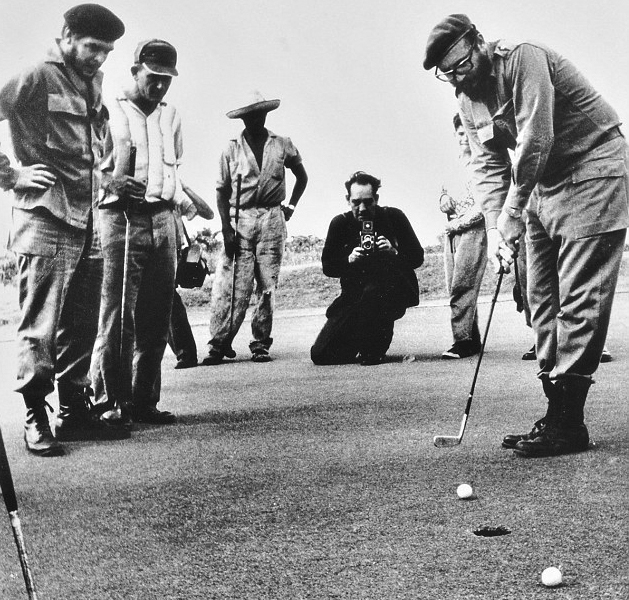
As an example, I long posted a fun picture of Cuban socialist leader Fidel Castro playing golf, the country club sport. I'm not sure this is the exact one, but it's similar:

In the mid-to-late 1980s, I found a discarded paperback about Henry Kissinger that included many images of the Nobel Prize winner with numerous celebrities, including many beautiful women of the 1960s and 1970s. He dated many of these women prior to his marriage to Nancy Maginnes in March 1974. 

Sometime in the late 1980s and early 1990s, I put some of those photos on my bulletin board. Here he is with Elizabeth Taylor. 


Why did I post those images? Where is the satire or ridicule? 

That question is particularly difficult in this instance for obvious reasons. After all, musician Tom Lehrer once said that "satire died" when Henry Kissinger won the Nobel peace prize. 

I'm not so sure. To my thinking, the images that used to hang on my office walls helped demonstrate Kissinger's faults. I meant to ridicule Kissinger by posting images like this one, featuring Jill St. John. 
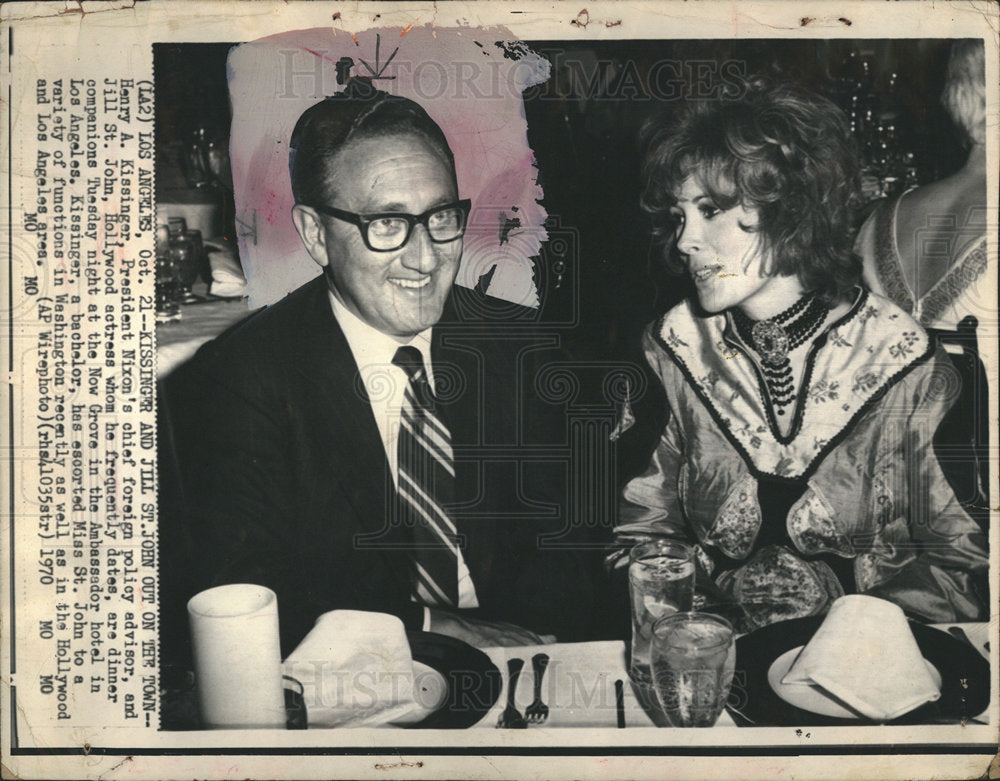


These photos reminded me of movies featuring mobsters with beautiful young mistresses -- or perhaps even better in this case, of global villains like 007 James Bond's Auric Goldfinger surrounding himself with attractive young female employees. Stereotypically, the women in these situations are shown to be with the men because the relationships were transactional, rather than built on romantic love. They were built on jewelry, cash, and jet-setting.

Over the years, much has already been made of the novelty of Kissinger's dating life and there are strong hints that even Kissinger recognized the material exchange implicit in his situation. This note from his AP obituary attempts to explain the phenomenon: 
Kissinger, who divorced his first wife in 1964, called women “a diversion, a hobby.” Hollywood executives were eager to set him up with starlets, whom Kissinger squired to premieres and showy restaurants, according to Isaacson. Jill St. John was a frequent companion. Others he dated included Shirley MacLaine, Marlo Thomas, Candice Bergen and Liv Ullmann.

In a poll of Playboy Club Bunnies in 1972, the man whom Newsweek dubbed “Super-K” finished first as “the man I would most like to go out on a date with.”

Kissinger’s explanation: “Power is the ultimate aphrodisiac.”
These images could be interpreted as living proof of that explanation. Why would beautiful women be attracted to Henry Kissinger if not for his political power? 

On the other hand, a feminist reading of that quip might be that Kissinger had a greatly distorted view of both gender and power relations. HE was attracted to power (and women) for the same reason(s). 

This image of Kissinger with musician (and far superior human being) Dolly Parton readily conveys his desires -- and they are just as awful and problematic as his policies towards Cambodia, Chile, or Indonesia:


Visit this blog's homepage.

For 280 character IR and foreign policy talk, follow me on twitter.

Or for basketball, baseball, movies or other stuff, follow this personal twitter account.

Tuesday, April 12, 2011

Tech check

Obviously, these past few weeks and months, members of the media have filed numerous stories about the important role of Facebook, Twitter, cell phones, and other technologies in empowering democratic activists around the world.

This is not fundamentally new. I've been in meetings about the Grawemeyer Award when serious people suggested and discussed the prospect of Twitter (its founders, I suppose) winning the prize because it was such a useful tool during the (failed) Iranian Green uprising. Similarly, a number of former students have contacted me electronically during the past few months to discuss the role of technology in coordinating demonstrations in Egypt and other middle eastern states.

This is a topic I've been thinking, writing, and teaching about for many years. In many respects, I have been a technological optimist and my former students recall the pre-9/11 discussions we had about information technologies and the Chiapas rebellion in Mexico in 1994 (remember Subcomandante Marcos?) and the democratic movement in Indonesia in 1998.

However, it now seems obvious that information technology can be used effectively by non-progressive forces as well. As Chris Lehman wrote recently in The Nation:
plenty of equally unsavory nonstate actors have also adapted to the new networked web—most notoriously in the cellphone-enabled Mumbai terrorist attacks, in which jihadists used Google maps to identify their targets. Mexican crime gangs have used Facebook to compile lists of kidnapping targets, while Indonesians can use a Craigslist-style service to arrange the sale of children’s organs. While Kenya has played host to a vital and influential site called Ushahidi, which helped modernize accurate citizen reporting of violence during the disputed 2007 elections, in that same episode ethnic leaders on both sides of the dispute used text messaging to spread violent attacks on their enemies.
Lehman also discusses the ability of governments to censor the internet and the willingness of western corporations to help them deny access to their populations.

Other pundits are also taking this position. This week, for instance, Harvard's Niall Ferguson's Newsweek piece argues that social networks can "empower the enemies of freedom." "Our most dangerous foes," he writes "are the Islamists who understand how to post fatwas on Facebook, email the holy Quran, and tweet the call to jihad.:

While critics and skeptics like Lehman and Ferguson make some good points, I continue to argue that decentralized information technology is bound to have progressive consequences. Wikileaks demonstrates that it is very difficult even for a powerful national security state to censor sensitive information. Useful technologies are cheap and getting cheaper, making them quite widely available around the globe. Given that participation in open discussion is a recipe for democracy in the public sphere, I do not see how some undesirable users can outweigh the communicative potential of everyone else. Sure, criminals and terrorists can foment hate in their niches of the world wide web, but that's certainly no reason to censor the rest of us. What's Ferguson's take home point?


Visit this blog's homepage.

Saturday, July 26, 2008

"The Year of Living Dangerously"

Somehow, before today, I'd never seen "The Year of Living Dangerously" (1982). Back in those days, I didn't see that many movies. College debate was the center of my life and I didn't even own a TV.

In any event, the film stars Sigourney Weaver, who was between Alien(s) movies (this is pre-"Ghostbusters"), Mel Gibson, who had already made a second Mad Max film (and appeared in "Gallipoli"), and Linda Hunt, who was terrific (Oscar winner for Supporting Actress).

If you haven't seen the movie, it's set in 1965 in Indonesia. Gibson and Weaver figure into a love story complicated by the setting -- communists attempt a coup against President Sukarno, but are put down by General Suharto's brutal military.

Throughout the movie, I kept thinking of two other films my summer class viewed recently: "Casablanca" and "The Quiet American." I think it would have made a nice companion to those movies.

If you want to know more about Indonesia, may I suggest heading to South End Press for a book? Apparently, the progressive press is in trouble and could use your support.


Visit this blog's homepage.