Search This Blog

Showing posts with label John McCain. Show all posts

Sunday, October 06, 2024

Republicans for Harris

In late August more than 235 Republicans who describe themselves as "alumni" of the campaigns or presidencies of George H.W. Bush, George W. Bush, John McCain, and Mitt Romney published a public letter explaining why they would not be voting for Donald Trump -- and would be voting for Kamala Harris. 

Here's a key part of their message:

Of course, we have plenty of honest, ideological disagreements with Vice President Harris and Gov. Walz. That’s to be expected. The alternative, however, is simply untenable. 

At home, another four years of Donald Trump’s chaotic leadership, this time focused on advancing the dangerous goals of Project 2025, will hurt real, everyday people and weaken our sacred institutions. 

Abroad, democratic movements will be irreparably jeopardized as Trump and his acolyte JD Vance kowtow to dictators like Vladimir Putin while turning their backs on our allies.

Earlier in the message, they blast Trump for lying about the results of the 2020 election and inciting an insurrection. They describe the crowd as "a mob of sore losers and sycophants."

I have an old friend who was part of the HW Bush administration, but I do not see his name on the list of signatories. From a conversation we had in the last year or so, I'm pretty sure he won't be voting for Trump. It's another step to say you are voting for Harris -- and to do so publicly as these individuals have done.

Incidentally, the list does not include Liz or Dick Cheney, though their positions on this are well-known. 


Visit this blog's homepage.

For 280 character IR and foreign policy talk, follow me on twitter.

Or for basketball, baseball, movies or other stuff, follow this personal twitter account.

Monday, February 12, 2018

Senator Schumer at UofL

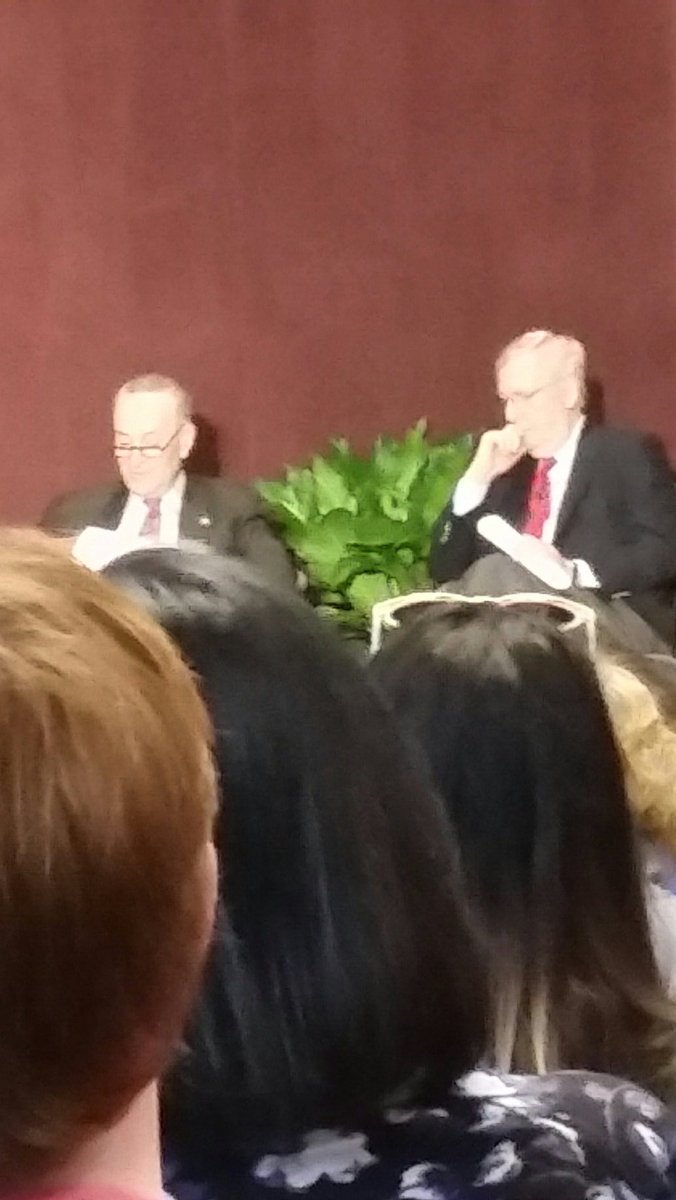
I went to the campus talk by NY Senator Chuck Schumer this morning. I was not sitting very close, so my photos didn't turn out very well. I posted a Twitter thread about the event:


The Department Twitter account posted a photo of the Senators with our new department chair Jasmine Farrier:


Did I mention that my term as chair ended and I'm on sabbatical through 2018?

Oh, I snapped this shot from my seat prior to the event (sorry it is blurry, but you were warned above):


Visit this blog's homepage.

For 140 character IR and foreign policy talk, follow me on twitter.

Or for basketball, baseball, movies or other stuff, follow this personal twitter account.

Friday, November 06, 2009

Senators against (Political) Science

Yesterday, the United States Senate voted down the so-called "Coburn amendment," which would have eliminated National Science Foundation support for research in the field of Political Science. Actually, I'm being polite. The resolution offered by the Republican from Oklahoma used this wording:
"Coburn Amendment 2631 – Prohibits the National Science Foundation from wasting federal research funding on political science projects."
Tough stuff.

The Senate defeated this amendment 62-36.

Locally, citizens are represented by Senators who side with Coburn. Mitch McConnell (a Political Science graduate of my Department) voted Yea, as did Jim Bunning and Indiana's Dick Lugar and Evan Bayh. All of those Senators are Republicans, except for Bayh.

John McCain, who is about to make an appearance at University of Louisville, voted with the losers to kill NSF funding to Political Science. Perhaps someone in the packed house can ask him about his vote.

On October 19, the President of the American Political Science Association, Henry E. Brady, outlined his organization's case against the Coburn amendment:
Senator Coburn’s amendment stems from a mistaken belief that political science research is neither scientific nor contributes to the well-being of our nation and its citizens. Science does not come in degrees; it is not logically possible for one science to be “truer” than another. Political science is a “science” because like all the sciences its research methods are based on testable hypotheses and evidence collected according to well-tested criteria that are subject to peer review and verification. The National Science Foundation has led the way in ensuring careful peer review and in applying the highest scholarly standards to all areas of research, including political science.

Political science funding at the National Science Foundation is a remarkably modest amount of funds – just some $9 million. It generates transformative results vastly beyond this small investment. Basic political science research funded by the National Science Foundation has contributed to the nation in myriad ways. Just last week, Dr. Elinor Ostrom, a political scientist at Indiana University, was awarded a Nobel Prize for research funded by the National Science Foundation. She found that collective use problems such as the overuse of shared resources and the degradation of water quality can be effectively handled by local communities rather than by relying exclusively on the central government.

Similarly, 13 of the 17 National Science Foundation and Department of Defense co-supported projects requested by Secretary Gates that examine threats to U.S. interests in the world and identify effective responses, are being carried out by political scientists.

The U.S. National Election Study, also supported by the National Science Foundation’s political science program, has operated since 1948 and is the only reliable, sustained source of information about Americans’ participation in their own political system. The National Election Study has provided assistance to government agencies including the Department of Homeland Security and the Elections Assistance Commission. Pollsters of all political persuasions have supported the ANES over the years because it provides the only reliable baseline for long-term trends and for innovative thinking about how to measure political participation and involvement.

Other political science research is helping federal, state, and local authorities charged with developing effective evacuation plans understand decisions that citizens make in response to natural disasters.

Still other research has helped identify the causes of ethnic strife and civil wars, the impacts of different electoral institutions around the world, and the causes of international disagreements and wars.
Disclosure: I'm a member of the APSA -- and have participated in selection processes and events pertaining to the McConnell Center.


Visit this blog's homepage.

Wednesday, October 29, 2008

On socialism

The John McCain campaign charge about Barack Obama's alleged socialism is ridiculous:

1. Obama is basically promoting progressive tax policy -- placing higher tax rates on the wealthy and lower rates on the poor. McCain himself dismissed charges that this was socialism in 2000 when a student pressed him about it. Watch this video, which I originally saw on "The Daily Show."

2. McCain seems to be complaining about tax refunds to people who don't pay taxes. This hints of Reagan's welfare queens, though McCain refuses to acknowledge that Republicans like him (and Reagan) sought the Earned Income Tax Credit so as to provide government tax rebates rather than higher minimum wages to the working poor.

Incidentally, the working poor pay payroll taxes (and regressive sales taxes), so this idea that a huge portion of the population pays no taxes is just bunk.

3. McCain's health care proposal, which includes a $5000 tax rebate to individuals, is precisely the kind of alleged "socialism" that he attacks in Obama's plan.


Visit this blog's homepage.

Tuesday, October 14, 2008

The election

Loyal readers must recognize that I've blogged a lot less about the 2008 presidential election than I did about 2004. Partly, this reflects the fact that this election is not going to be as close as the last two. At least that's what the polls, the experts, and the insiders are saying.

Second, while I cannot imagine voting for John McCain for President, I've admired some of his previous "straight talk" on policy questions. He was "my favorite Republican" during the early aughts, before losing that title to Chuck Hagel and Ron Paul.

A large part of my problem with McCain 2008 is that he's backed away from the "maverick" positions I admired in the first place. Contrary to his current position, McCain originally opposed the Bush tax cuts on the wealthy, favored diplomacy towards all sorts of dubious states, fought the administration's policy of indefinite detention, supported the moratorium on coastal oil drilling, supported mandatory cap-and-trade proposals to fight global warming, etc. There's a comprehensive list of McCain "flipflops" here.

Even though I'm not writing as much about the election, I've still been following it very closely (at least that's what I told Rasmussen yesterday when I was polled over the telephone). I read the blogs linked in the first paragraph (or on my blogroll) and remain quite interested in the campaign minutiae, such as newspaper endorsements.


Visit this blog's homepage.

Monday, September 29, 2008

Partisanship and the financial rescue

About 60% of House Democrats voted for the economic rescue package earlier today, even as over 2/3 of House Republicans voted against it. Nonetheless, the McCain campaign is blaming Obama and Democratic partisanship for the failure. McCain said the following a bit after 5 pm ET:
"Senator Obama and his allies in Congress infused unnecessary partisanship into the process. Now is not the time to affix the blame. It’s time to fix the problem. "
Forget for a moment the illogic in those consecutive sentences. What, specifically, does the McCain campaign reference as partisan? The answer is Nancy Pelosi's speech introducing the debate. Here's senior policy adviser Doug Holtz-Eakin:
Just before the vote, when the outcome was still in doubt, Speaker Pelosi gave a strongly worded partisan speech and poisoned the outcome. This bill failed because Barack Obama and the Democrats put politics ahead of country.
Read the speech and Speaker Pelosi blamed the Bush administration for the current crisis:
It [$700 billion] is a number that is staggering, but tells us only the costs of the Bush Administration’s failed economic policies—policies built on budgetary recklessness, on an anything goes mentality, with no regulation, no supervision, and no discipline in the system.

Democrats believe in the free market, which can and does create jobs, wealth, and capital, but left to its own devices it has created chaos.

That chaos is the dismal picture painted by Treasury Secretary Paulson and Federal Reserve Chairman Bernanke a week and a half ago in the Capitol.

As they pointed out, we confront a crisis of historic magnitude that has the ability to do serious injury not simply to our economy, but to the American people: not just to Wall Street, but to everyday Americans on Main Street.

It is our responsibility today, to help avert that catastrophic outcome.

Let us be clear: This is a crisis caused on Wall Street. But it is a crisis that reaches to Main Street in every city and town of the United States.

It is a crisis that freezes credit, causes families to lose their homes, cripples small businesses, and makes it harder to find jobs.

It is a crisis that never had to happen. It is now the duty of every Member of this body to recognize that the failure to act responsibly, with full protections for the American taxpayer, would compound the damage already done to the financial security of millions of American families.

Over the past several days, we have worked with our Republican colleagues to fashion an alternative to the original plan of the Bush Administration.
Now, compare that to what McCain said in Friday's debate:
we are seeing, for the first time in a long time, Republicans and Democrats together, sitting down, trying to work out a solution to this fiscal crisis that we're in.

And have no doubt about the magnitude of this crisis. And we're not talking about failure of institutions on Wall Street. We're talking about failures on Main Street, and people who will lose their jobs, and their credits, and their homes, if we don't fix the greatest fiscal crisis, probably in -- certainly in our time, and I've been around a little while.

But the point is -- the point is, we have finally seen Republicans and Democrats sitting down and negotiating together and coming up with a package.

This package has transparency in it. It has to have accountability and oversight. It has to have options for loans to failing businesses, rather than the government taking over those loans. We have to -- it has to have a package with a number of other essential elements to it.

And, yes, I went back to Washington, and I met with my Republicans in the House of Representatives. And they weren't part of the negotiations, and I understand that. And it was the House Republicans that decided that they would be part of the solution to this problem...

Somehow we've lost that accountability. I've been heavily criticized because I called for the resignation of the chairman of the Securities and Exchange Commission. We've got to start also holding people accountable, and we've got to reward people who succeed.

But somehow in Washington today -- and I'm afraid on Wall Street -- greed is rewarded, excess is rewarded, and corruption -- or certainly failure to carry out our responsibility is rewarded...

look, we've got to fix the system. We've got fundamental problems in the system. And Main Street is paying a penalty for the excesses and greed in Washington, D.C., and on Wall Street.

So there's no doubt that we have a long way to go. And, obviously, stricter interpretation and consolidation of the various regulatory agencies that weren't doing their job, that has brought on this crisis.
If Pelosi repeats (and makes a bit more explicit) McCain's charges, then how is that overly partisan?

Who, exactly, presided over the failure of accountability? Who let greed call the shots on Wall Street and in Washington?

It was in the context of spending, but McCain offered the most scathing partisan attack issued over the past few days:
"We Republicans came to power to change government, and government changed us."
In this case, Republicans were supposed to deliver just 75 to 80 House votes and they failed.

The emergency rescue bill would have passed the House if 12 more Republicans (of 133 voting no) had joined their colleagues (plus 140 Democrats) and voted yes.


Visit this blog's homepage.

Sunday, September 28, 2008

Trying to understand the foreign policy debate

At least seven times in Friday night's debate, Senator John McCain accused Senator Barack Obama of failing to understand an important dimension of national security policy. Let's review:

First, Iraq:
Senator Obama doesn't understand [1] the difference between a tactic and a strategy...There is social, economic progress, and a strategy, a strategy of going into an area, clearing and holding, and the people of the country then become allied with you. They inform on the bad guys. And peace comes to the country, and prosperity. That's what's happening in Iraq, and it wasn't a tactic.

...if we adopted Senator Obama's set date for withdrawal, then that will have a calamitous effect in Afghanistan and American national security interests in the region. Senator Obama doesn't seem to understand [2] there is a connected (sic) between the two...

Senator Obama still doesn't quite understand [3] -- or doesn't get it -- that if we fail in Iraq, it encourages al Qaeda. They would establish a base in Iraq...
What to make of all this?

Obviously, "the surge" is part of America's counterinsurgency approach in Iraq. Obama has long argued for a new US grand strategy; focusing on tactics within Iraq is not a sufficient way to discuss the national security problems of the US:
Senator McCain wants to talk of our tactics in Iraq; I want to focus on a new strategy for Iraq and the wider world.
If you read the July 15 speech I just linked, Obama clearly sees a relationship between Iraq and Afghanistan. In the debate, Obama noted that "al Qaeda and the Taliban have safe havens in Pakistan." Furthermore, "we took our eye off Afghanistan, we took our eye off the folks who perpetrated 9/11...we are having enormous problems in Afghanistan because of that decision" [to attack Iraq].

Obama should have directly dismissed the notion that al Qaeda would establish a base in Iraq if the US pulled out. Why would Sunni or Shia tolerate that? How would it be more threatening than the current safe haven in Pakistan? Previously, Obama has discussed a withdrawal strategy for Iraq that would retain capabilities for attacking the "remnants" of al Qaeda.

Afghanistan:
Senator Obama calls for more troops, but what he doesn't understand, [4] it's got to be a new strategy, the same strategy that he condemned in Iraq.
Obama, as noted, is calling for a new strategic prioritization of Afghanistan over Iraq. The July 15 speech:
"[T]he second goal of my new strategy will be taking the fight to al Qaeda in Afghanistan and Pakistan."
That address outlined a lot of specific measures to change US tactics in Afghanistan and Pakistan; "the surge" would not obviously be inconsistent with them.

Iran:
What Senator Obama doesn't seem to understand [5] that if without precondition you sit down across the table from someone who has called Israel a "stinking corpse," and wants to destroy that country and wipe it off the map, you legitimize those comments.
Obama pretty clearly explained what he meant by meeting without preconditions.
Now, understand what this means "without preconditions." It doesn't mean that you invite them over for tea one day. What it means is that we don't do what we've been doing, which is to say, "Until you agree to do exactly what we say, we won't have direct contacts with you."

There's a difference between preconditions and preparation. Of course we've got to do preparations, starting with low-level diplomatic talks, and it may not work, because Iran is a rogue regime.
Negotiation experts frequently point out that preconditions threaten to preclude negotiation -- and often fail the test of reciprocity. Moreover, the preconditions set by parties are often the precise goals of the diplomacy.

Imagine if Iran said that it wouldn't meet with the US unless America renounced the threat to use force. That precondition actually makes a lot of sense to many, but the current administration persistently says that "all options are on the table." It likely thinks that the threat to use force is part of its leverage in negotiations -- even if it would violate Article 2(4) of the UN Charter. Wouldn't Iran legitimize US illegality by meeting with the US without preconditions?

Next, Russia:
He doesn't understand [6] that Russia committed serious aggression against Georgia. And Russia has now become a nation fueled by petro-dollars that is basically a KGB apparatchik-run government.
From the August 9, Obama statement:
"Over the last two days, Russia has escalated the crisis in Georgia through it's clear and continued violation of Georgia's sovereignty and territorial integrity. On Friday, August 8, Russian military forces invaded Georgia. I condemn Russia's aggressive actions and reiterate my call for an immediate ceasefire. Russia must stop its bombing campaign, cease flights of Russian aircraft in Georgian airspace, and withdraw its ground forces from Georgia."
As for Putin's petro-dollar state, Obama used this as an opportunity to contrast his plan for energy independence -- built primarily on the promotion of alternative energy -- with McCain's many votes against alternative energy and his long-time support for oil interests. Over at the Duck of Minerva, Dan Nexon points out that Russia is now calling for a return to cooperative relations with the US and the international community!

Finally, Pakistan:
I don't think that Senator Obama understands [7] that there was a failed state in Pakistan when Musharraf came to power. Everybody who was around then, and had been there, and knew about it knew that it was a failed state.
These sentences immediately followed Obama's blistering attack of the status quo:
the problem, John, with the strategy that's been pursued was that, for 10 years, we coddled Musharraf, we alienated the Pakistani population, because we were anti-democratic. We had a 20th-century mindset that basically said, "Well, you know, he may be a dictator, but he's our dictator."

And as a consequence, we lost legitimacy in Pakistan. We spent $10 billion. And in the meantime, they weren't going after al Qaeda
The State Department's Richard Armitage caused a bit of a hullabaloo in early 2001 when he told Indian reporters that Pakistan might be viewed as a "rogue state." There's a great deal of difference between a rogue state and a failed state. Given its 1998 nuclear tests and its position on Kashmire, Pakistan was closer to a rogue than a failure when Musharraf's military coup toppled a democratically elected government in October 1999.

The State Failure Task Force phase 3 report from 2000 did not include Pakistan on its list of "Near-Total Failures of State Authority, 1955-1998" (the complete list is on p. 79). The report found times in Pakistan's past (1983 and before) when it was in serious trouble, but Pakistan was categorized as a "partial democracy" in the report.

If anything, the evidence suggests that Musharraf presided over Pakistan as it was moving toward failure.

As I said on Friday, I think it is pretty clear that Obama understands foreign policy. McCain perhaps fails to understand what foreign policy analysts mean by "grand strategy" and "failed state."


Visit this blog's homepage.

Friday, September 26, 2008

Instant Debate Analysis

1. John McCain kept saying "Senator Obama doesn't understand," but Barack Obama pretty clearly proved time and time again that he did.

2. Did McCain get the last word on every question? Whether he got the question first or last, he refused to let Obama have the last word. With the first point, this made him seem like a bully to me.

3. Obama blew the closing. I don't know why he talked about his Kenyan father when McCain had just said he wasn't qualified to be President. I suspect that people make their own judgments about qualifications, but I would have responded to something that outrageous.

4. McCain was able to dominate the agenda on economics. Obama let McCain make the discussion about taxes and spending, rather than unemployment and foreclosures.

5. Pundits are emphasizing how much Obama agreed with McCain, but that might have been intentional. Both guys have said they will bring a new kind of politics to Washington. Well, after 8 years of "my way or the highway," which guy seemed like the one who could work on a bipartisan basis to solve problems? First, you have to find room for agreement with opponents.


Visit this blog's homepage.

Wednesday, September 10, 2008

John McCain, Feminist Warrior

Despite his numerous appearances on "The Daily Show," Senator John McCain is not especially known for his comic styling. Here's a sampling of his gendered humor -- and I'm not even going to repeat his alleged worst joke.

In June 1998, this McCain "joke" at a Republican fundraiser was widely reported:
"Why is Chelsea Clinton so ugly?
Because her father is Janet Reno."
Fox News, 2006:
"You know, the French remind me a little bit of an aging actress of the 1940s who is still trying to dine out on her looks but doesn't have the face for it."
McCain on beating Hillary Clinton, November 2007:
"How do we beat the bitch?" McCain's supporter asked him. And as you can see, it appears that after McCain joked about offering a "translation" of his supporter's query, he said:

"That's an excellent question."
Yes, of course, there's video.

ABC's Jake Tapper, 2008:
In an interview with the Las Vegas Sun, Sen. John McCain, R-Ariz., was asked by columnist Jon Ralston why he didn't choose Gov. Jim Gibbons to chair his Nevada campaign.

"I appreciate his support," McCain said. "As you know, the lieutenant governor is our chairman."

Why snub the governor? Ralston asked.

"I didn’t mean to snub him,. I've known the lieutenant governor for 15 years and we've been good friends," McCain said. "I didn't intend to snub him. There are other states where the governor is not the chairman."

Maybe it's the governor's approval rating and you are running from him like you are from the president? Asked Ralston in a question McCain clearly found loaded.

Said McCain, chuckling, "And I stopped beating my wife just a couple of weeks ago."
Cindy McCain: Miss Buffalo Chip? August 2008
McCain dipped in and out yesterday at the big bikers’ rally in Sturgis, S.D., to the roar of motorcycles and the admiration of veterans in attendance.

We’re pretty sure then that when he offered up his wife Cindy, who has graced Vogue this year and other magazines as one of the country’s most beautiful women, to compete in the rally’s Miss Buffalo Chip contest, that well, he didn’t entirely get — as an ESPN writer suggests — that the contestants sometimes wind up topless, walk about in thongs (Shocking!) or are otherwise scantily clothed. (Oh! Debauchery!)

Or maybe he did and was just having a little fun.
Video here.


Visit this blog's homepage.

Saturday, September 06, 2008

"Words mean something"

Barack Obama doesn't think John McCain and Sarah Palin are agents of change. The AP, September 6:
"Don't be fooled," Obama told the crowd surrounding him in a large barn. "John McCain's party, with the help of John McCain, has been in charge" for nearly eight years.

"I know the governor of Alaska has been saying she's change, and that's great," Obama said. "She's a skillful politician. But, you know, when you've been taking all these earmarks when it's convenient, and then suddenly you're the champion anti-earmark person, that's not change. Come on! I mean, words mean something, you can't just make stuff up."
Obama is referring to the fact that Palin was for the "bridge to nowhere" before she was against it. Plus, she used $27 million in appropriated earmarks to fund "the approach road to the bridge."

In the same event, Obama also went after McCain's extensive ties to lobbyists and President Bush:
McCain has acknowledged voting with President Bush 90 percent of the time in Congress, Obama said.

"And suddenly he's the change agent? Ha. He says, 'I'm going to tell those lobbyists that their days of running Washington are over.' Who is he going to tell? Is he going to tell his campaign chairman, who's one of the biggest corporate lobbyists in Washington? Is he going to tell his campaign manager, who was one of the biggest corporate lobbyists in Washington?"

"I mean, come on, they must think you're stupid," Obama said as the crowd laughed and cheered.
Joe Biden too was on top of his game this weekend.


Visit this blog's homepage.

Monday, August 18, 2008

Hypocrisy watch: Georgia edition

Because of Iraq, American officials are having a hard time explaining their opposition to Russia's intervention into Georgia.

U.S. ambassador to the U.N., Zalmay Khalilzad, quoted by CNN on August 11:
This is completely unacceptable and crosses a line...The days of overthrowing leaders by military means in Europe -- those days are gone,"
Watch it here. As Jon Stewart pointed out last week on The Daily Show, the entire war would apparently have been OK outside Europe.

Secretary of State Condi Rice, August 13, 2008:
I am not going to sit here and judge each Russian military operation. I am going to say that when you start bombing ports and threatening to bomb airfields and bombing a city like Gori and bringing troops in a flanking maneuver on the western flank of Georgia and tying up the main roads between Georgia – between Tbilisi and Gori, that’s well beyond anything that is needed to protect Russian peacekeepers. And that is why Russia is starting to face international condemnation for what it is doing.

This is not 1968 and the invasion of Czechoslovakia, where Russia can threaten its neighbors, occupy a capital, overthrow a government, and get away with it. Things have changed. And so, what Russia, I think, is seeing is that to the degree that this is about South Ossetia, about even Abkhazia, let’s accept that it is time to move the forces back. Let’s accept that it’s -- first to end the fighting, move the forces back to August 6th, and then have an international mediation to try to resolve these conflicts within the context of the territorial integrity and sovereignty of Georgia.
Watch it here. Rice almost seems to be implying that Russia could not justifiably attack Georgia simply because Russia is too weak in the post-cold war world.

President George Bush, August 15:
The days of satellite states and spheres of influence are behind us. A contentious relationship with Russia is not in America's interest. And a contentious relationship with America is not in Russia's interest.

With its actions in recent days Russia has damaged its credibility and its relations with the nations of the free world. Bullying and intimidation are not acceptable ways to conduct foreign policy in the 21st century. Only Russia can decide whether it will now put itself back on the path of responsible nations, or continue to pursue a policy that promises only confrontation and isolation. To begin to repair its relations with the United States and Europe and other nations, and to begin restoring its place in the world, Russia must respect the freedom of its neighbors.
Watch it here. Again, was the behavior only bad because Russia attacked a neighbor?

John McCain, August 13, 2008 (via Yglesias):
"In the 21st century, nations don’t invade other nations."
Watch it here.

Back in 2002 and 2003, a lot of critics (pdf alert) warned that states like Russia, India and Israel might take the logic of "preemption" from the Bush Doctrine in order to justify wars that would otherwise be seen as illegitimate.


Visit this blog's homepage.

Friday, August 08, 2008

McCain's ad is "Painful"

John McCain released another new TV ad today: "Painful." The AP notes that it is airing in 11 key states targeted by the McCain campaign.

A female voiceover says, "Life in the spotlight must be grand, but for the rest of us times are tough. Obama voted to raise taxes on people making just $42,000."

It is interesting that Senator McCain says "times are tough" for "the rest of us."

Who is he trying to kid?

McCain is not really like the rest of us, thanks primarily to his affluent heiress spouse, Cindy McCain. She is worth at least $27 million -- and may be worth $100 million. From ABC blogger Jake Tapper:
CNN this week [reported that]... she "is not only a wife to Senator John McCain, she is also his meal ticket. Her reported 2006 income of more than $6 million exceeded her husband's earnings 16 times over. That money pays for a wealthy lifestyle of high end condos, an Arizona ranch, flying in a corporate jet, and more."
The McCains apparently have 8 or 9 houses and access to a corporate jet.

The Senator wears $520 loafers.

The AP story also reveals the truth about the ad's tax details. Obama didn't vote for a binding policy that would have increased taxes -- and if he had, John McCain would have agreed with him just a few years ago:
The ad's most specific assertion — Obama voted to raise taxes on people making $42,000 — is based on a nonbinding Senate budget resolution early this year that the Bush tax cuts of 2001 and 2003 be allowed to expire in 2011 as scheduled. Obama has criticized the Bush tax cuts and called for ending them for the wealthiest taxpayers.

McCain didn't support Bush's tax cuts when they were passed but has said he supports them now. He contends that to allow the cuts to expire would be tantamount to a tax increase.
Someone not altogether committed to "truthiness" might ask Senator McCain why he flip-flopped on Bush's tax cuts. The far right has been attacking McCain about this since 2000.

In the primary season, Mitt Romney said McCain failed "Reagan 101" because of his past tax arguments.


Visit this blog's homepage.

Wednesday, July 30, 2008

McCain's celebrity

The more I think about it, I am increasingly convinced that the latest McCain "celebrity" ad and attack is ridiculous -- or at least hypocritical.

Last week, blogger Robert Paul Reyes at American Chronicle explained the blunt facts about John McCain, celebrity, and talk show appearances:
The typical guest on a late-night comedy show is a jaded celebrity who oozes irony or an average person who makes the news for some wacky reason.

Sen. John McCain, 71, the presumptive Republican presidential nominee is from a generation that eschews irony. McCain is like a fish out of water trying to exchange quips with Jay Leno or Conan O'Brien.
One of McCain's 2000 campaign officials says his success that year was caused, in large part, by his celebrity...as a former prominent POW:
Ken Khachigian, Reagan's chief speech writer in 1980 and now McCain's top California strategist, said Reagan and McCain both benefited from their celebrity status, Reagan as an actor and governor, McCain as a POW and senator. ''It's an accident of history'' that the similarities exist, Khachigian said. ''But in my own mind, it's constantly there.''
In any case, do you know just how many times John McCain has appeared on "The Daily Show"? Comedy Central Insider reveals all:
Senator John McCain (R-AZ) will be a guest on "The Daily Show with Jon Stewart" on Wednesday, May 7 at 11:00 p.m. (ET/PT). This appearance will mark the Senator's 13th time on the show, more than any other guest...
After learning this, I clicked over to the Internet Movie Database to see just how often John McCain has appeared on other TV talk shows since 2000, when he became nationally famous after his failed presidential bid:
Jay Leno: 10 times
David Letterman: 8 times
The Daily Show: 12 times (or 13?)
Conan O'Brien: 3 episodes
Larry King Live: 9 times
Saturday Night Live: twice
Live with Regis and Kathie Lee (!): once
Entertainment Tonight (!!): twice
The View: twice
Tony Danza Show (!!!): once
The man had a cameo in "The Wedding Crashers"!

And in 2006, Senator McCain apparently appeared as an actor in an episode of "24."


Visit this blog's homepage.

Who's the celebrity?

John McCain's latest TV ad tags Barack Obama as "the biggest celebrity in the world" and includes images of Paris Hilton and Britney Spears.

"Is he ready to lead?" asks the voiceover.

Then, today, Politico quotes a McCain adviser dropping in a reference to Obama's celebrity-like response to an attack.
"This is a typically superfluous response from Barack Obama. Like most celebrities, he reacts to fair criticism with a mix of fussiness and hysteria," says McCain spokesman Tucker Bounds, before trying to link the attack back to offshore drilling.
I wonder, did they think through this meme?

After all, John McCain is a constant guest on "The Daily Show" and other celebrity talk shows. We've all seen him...for years and years.

In fact, as recently as July 11, 2008, John McCain's own website included this line from an article about one of his 2007 appearances on David Letterman:
"A political celebrity, McCain is considered a top contender for the nomination."
That's from the google cache. The original article has been scrubbed.


Visit this blog's homepage.

Tuesday, June 03, 2008

The smears to come

I've been on the road lately and had some conversations with various people about the likely shape of the fall campaign. Many think there's a good chance it will "feature" a litany of smears. The politics of the past continues to haunt the present.

He is a dangerous upper class elitist.

Did you know he wasn't born in the USA?

He spent all those years abroad...is he some kind of Manchurian candidate?

What makes a man of his limited background qualified to run for President? Is his success just a fairy tale?

Can American elect someone who seems so unpatriotic?

Why is he trying to hide important information about his identity?

What about those awful things he did in his past?


Visit this blog's homepage.

Monday, May 26, 2008

Grave

I received a forwarded email today that included these two quotes, back-to-back. Their intent is fairly obvious, since "grave" and "serious" are synonyms:
"They don't pose a serious threat to us."
-- Barack Obama on Iran, speaking in Portland, Oregon on May 18

"I've made it clear for years that the threat from Iran is grave."
-- Barack Obama speaking in Billings, Montana on May 19
After a quick search, I discovered that these are already widely circulated on right-leaning blogs.In context, it is easy to see that both quotes are taken from part of the same argument about Iran. Obama said -- as he has often on the campaign trail -- that Iran is not a serious threat in the same way that the Soviet Union was.

Does anyone deny that?

Here's the first quote, as reported in the IHT on May 20, with surrounding phrases:
Obama said in a speech Sunday that "strong countries and strong presidents talk to their adversaries."

"That's what Reagan did with Gorbachev," he said, adding, "I mean, think about it: Iran, Cuba, Venezuela - these countries are tiny compared to the Soviet Union. They don't pose a serious threat to us the way the Soviet Union posed a threat to us. And yet we were willing to talk to the Soviet Union at the time when they were saying, 'We're going to wipe you off the planet."'

Obama said Iran was a threat partly because it had been emboldened by a war in Iraq backed by Bush and McCain. "Iran is the biggest single beneficiary of the war in Iraq," he said.
And here's the second one, as reported on a Chicago Tribune blog on May 19:
"Anything but their failed cowboy diplomacy that has produced no results is called appeasement," Obama countered. "Here's the truth: the Soviet Union had thousands of nuclear weapons and Iran doesn't have a single one. But when the world was on the brink of nuclear Holocaust, Kennedy talked to Khrushchev and he got those missiles out of Cuba. Why shouldn't we have the same courage and confidence to talk to our enemies? That's what strong countries do. That's what strong presidents do."

Obama said he fully realizes the danger posed by Iran, but that it is nothing compared to those presented by the former Soviet Union.

"The Soviet Union had the ability to destroy the world several times over, had satellites spanning the globe, had huge masses of conventional military power, all directed at destroying us," he said. "So, I've made it clear for years that the threat from Iran is grave. But what I've said is that we should not just talk to our friends. We should be willing to engage our enemies as well. That's what diplomacy is all about."

Obama repeatedly stressed the risk posed by Iran, as he suggested that danger has grown because of policies supported by McCain.

"Iran is a grave threat. It has an illicit nuclear program. It supports terrorism across the region and militias in Iraq. It threatens Israel's existence. It denies the Holocaust," he said. "The reason Iran is so much more powerful than it was a few years ago is because of the Bush-McCain policy of fighting in Iraq and refusing to pursue direct diplomacy with Iran. They're the ones who have not dealt with Iran wisely."

Obama also called Iran the "single biggest beneficiary" of Iraq war and pledged to secure all lose nuclear materials during first term, if he is elected president.
More here.


Visit this blog's homepage.

Tuesday, May 06, 2008

Clinton: 50 years may be enough

While many Democrats have piled on Senator John McCain for saying that it would be OK for the US to spend "maybe 100" years in Iraq, few have taken note of Senator Hillary Clinton's similar comment. Mark Kleiman has this from a "Face the Nation" transcript in February 2005:
Senator McCain made the point earlier today, which I agree with, and that is, it's not so much a question of time when it comes to American military presence for the average American; I include myself in this. But it is a question of casualties.

We don't want to see our young men and women dying and suffering these grievous injuries that so many of them have. We've been in South Korea for 50-plus years. We've been in Europe for 50-plus. We're still in Okinawa with respect to protection there coming out of World War II.

You know, we have been in places for very long periods of time. And in recent history, we've made a commitment to Bosnia and Kosovo, and I think what is different is the feeling that we're on a track that is getting better and that we can see how the Iraqi government will begin to assume greater and greater responsibility. The elections were key to that. The training, equipment, equipping and motivating of the Iraqi security forces is key to that. But so is our understanding that if we were to artificially set a deadline of some sort, that would be like a green light to the terrorists, and we can't afford to do that.
I suspect, as does Kleiman, that a Clinton candidacy would dramatically reduce Democratic options concerning Iraq against McCain in the fall campaign.


Visit this blog's homepage.

Wednesday, March 12, 2008

Free campaign advice

The political calendar, packed with weekly events since the start of the new year, is now about to take a spring break. The next scheduled primary is in Pennsylvania, April 22. By then, my classes will be over for this term!

Can the main Democratic rivals continue for nearly six weeks without destroying each other? Events of the last week suggest that this might be a big problem. Surrogates from both campaigns have made unfortunate word choices to describe the opponent camp's candidate.

One significant reason the battle between Obama and Clinton has become so personally destructive is that the candidates agree on a heck of a lot of issues. Highlighting their images, personal narratives and approaches to politics is about the only way for the candidates to distinguish themselves from each other.

Sure, they disagree about some policy details.

And yes, to policy wonks, many of those details are important.

However, to the average voter the campaigns probably sound very much alike. They both want to create health insurance plans that would offer universal coverage, to move forward on global warming, to renegotiate NAFTA (to take into account labor and environmental interests), and to withdraw from Iraq.

It's a popular Democratic agenda and the loser's supporters should naturally navigate to the other candidate in the fall.

To avoid the potential self-destruction of identity politics, the Obama campaign should turn its focus toward presumptive Republican nominee John McCain in the next month or so. Because he has more delegates, constituting a virtually insurmountable lead after 40 state elections, Obama can afford to campaign differently.

By focusing on McCain, Obama can illustrate that one of Clinton's central attacks is wrong. She says he's not ready to be President, especially on matters of national security. Obama could spend the next month disproving that very point -- by debating McCain through speeches and ads.

Based on the exchange they had about al Qaeda of Iraq a couple of weeks ago, McCain seems more than willing to engage this debate.

By demonstrating his security acumen and debating an opponent with major differences on these issues, Obama can highlight more clearly that he is the change that his supporters want him to be.

Such a campaign strategy would indicate that Obama is "ready on day one" to take on the heavy hitters he is going to face from the Republicans in Congress and embedded in think tanks. On substance, Obama will make a lot of points that Democrats want to hear -- about the war's failings, about energy policy, etc.


Visit this blog's homepage.

Friday, February 29, 2008

McCain Sings

I believe this is a first for the blog -- an embedded video. However, leap year day is a rare event too, so perhaps this is the correct day to do this:


Visit this blog's homepage.