Search This Blog

Showing posts with label Hillary Clinton. Show all posts

Tuesday, October 31, 2017

The "young, low level volunteer named George"

The title of this post comes from one of President Trump's tweets earlier this morning.

A post shared by President Donald J. Trump (@realdonaldtrump) on

George Papadopoulos is third from left in this picture, seated a few feet away from Donald Trump. Yesterday, it was revealed that Papadopoulos had pled guilty to lying to the FBI about his contacts with representatives of the Russian government. The photo was posted by Trump on his Instagram feed on March 31, 2016 with the caption  "Meeting with my national security team in #WashingtonDC." Current Attorney General Jeff Sessions (then-head of the national security team) is seated at the opposite end of the table.

The FBI guilty plea agreement says Papadopoulos first met with an alleged Russian intermediary on March 14:
...defendant PAPADOPOULOS met the Professor for the first time on or about March 14, 2016, after defendant PAPADOPOULOS had already learned he would be a foreign policy advisor for the Campaign; the Professor showed interest in defendant PAPADOPOULOS only after learning of his role on the Campaign...
Additionally, Trump mentioned Papadopoulos by name as an advisor in The Washington Post on March 21.  Thus, the picture above isn't some random photo opportunity showing Trump with a campaign volunteer or celebrity.  During at least a few weeks in March 2016, Papadapoulos was meeting with Russians who allegedly had dirt on Hillary Clinton -- and Donald Trump knew him by name and sat with him at a table of national security advisors. He apparently stayed with the team for 7 to 11 months.

On August 14, The Washington Post had a story about Papadopoulos and his efforts to connect Trump and Russia. Lots of people in the story tried to play down the importance of these efforts even as senior officials like Sessions and Jared Kushner actually later took meetings with Russians. For lots of interesting links and assessment amidst some conspiratorial speculation, see this September 22 Twitter thread from Professor Seth Abramson. Continued here and here. All 100 tweets are also on Facebook.

Note:

The photo is also here, in case the Trump team takes it down. Fox had an informative news bit about investigator interest in the meeting in late September, 2017.


Visit this blog's homepage.

For 140 character IR and foreign policy talk, follow me on twitter.

Or for basketball, baseball, movies or other stuff, follow this personal twitter account.

Friday, September 09, 2016

Presidential politics goes nuclear

This "daisy ad" from 1964 is infamous, though it aired only once (but see also this ad for more context from that campaign cycle). I've showed this ad many times in my classes:


A super-PAC supporting Hillary Clinton is going to run the following ad in a number of swing states this election cycle -- Florida, Iowa, Nevada, North Carolina, and Ohio.


I'm not 100% sure that ad is all that effective. Read this piece and watch the accompanying videos to understand the context for this ad. People who have paying attention to the campaign for months (high information voters) already know this material, but those not paying attention (low information voters) won't get enough content from the new ad.

Will it resonate emotionally?

I'll close by quoting a (former?) Republican hero:

“A nuclear war cannot be won and must never be fought. The only value in our two nations possessing nuclear weapons is to make sure they will never be used. But then would it not be better to do away with them entirely?”
Ronald Reagan, 1984 State of the Union


H/T to Patrick Caldwell. 

Visit this blog's homepage.

For 140 character IR and foreign policy talk, follow me on twitter.

Or for basketball, baseball, movies or other stuff, follow this personal twitter account.

Sunday, October 25, 2015

Benghazi: Time to Think the Unthinkable?

Three weeks ago, I gave a paper on "Thinking the Unthinkable About National Security Narratives." It was inspired by the brief uproar over Seymour Hersch's claims about the Obama administration's tale about the killing of Osama bin Laden. Indeed, much of the paper tracks a long series of likely political deceptions and fabrications fomented by various U.S. national security elites over the years. I focus on threat inflation, misapplied analogies to justify war, stories to support the conduct of American wars, etc.

Ultimately, the paper will need to expand on the evidence, but it briefly considers the bomber gap, missile gap, and window of vulnerability. These cases largely led to unnecessary and costly increases in US military spending. It also considers inflated threats that helped lead to war -- the Gulf of Tonkin incident and the first Persian Gulf War, for example. I barely discussed the numerous deceptions allegedly employed to sell the most recent Iraq war, which was the subject of so much of my blogging and academic writing for a decade. Instead, I quote some scholars who argue that we won't know for certain about alleged Bush administration deceptions until additional critical materials are declassified.

There are plenty of other likely deceptions with more modest political goals and some are mentioned in the paper (Jessica Lynch, Pat Tillman). Remember, Secretary of Defense Robert McNamara didn't even think the deployment of Soviet Missiles in Cuba in October 1962 posed a new military threat to the US. He described it as a domestic political problem. That's not the way JFK framed it to the American public or to the Soviets.

Indeed, my "Unthinkable" paper describes the problem of deception about national security as endemic -- and especially problematic to study academically because of the huge advantages security elites have in the marketplace of ideas. They control information, largely thanks to secrecy, which gives them the ability to provide a particular narrative about threats, war, etc. They have the authority to speak, thanks to their position in power, which is accompanied by access to impressive material resources as well. The stories elites tell may endure for a long time, even as new evidence challenges some of it. My paper points out that historians and political scientists are still arguing about whether FDR tried to deceive Americans about the need for World War II. The relevant documents are ~75 years old.

Last weekend, the NY Times Magazine drew attention to some of the same questions I'm asking and problems I'm exploring, though Jonathan Mahler chose to focus on the Obama administration story about killing bin Laden.
It’s not that the truth about bin Laden’s death is unknowable; it’s that we don’t know it. And we can’t necessarily console ourselves with the hope that we will have more answers any time soon; to this day, the final volume of the C.I.A.’s official history of the Bay of Pigs remains classified. We don’t know what happened more than a half-century ago, much less in 2011. 
There are different ways to control a narrative. There’s the old-fashioned way: Classify documents that you don’t want seen and, as [Defense Secretary Robert] Gates said, ‘‘keep mum on the details.’’ But there’s also the more modern, social-media-savvy approach: Tell the story you want them to believe. Silence is one way to keep a secret. Talking is another. And they are not mutually exclusive.
In any case, this week, the world watched former Secretary of State Hillary Clinton testify for nearly 11 hours about the September 11, 2012, attack on the American diplomatic mission in Benghazi. The questions that Republicans wanted to ask were much like the ones I'm asking: Did the Obama administration, and especially Secretary Clinton, fabricate a political lie to the American people? Did they do this for reasons unrelated to genuine national security purposes (domestic politics)?

My paper included a number of caveats about the strength of the evidence about various alleged cases of deception because the ideas I'm exploring are ordinarily "unthinkable." Political opponents in the heat of a partisan struggle might accuse their foes of engaging in deception and political fabrication in the area of national security, but the wider reaction is usually much more cautious. And academics are especially cautious.

Critics are often not taken seriously if they argue that elites use national security matters to increase their popularity ("rally 'round the flag"), win elections, create jobs, or divert attention from personal political crisis. This is said to reflect paranoia and conspiracy theorizing.

And, in fact, Mahler's piece was attacked by critics as promoting "conspiracy theory."  Colleagues at the NY Times were apparently worried about the effect this story would have on the credibility of their newspaper's journalism. CNN's Peter Bergen called Mahler's story "bizarre."

So what is the story with Benghazi? Did Clinton seek to deceive? Or are conservatives serving up a juicy conspiracy theory based on thin evidence?

Based on my reading of various conservative twitter users, the question about Clinton's alleged deceptions now seem to be their primary concern. The critics argue that Clinton and others blamed an anti-Islamic video for the attack, when she and others in the administration knew it was an intentional act of terror. This is Clinton's entire statement of September 11, 2012, with the most controversial part in red:
 "I condemn in the strongest terms the attack on our mission in Benghazi today. As we work to secure our personnel and facilities, we have confirmed that one of our State Department officers was killed. We are heartbroken by this terrible loss. Our thoughts and prayers are with his family and those who have suffered in this attack.

This evening, I called Libyan President Magariaf to coordinate additional support to protect Americans in Libya. President Magariaf expressed his condemnation and condolences and pledged his government’s full cooperation.

Some have sought to justify this vicious behavior as a response to inflammatory material posted on the Internet. The United States deplores any intentional effort to denigrate the religious beliefs of others. Our commitment to religious tolerance goes back to the very beginning of our nation. But let me be clear: There is never any justification for violent acts of this kind.

In light of the events of today, the United States government is working with partner countries around the world to protect our personnel, our missions, and American citizens worldwide."
The debate over the years has often focused on a memo drafted by then-White House Deputy Strategic Communications Adviser Ben Rhodes a few days after this statement, which formulated the White House talking points to guide then-UN Ambassador Susan Rice on various Sunday TV programs. The administration wanted to sell the attack as “rooted in an Internet video, and not a failure of policy.” The presidential election was about 7 weeks away and the killing of bin Laden was a featured part of their story for reelection.

Essentially, conservatives claim that the evidence was soon clear that Benghazi was a predesigned terrorist attack and that there had been no anti-video protest at the mission in Libya. Nonetheless, the Obama administration blamed a video repeatedly.

This suggests a partisan deception about policy, right?

What is the evidence for the defense? Obama himself called the event an "act of terror" on September 12. The administration started acknowledging the premeditated terrorism by September 19.  That date is important because it turns out the intelligence agencies were apparently telling the administration that the video protest was the likely cause until September 24. In November 2014, the House Permanent Select Committee on Intelligence released a report that seemingly debunked the theory about political fabrication:


This week, conservatives are convinced that Clinton's same-night email to daughter Chelsea and phone call with Egyptian prime minister (September 12) constitute new smoking gun evidence about their original concerns. In a brief email reference, Clinton told Chelsea that the act was perpetrated by an al-Qaeda like group. She also told the Egyptian PM that “We know the attack in Libya had nothing to do with the film. It was a planned attack — not a protest.”

This sounds like fairly damning evidence and it might well be correct to blame Clinton and the Obama administration for playing politics with national security. However, this version of the narrative overlooks certain facts.

First, the Republicans still have not grappled with the intelligence reports. Was it wrong to say something publicly that was consistent with the intelligence? Readers may remember that this was essentially the defense of the Bush administration regarding Iraq, even though members of the administration often said things that seemed well beyond the intelligence findings. This reading doesn't explain the sentences Clinton apparently communicated to her daughter or to the Egyptians, but ask this question: Is it possible that those far more private instances simply reflect her going beyond the intelligence, perhaps based on unconfirmed evidence? I don't know, and neither do the conservative critics.

Second, Clinton's statement used the passive voice. She didn't say the video caused the attacks, she said some had claimed that. It's a classic Fox News tactic, of course. Indeed, Fox News was running with the video story on September 11, just as many other news agencies were. Susan Rice's statements on Sunday TV went further, but she wasn't the one being scrutinized this week. On those shows, Rice also repeatedly said, "we'll wait to see exactly what the investigation finally confirms." President Obama also made similar remarks that week about waiting for additional evidence to confirm what happened.

Third, the right's interpretations focused narrowly on Benghazi and ignores other important events occurring that day. The inflammatory video in question was provoking demonstrations at American embassies around the world. The US mission in Cairo was of special concern, though other attacks elsewhere led to deaths. The Obama administration was arguably trying to signal that the US would not tolerate this behavior. Perhaps they were thinking that there would be no replay of Iran 1979 on their watch.

I'm not creating this tale for them, I'm just providing a charitable reading of the situation. This is the story Clinton told the members of Congress this week:
FMR. SECRETARY OF STATE HILLARY CLINTON: During the day on September 11th, as you did mention, Congressman, there was a very large protest against our embassy in Cairo. Protesters breached the walls. They tore down the American flag. And it was of grave concern to us because the inflammatory video had been shown on Egyptian television, which has a broader reach than just inside Egypt. 
And if you look at what I said, I referred to the video that night in a very specific way. I said, some have sought to justify the attack because of the video. 
I used those words deliberately, not to ascribe a motive to every attacker but as a warning to those across the region that there was no justification for further attacks. 
And, in fact, during the course of that week, we had many attacks that were all about the video. We had people breaching the walls of our embassies in Tunis, in Khartoum; we had people, thankfully not Americans, dying at protests. But that's what was going on, Congressman. 
I'm not sure of Clinton's motives, but her story fits the words. Sure, the Republican story also seems to fit, but it presumes malfeasance without proving it. I'm willing to think about the unthinkable, but I want the evidence of deception to be as strong as it can be.

This post was motivated by several twitter exchanges I had yesterday with people on the right (linked above). I certainly agree that there's reason to be interested in this case, but it seems like a relatively mild instance of a much larger problem. Some people are quite worked up about it, but I didn't notice them screaming for heads to role because of Iraq. Or lies about Jessica Lynch. Or lies about Pat Tillman.

I know that Tom Nichols has a crafty argument about Bill Clinton's role in inflating the chemical weapons threat from Iraq, but Clinton wasn't the President who puffed up a nuclear threat to launch a war on Iraq. As I've written before, referencing David Kay, letting a chemical threat justify preventive war might spark dozens of such wars. 


Visit this blog's homepage.

For 140 character IR and foreign policy talk, follow me on twitter.

Or for basketball, baseball, movies or other stuff, follow this personal twitter account.

Friday, April 16, 2010

Duck days

April 9 at Duck of Minerva, I blogged "Nuclear Arms Control," about Hillary Clinton's visit to Louisville to sell the latest nuclear START agreement to Senator Mitch McConnell -- and the rest of us.

April 7, I posted "New Nuclear Posture," about that Obama administration's Nuclear Posture Review. The U.S. announced that it (mostly) would not use nuclear weapons against non-nuclear weapons states. Believe it or not, that is actually news.


Visit this blog's homepage.

Saturday, June 07, 2008

Stereotypes in 2008

Today, Hillary Clinton delivered a speech in Washington suspending her campaign and throwing her support to Barack Obama. Unsurprisingly, journalists, bloggers and political analysts have spent much of this past week analyzing why Clinton's campaign failed. After all, she started out as the big favorite with significant advantages.

Many of her most fervent supporters believe that Clinton was a victim of overt media bias and sexism. For example, a number of bloggers have been linking to this video highlighting the disturbing sexism and misogyny in the media. In linking to this video, Judith Warner wrote on June 5:
... if similarly hateful racial remarks had been made about Obama, our nation would have turned itself inside out in a paroxysm of soul-searching and shame.
Is this basic analysis correct?

Was Hillary Clinton victimized in a way that Barack Obama was not?

Allow me to review some of the lowlights of this past campaign. I'll ignore informal reports of racism on the campaign trail. Let's pretend the voting demographics don't matter and overlook the role Obama's black church played in the campaign. Instead, I'll focus on the same kind of verbal snippets used in the video.

Joe Biden, February 2007:
"I mean, you got the first mainstream African-American who is articulate and bright and clean and a nice-looking guy,"
Biden said. "I mean, that's a storybook, man."
Billy Shaheen, December 2007:
"one of the things Republicans are certainly going to jump on is his drug use."..."It'll be, 'When was the last time? Did you ever give drugs to anyone? Did you sell them to anyone?'" Shaheen said. "There are so many openings for Republican dirty tricks. It's hard to overcome."

Bill Clinton, January 2008
:
"Jesse Jackson won South Carolina in '84 and '88," Clinton said at a rally in Columbia. "Jackson ran a good campaign. And Obama ran a good campaign here."
Hillary Clinton, January 2008:
"Dr. King’s dream began to be realized when President Johnson passed the Civil Rights Act of 1964, when he was able to get through Congress something that President Kennedy was hopeful to do, the president before had not even tried, but it took a president to get it done,” she said. “That dream became a reality, the power of that dream became real in people’s lives because we had a president who said we are going to do it and actually got it accomplished.”
Bill O'Reilly, February 2008:
"I don't want to go on a lynching party against Michelle Obama unless there's evidence, hard facts, that say this is how the woman really feels. If that's how she really feels -- that America is a bad country or a flawed nation, whatever -- then that's legit. We'll track it down."
Geraldine Ferraro, March 2008:
" "I got up and the question was asked, 'Why do you think Barack Obama is in the place he is today" as the party's delegate front-runner? "I said in large measure, because he is black....If Obama was a white man, he would not be in this position. And if he was a woman, he would not be in this position. He happens to be very lucky to be who he is. And the country is caught up in the concept."
Ron Fournier (AP), March 2008:
Arrogance is a common vice in presidential politics. A person must be more than a little self-important to wake up one day and say, "I belong in the Oval Office." But there's a line smart politicians don't cross — somewhere between "I'm qualified to be president" and "I'm born to be president." Wherever it lies, Barack Obama better watch his step. He's bordering on arrogance....both Obama and his wife, Michelle, ooze a sense of entitlement.
Hillary Clinton, April 2008:
Sen. Obama's remarks are elitist and they are out of touch. They are not reflective of the values and beliefs of Americans. Certainly not the Americans that I know - not the Americans I grew up with, not the Americans I lived with in Arkansas or represent in New York.
Rep. Geoff Davis (R-KY), April 2008:
“I’m gonna tell you something. That boy’s finger does not need to be on the button,”
Mike Huckabee, May 2008:
Appearing in front of about 6,000 gun rights activists, Huckabee's speech was interrupted by a loud noise. The former Arkansas governor said, "That was Barack Obama. He just tripped off a chair. He's getting ready to speak and somebody aimed a gun at him and he -- he dove for the floor."
Hillary Clinton, May 2008:
"I have a much broader base to build a winning coalition on," she said in an interview with USA TODAY. As evidence, Clinton cited an Associated Press article "that found how Sen. Obama's support among working, hard-working Americans, white Americans, is weakening again, and how whites in both states who had not completed college were supporting me."
HRC was correct about one thing she said in May, "There's a pattern emerging here."


Visit this blog's homepage.

Friday, May 23, 2008

Clinton's raison d'être?

This is not good:
ABC News' Kate Snow Reports: In an interview with the Argus Leader, Sen. Hillary Clinton, D-N.Y., took the unusual step of invoking the assassination of Sen. Robert Kennedy, D-N.Y., when discussing reasons why she was staying in the presidential race.

"My husband did not wrap up the nomination in 1992 until he won the California primary somewhere in the middle of June, right? We all remember Bobby Kennedy was assassinated in June in California. I don't understand it," Clinton said.
Did you see "The Daily Show" on May 14? They had some West Virginia voters commenting about candidate Obama here (the worst starts at about 1:45, though the entire piece is good).

None of them made death threats, but others have. Still, this seems to be in bad taste -- Did she jump the shark?

Just yesterday, I know some Democrats who think this was pretty bad news. Now, that seems mild.


Visit this blog's homepage.

Thursday, May 22, 2008

Hillary's Hypocrisy

These days, Hillary Clinton has only one or two thin straws left to grasp in her efforts to win the Democratic nomination for the presidency. Voting is about to end -- Barack Obama has secured a majority of elected delegates even though Montana, South Dakota and Puerto Rico will still select 86 delegates.

Likewise, the Superdelegate "primary" -- which she was once winning by a sizable margin -- has turned away from Clinton. Obama has seized the lead among those convention participants and seems to add several more delegates each day. He currently leads the superdelegate race by 25 to 30 delegates. Just over 200 are yet to declare their allegiance.

By the math long accepted in this race -- Clinton too once agreed that the number for victory was 2025 -- Obama needs only about 60 more delegates to secure the nomination. Given proportional representation, he's going to get at least half of those from the remaining three electoral contests even if Clinton wins Puerto Rico by a 3-to-1 margin.

To get to the magic number assuring victory, Obama will likely need the support of fewer than 30 of the remaining 210 unpledged superdelegates.

So, where is Clinton making her last stand?

The answer is in Michigan and Florida, states where Clinton won both primaries.

However, Democrats agreed in 2007 not to campaign -- and not to count the delegates from those states. The states are being penalized harshly by the Democratic National Committee for moving their primaries to early dates, which competed for attention with traditional opening contests in Iowa and New Hampshire. Back in 2007, none of the candidates wanted to offend early voters in Iowa and New Hampshire.

Here's the Clinton press release from September 2007:
"We believe Iowa, New Hampshire, Nevada and South Carolina play a unique and special role in the nominating process," Clinton's campaign said in a statement. "And we believe the DNC's rules and its calendar provide the necessary structure to respect and honor that role."
The Clinton campaign, like the campaigns of Obama, John Edwards, Joe Biden, Bill Richardson, Dennis Kucinich and Chris Dodd, signed a pledge not to "campaign or participate in any state which schedules a presidential election primary or caucus before Feb. 5, 2008, except for the states of Iowa, Nevada, New Hampshire and South Carolina," as drafted by the DNC.

Note that this was not merely a pledge not to campaign. This was a promise not to participate in an election. Can one claim victory if such an election occurs? All the candidates save for Clinton and Dodd withdrew their names from the Michigan ballot. The DNC had already invoked the penalty. Clinton certainly agreed when she was campaigning in New Hampshire:
...she told a New Hampshire public-radio audience, "It's clear, this election [Michigan is] having is not going to count for anything."
Moreover, the DNC is not some disinterested third party. Hillary Clinton supporters were the mainstream of the Democratic party when these penalties were imposed. Some of her highest profile supporters helped make the DNC decision:
On Aug. 25, when the DNC's rules panel declared Florida's primary date out of order, it agreed by a near-unanimous majority to exceed the 50 percent penalty called for under party rules. Instead, the group stripped Florida of all 210 delegates to underscore its displeasure with Florida's defiance and to discourage other states from following suit. In doing so, the DNC essentially committed itself, for fairness' sake, to strip the similarly defiant Michigan of all 156 of its delegates three months later. Clinton held tremendous potential leverage over this decision, and not only because she was then widely judged the likely nominee. Of the committee's 30 members, a near-majority of 12 were Clinton supporters. All of them—most notably strategist Harold Ickes—voted for Florida's full disenfranchisement. (The only dissenting vote was cast by a Tallahassee, Fla., city commissioner who supported Obama.)
By the way, Clinton now has the support of 13 members of the DNC, to 8 for Obama, with 9 unaligned.

To hear Clinton talk now, however, voters from Florida and Michigan are comparable to the voters in authoritarian states, who are ruled by thugs who do not care about their concerns:
Speaking in Sunrise, Fla., Clinton said: "You heard Diana talk about coming from a country where votes don't count. People go through the motions of an election only to have it discarded and disregarded. We're seeing that right now in Zimbabwe -- tragically an election was held, the president lost, they refused to abide by the will of the people. So we can never take for granted our precious right to vote."
I wonder what Clinton thinks of elections in single-party states, where voters are given ballots that do not reflect electoral choice?

In the former Soviet Union, the state's sanctioned candidate used to get over 90% of the vote; Clinton managed only 55% in Michigan. Uncommitted ran a strong second -- with 40%.

Clinton has also been making the argument that she should be the nominee because she leads the popular vote:
We believe the popular vote is the truest expression of your will. We believe it today, just as we believed it back in 2000 when right here in Florida, you learned the hard way what happens when your votes aren’t counted and the candidate with fewer votes is declared the winner. The lesson of 2000 here in Florida is crystal clear. If any votes aren’t counted, the will of the people is not realized and our democracy is diminished. That is what I have always believed.
Independent sources that track the vote count reveal Clinton's hypocrisy on this issue.

Obama won a number of caucuses that do not report traditional vote counts. Would Clinton not want to count those votes? She won Michigan where Obama was not on the ballot. Indeed, the only calculations that give Clinton a popular vote lead are those that fail to count every vote -- by ignoring caucus results or by counting votes in states where voters had no chance to register their support for Senator Obama.

Make a reasonable estimate of the caucus results and exclude Michigan where Obama was not on the ballot, and the popular vote results do not favor Clinton. Barack Obama has not only secured more delegates than Hillary Clinton, he's ahead in the popular vote as well.

This would be a nice opportunity for Al Gore, who was genuinely wronged in 2000, to step forward and silence Clinton's latest argument. Failing that, this is likely to be resolved on May 31. It now appears that Obama's delegate lead is insurmountable, meaning that he's going to win the nomination even if Michigan and Florida delegates are seated. Democrats from those states have presented plans to the DNC that would not hand Hillary Clinton a last minute victory.


Visit this blog's homepage.

Tuesday, May 20, 2008

Election day in Kentucky

Some anecdotes as we wait for results from Kentucky (and Oregon):

1. Today, as I voted in Louisville, a well-dressed 50-something women turned around in the voting booth next to mine and cried out, "Hey, Barack Obama is not listed on my ballot."

The poll workers reminded her that she had requested a Republican primary ballot and told her that she could not vote for a Democrat until the November general election.

The woman turned back around and muttered under her breath, "But I don't want any of these guys." She may have said "losers" instead of "guys." Her voice was trailing off.

2. In the past five days, I've received 2 phone calls from the Obama campaign asking me if I planned to vote for him and reminding me where to vote. Sunday, my spouse received one of those calls too. Yesterday, we also received 2 tape-recorded calls from his campaign that reminded us to vote. Today, a kid from my daughter's high school knocked on our door to remind us to vote for Obama. We were also apparently canvassed by an Obama worker last week when I was not home.

We received no calls from Hillary Clinton's campaign, though some months ago we did receive mailed requests for donations to her campaign.

Moreover, as of last Friday, our local Obama office was completely out of yard signs. I've also seen a number of Obama TV commercials, but none that I recall for Hillary Clinton. Our neighbor has a Hillary sign, as do a few other people on the street. Nonetheless, I think Obama is winning my block and neighborhood.

That said, Hillary or Bill Clinton have been on the front page of the local newspaper almost every day for the past week because of community or state appearances. Obama was in town once and his spouse came through as well. She did not make the front page. The paper had a long piece about Chelsea Clinton, but it was in the opinion section.


Visit this blog's homepage.

Tuesday, May 13, 2008

Delegates

By all accounts, Hillary Clinton is going to win today's West Virginia Primary.

At stake? 28 delegates to the Democratic presidential nominating convention.

If Clinton wins the state by a 75-25 landslide, she'll pick up 21 delegates while Barack Obama will receive 7. That's a net gain of 14.

Meanwhile, since last Friday when I last posted about the then-nearly tied Superdelegate "primary," Obama has picked up 14 more superdelegates, while Clinton has added one and lost one.

Indeed, Obama has now gained a net of 29 superdelegate endorsements since last Tuesday and has clearly taken a lead in that battle.

Don't be surprised tonight if the talking heads covering the election spend as much time talking about superdelegate endorsements as they do about West Virginia returns.


Visit this blog's homepage.

Friday, May 09, 2008

The Superdelegate Primary

This week, including Monday, Barack Obama has gained commitments from 17 Democratic superdelegates.

Hillary Clinton has gained 3 new commitments, but has also lost 2 as Obama's additions include 2 delegates that previously committed to Clinton.

That means Obama has added 16 more delegates to his lead this week, which is about as many as he advanced his overall lead on Tuesday in the Indiana and North Carolina primaries.

ABC News is reporting that Obama now leads the "superdelegate primary."
With these [latest] endorsements, Obama has the support of 267 superdelegates and Clinton has 265 superdelegates.

...Clinton’s advantage among superdelegates was once massive and has been dwindling steadily since Super Tuesday, when she was ahead by over 60 superdelegates.
Other news organizations still report Clinton with a narrow lead, but the slow trickle may yet become an avalanche.

Apparently, Obama is now free to put together a "winning coalition" against John McCain.


Update at 6pm ET: The AP is now reporting that Obama gained 9 superdelegates today, including one that used to support Clinton. The AP's count (and DCW's) shows that the race for supers is now essentially tied.

Visit this blog's homepage.

Wednesday, May 07, 2008

Bargaining time

Virtually everyone agrees the Obama-Clinton race for the Democratic nomination is over. Today's NYT:
The moment came shortly after midnight Eastern time, captured in a devastatingly declarative statement from Tim Russert of NBC News: “We now know who the Democratic nominee’s going to be, and no one’s going to dispute it,” he said on MSNBC.
Expect a superdelegate avalanche to start growing more pronounced this week.

The next stage of the contest is a negotiation and Hillary Clinton loses much of her leverage if she stops campaigning altogether. Thus, she is making appearances in West Virginia today. She might crush Barack Obama in West Virginia and both sides know it. Presumably, both sides also know that while this result would look bad for him, it would do almost nothing for her electoral chances.

Thus, both sides should be talking now about the terms of her withdrawal from the race. HRC has personal debt to retire and will have concerns about delegations from MI/FL, the platform, and perhaps the Veep. She likely wants to place some of her staff on Obama's campaign and may want the power to name some potential Cabinet members.

My guess is Obama caves on the debt question and figures out a way to seat the delegations for MI/FL. However, he will reveal less interest on most of the other demands. He will accept some Clinton staffers who are known to his people.

The McCain-Obama race has started.


Visit this blog's homepage.

Tuesday, May 06, 2008

Clinton: 50 years may be enough

While many Democrats have piled on Senator John McCain for saying that it would be OK for the US to spend "maybe 100" years in Iraq, few have taken note of Senator Hillary Clinton's similar comment. Mark Kleiman has this from a "Face the Nation" transcript in February 2005:
Senator McCain made the point earlier today, which I agree with, and that is, it's not so much a question of time when it comes to American military presence for the average American; I include myself in this. But it is a question of casualties.

We don't want to see our young men and women dying and suffering these grievous injuries that so many of them have. We've been in South Korea for 50-plus years. We've been in Europe for 50-plus. We're still in Okinawa with respect to protection there coming out of World War II.

You know, we have been in places for very long periods of time. And in recent history, we've made a commitment to Bosnia and Kosovo, and I think what is different is the feeling that we're on a track that is getting better and that we can see how the Iraqi government will begin to assume greater and greater responsibility. The elections were key to that. The training, equipment, equipping and motivating of the Iraqi security forces is key to that. But so is our understanding that if we were to artificially set a deadline of some sort, that would be like a green light to the terrorists, and we can't afford to do that.
I suspect, as does Kleiman, that a Clinton candidacy would dramatically reduce Democratic options concerning Iraq against McCain in the fall campaign.


Visit this blog's homepage.

Clinton hypocrisy on tax relief

I just watched a Hillary Clinton surrogate on MSNBC praising the $70 that average people might save this summer if her gas tax holiday is achieved. The surrogate said that Senator Obama might find that amount to be trivial, but that it was important to ordinary Americans.

So, I went to google investigating the Clinton campaign's response to the "Bush" stimulus. This is from April 28 on a CNN blog:
The federal government started depositing the stimulus checks Monday into bank accounts of 800,000 Americans hoping the extra money will encourage people to spend.

Between now and July, the treasury will distribute more than $110 billion to at least 117 million low and middle income homes.

[Bill] Clinton said the fundamental issue is most people need the checks to pay off credit debt and bills. “Even if it’s all spent the way the president and Congress hoped it would be,” the current housing crisis would dwarf any possible gains.
I think this demonstrates Senator Obama's point -- the gas tax holiday is a "phony" idea "calculated to win elections instead of actually solving problems."


Visit this blog's homepage.

The Taboo

Political Scientists John Mearsheimer and Stephen Walt received a lot of heat for their recent work about the power of the Israeli lobby inside the United States.

Mearsheimer and Walt raised issues that are rarely discussed in the United States. Indeed. some describe this topic as "the third rail" of US foreign policy debate.

Now that the power of "the Lobby" has been made part of the US public debate, Israel's nuclear weapons program should also be scrutinized more publicly. Ordinarily, that subject is taboo.

Lew Butler (who used to chair the Ploughshares Fund) explained in an op-ed in the SF Chronicle, November 30, 2007:
Estimates are that there are probably as many as 200 [nuclear weapons] in the Israeli arsenal, including thermonuclear (hydrogen) ones.

What is surprising is that there is almost never any public discussion in the United States, and certainly none in the White House or the Congress, about these weapons.

...Clearly, the Bush administration is not going to talk publicly about our understanding, if any, with Israel about its nuclear weapons. And no member of Congress is rushing to get into a subject as politically delicate as this one. That leaves it to those of us in private life to begin the debate, for the sake of the United States and Israel.
Part of the reason nobody wants to talk about Israeli nuclear weapons is that any debate would quickly reveal American hypocrisy. How can the US put pressure on Iran or North Korea about their proliferation if it turns a blind eye to Israel?
The unspoken basis for U.S. policy about Israel's nukes seems to be that we don't want our enemies to have such weapons but we don't worry as much if our friends, like Israel, Pakistan and India, have them.
However, the lack of debate about Israel's arsenal occasionally causes US political leaders to make careless and immoral threats. Hillary Clinton's recent warning that she would "obliterate" Iran if it attacked Israel led me to note the following in comments:
I don't know why Israel's nuclear force isn't sufficient to deter Iran's. Estimates suggest that it has 100s of deliverable weapons, some in the form of accurate cruise missiles on relatively invulnerable submarines.
Butler asks a set of related questions
Is there any understanding between Israel and the United States, its principal source of military aid, about their use? If so, does the understanding cover "no first use," similar to the policy advocated in the United States at the height of the Cold War? What would the United States do if Israel were ever under an attack that might lead it to a nuclear response? Has the United States ever talked with Israel about its refusal to sign the Nuclear Non-Proliferation Treaty? For Israel, are the weapons more of a danger to its security than a defense?
I see no reason to avoid public debate about these issues.

An honest discussion about Israel's arsenal might lead the US to adopt policies that would reduce its hypocrisy. For example, achieving genuine nonproliferation in the Middle East might require Israel to abandon its reliance upon nuclear weapons. Alternatively, perhaps the US and the regional states could embrace some kind of mutual deterrence based on Iran maintaining a secure second strike force. Iran does not currently have a nuclear-armed ally willing to extend deterrence on its behalf.

How would the US respond if Russia announced that it would obliterate Israel if it used nuclear weapons against Iran?


Visit this blog's homepage.

Friday, May 02, 2008

Email as echo chamber

I've known about Sidney Blumenthal's emails for some months, but did not write anything about them because I lacked first-hand evidence. I am not on Blumenthal's email list. However, I did link to a Newhouse New story about the email list back in mid-February when I discussed the Barack Obama-as-messiah smear.

Peter Dreier, who gets the material via a forward, explains how it works:
Former journalist Sidney Blumenthal has been widely credited with coining the term "vast right-wing conspiracy" used by Hillary Clinton in 1998 to describe the alliance of conservative media, think tanks, and political operatives that sought to destroy the Clinton White House where he worked as a high-level aide. A decade later, and now acting as a senior campaign advisor to Senator Clinton, Blumenthal is exploiting that same right-wing network to attack and discredit Barack Obama. And he's not hesitating to use the same sort of guilt-by-association tactics that have been the hallmark of the political right dating back to the McCarthy era.

Almost every day over the past six months, I have been the recipient of an email that attacks Obama's character, political views, electability, and real or manufactured associations. The original source of many of these hit pieces are virulent and sometimes extreme right-wing websites, bloggers, and publications. But they aren't being emailed out from some fringe right-wing group that somehow managed to get my email address. Instead, it is Sidney Blumenthal who, on a regular basis, methodically dispatches these email mudballs to an influential list of opinion shapers -- including journalists, former Clinton administration officials, academics, policy entrepreneurs, and think tankers -- in what is an obvious attempt to create an echo chamber that reverberates among talk shows, columnists, and Democratic Party funders and activists. One of the recipients of the Blumenthal email blast, himself a Clinton supporter, forwards the material to me and perhaps to others.
Blumenthal has gone from critic of "right wing conspiracy" to enabler. Apparently, some of the stuff he's circulated is comparable to the "Clintons-killed-Vince Foster" crap from the 1990s.

Jonathan Tilove of Newhouse News named some of the recipients back in February:
the list of those receiving Blumenthal's e-mail included reporters John B. Judis, a senior editor at The New Republic; Joe Conason, national correspondent for The New York Observer and columnist for Salon.com; and Gene Lyons, columnist with the Arkansas Democrat Gazette and author of "The Hunting of the President: The Ten Year Campaign to Destroy Bill and Hillary Clinton."
Dreier names more:
Among those whose names show up as recipients of Blumenthal's emails are writers and journalists Craig Unger, Edward Jay Epstein, Thomas Edsall (Politics Editor of the Huffington Post), Joe Conason, Gene Lyons (Arkansas Democrat-Gazette columnist and author of The Hunting of the President: The Ten Year Campaign to Destroy Bill and Hillary Clinton), John Judis, Eric Alterman, Christine Ockrent, David Brock, Reza Aslan, Harold Evans, and Josh Marshall; academics and think tankers Todd Gitlin (Columbia U sociologist), Karen Greenberg (NYU law school), Sean Wilentz (Princeton historian), Michael Lind, William M. Drozdiak, and Richard Parker; and former Clinton administration officials John Ritch, James Rubin, Derek Shearer, and Joe Wilson.
Mark Kleiman is fairly disgusted that the journalists kept this to themselves.

I think this is why some Obama supporters so actively want to find a politician who are
"hungry for a new kind of politics, a politics that focused not just on how to win but why we should, a politics that focused on those values and ideals that we held in common as Americans; a politics that favored common sense over ideology, straight talk over spin."
On substance, there's very little separating Hillary Clinton and Barack Obama. The former is a bit better on health care and some other domestic issues, while I like Obama's foreign policy better.

On political process, I see big differences. Blumenthal has been sending this stuff around for six months.


Visit this blog's homepage.

Wednesday, April 30, 2008

Clinton: When to obliterate Iran

I have some security question fors Senator Clinton. First, what policy choices should the U.S. pursue so as to avoid "doing something that would be reckless, foolish, and tragic."
CLINTON: Well, the question was, if Iran were to launch a nuclear attack on Israel, what would our response be? And I want the Iranians to know that if I am president, we will attack Iran. And I want them to understand that. Because it does mean that they have to look very carefully at their society. Because whatever stage of development they might be in their nuclear weapons program, in the next 10 years during which they might foolishly consider launching an attack on Israel, we would be able to totally obliterate them. That's a terrible thing to say, but those people who run Iran need to understand that. Because that, perhaps, will deter them from doing something that would be reckless, foolish, and tragic.
Certainly, Dick Cheney was wrong pretending that deterrence cannot work against Iran.

However, it is morally reprehensible to talk lightly of obliterating a society. Would the U.S. really punish millions of innocent people if their government acted reprehensively? How could this be consistent with just war theory? Just think about proportionality for one moment.

Do all the Catholics in Pennsylvania who apparently voted for Clinton know about this?


Visit this blog's homepage.

Tuesday, March 25, 2008

The DISH: Borat, Clinton and $$$

"In Kazakstahn we think America technologely very good, and now I see is a very primitive." -- Borat.

From Broadcasting & Cable, March 17:
A new Ku-band satellite that was to be used by satellite-TV service Dish Network to increase its slate of HD channels failed to reach orbit after being launched from Kazakhstan Friday...

Regardless of the reason for the launch failure, the loss of AMC-14 casts significant doubt on Dish Network’s plan to expand from its existing 50-odd HD channels to 70-100 in order to better compete with DirecTV, Sanford C. Bernstein analyst Craig Moffett said. In a research note to investors, Moffett declared that the competitiveness of Dish’s HD offering has “suffered a major blow.”

“Dish Network had made it clear that HD featured prominently in their own future plans, and that they did not plan to cede ‘video superiority’ to anyone,” Moffett wrote. “Given the long lead times involved in contracting for, building, and launching a satellite, however, it could take years for Dish Network to fully recover.”
As you may know, money related to business deals involving Borat's homeland is tangentially tied to the US presidential race.

Anyone interested in the web of connections might want to consider that the deal behind this failed satellite dates to 1994 and the Clinton administration, which brokered US business and Kazakh ties. The NY Times reported in February 1994: "a Russian rocket will use the Baykonur space center in Kazakhstan to launch an American communications satellite."


Visit this blog's homepage.

Saturday, March 15, 2008

Delegate math

When I should have been finishing a paper, I played around this morning with the Democratic delegate numbers for a few minutes..

Using CNN's delegate counter, it is VERY difficult to engineer a Hillary Clinton victory from the remaining contests.

I gave her huge 60-40 victories in PA, WV, IN, and KY, a 2 to 1 win in Puerto Rico and a 3 to 1 rout in Guam.

I limited Barack Obama to a very narrow margin of victory in NC (+3 delegates, a 51/49 vote split) and declared MT, SD and OR virtual ties (tilting 1 odd delegate to Clinton).

In my scenario, which seems incredibly optimistic for Clinton, she has to win the remaining superdelegates 221-130 to get to the current magic number, 2025.

Conversely, if Obama earns the delegates he expects to win in the coming states, then he only needs to garner support from 131 of the 351 remaining unpledged superdelegates.

The Obama projections look very reasonable to me, though I suppose Clinton could earn bandwagoning momentum in the race if she pulls off a huge victory in PA. His team projects a win in Indiana, which means they think Gary is far more important than the Ohio/KY part of the state.

What about Florida and Michigan? The Slate delegate calculator has the ability to add FL and MI. Give Clinton all the optimistic scenario results from above, make MI and FL 60-40 for her, and she still needs 216 of the 351 remaining unpledged delegates to win.

Her magic number of superdelegates needed to win does not drop much at all even with FL and MI because she is currently quite a distance behind in pledged delegate support (53.6% to 46.3%) and the overwhelming majority of pledged delegates have already been committed.

Everyone knows that, right?

I'm trying to figure out if the people giving Clinton money realize it?


Visit this blog's homepage.

Wednesday, March 12, 2008

Free campaign advice

The political calendar, packed with weekly events since the start of the new year, is now about to take a spring break. The next scheduled primary is in Pennsylvania, April 22. By then, my classes will be over for this term!

Can the main Democratic rivals continue for nearly six weeks without destroying each other? Events of the last week suggest that this might be a big problem. Surrogates from both campaigns have made unfortunate word choices to describe the opponent camp's candidate.

One significant reason the battle between Obama and Clinton has become so personally destructive is that the candidates agree on a heck of a lot of issues. Highlighting their images, personal narratives and approaches to politics is about the only way for the candidates to distinguish themselves from each other.

Sure, they disagree about some policy details.

And yes, to policy wonks, many of those details are important.

However, to the average voter the campaigns probably sound very much alike. They both want to create health insurance plans that would offer universal coverage, to move forward on global warming, to renegotiate NAFTA (to take into account labor and environmental interests), and to withdraw from Iraq.

It's a popular Democratic agenda and the loser's supporters should naturally navigate to the other candidate in the fall.

To avoid the potential self-destruction of identity politics, the Obama campaign should turn its focus toward presumptive Republican nominee John McCain in the next month or so. Because he has more delegates, constituting a virtually insurmountable lead after 40 state elections, Obama can afford to campaign differently.

By focusing on McCain, Obama can illustrate that one of Clinton's central attacks is wrong. She says he's not ready to be President, especially on matters of national security. Obama could spend the next month disproving that very point -- by debating McCain through speeches and ads.

Based on the exchange they had about al Qaeda of Iraq a couple of weeks ago, McCain seems more than willing to engage this debate.

By demonstrating his security acumen and debating an opponent with major differences on these issues, Obama can highlight more clearly that he is the change that his supporters want him to be.

Such a campaign strategy would indicate that Obama is "ready on day one" to take on the heavy hitters he is going to face from the Republicans in Congress and embedded in think tanks. On substance, Obama will make a lot of points that Democrats want to hear -- about the war's failings, about energy policy, etc.


Visit this blog's homepage.

Saturday, March 08, 2008

Obama's problem

In recent days, Hillary Clinton's campaign has seemingly backed Barack Obama into a corner. They've been pounding him with various attacks about his foreign policy leadership -- even comparing him unfavorably to John McCain.
"Sen. McCain will bring a lifetime of experience to the campaign; I will bring a lifetime of experience; and Sen. Obama will bring a speech that he gave in 2002," Clinton said today after her event with the military leaders.
If Obama strikes back, in a conventional negative counterattack, that action would arguably undermine the central argument he's been making throughout this campaign about bringing a new kind of politics to Washington.

If Obama ignores the attacks, he runs the risk of the losing the nomination.

What should the campaign do?

I think Obama has to go negative in a way that is completely consistent with the arguments he's been making about the need for a new kind of politics.

Here's a line from one of his fall stump speeches:
Hillary Clinton is a colleague and a friend. She's also a skilled politician, and she's run what Washington would call a "textbook" campaign. But the problem is the textbook itself.

It's a textbook that's all about winning elections, but says nothing about how to bring the country together to solve problems.
At the time, Obama was criticizing Clinton for offering calculated campaign promises, designed to win narrow majorities.

Now, he could use that line to highlight the Clinton team's divisive and negative campaigning. Sure, there's some danger that he would reinforce the negative ads, but some scholars of political communication describe an "inoculating effect" of this tactic. Tell voters what they are going to hear from the opponent, and explain it away, even before the opponent makes the case. There's still time to do this in Pennsylvania and other remaining states (including perhaps Florida and Michigan)

The first part is actually fairly easy. Obama could readily list a few of the points Clinton has been making in regard to his alleged foreign policy inexperience.

Then, however, Obama must inoculate himself and that is going to be somewhat harder. Obama needs to make an argument about his own foreign policy experience that resonates. Ideally, he wants to make some comparisons that won't get either one of them in trouble against McCain in the fall.

What are his options?

1. Obama could highlight his form of smart leadership -- acting on issues that matter most, in an innovative way that brings together a broad political coalition. Recall, in 2002, he was opposed to a dumb war, rashly and cynically pushed by ideologues to distract from other issues.

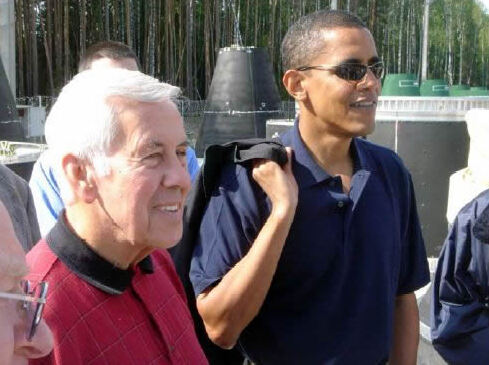
In the Senate, Obama has linked himself to Republican Dick Lugar on the question of Russian nuclear weapons -- making site visits, cosponsoring key nonproliferation legislation, etc. There must be tape of Obama shaking hands with Russian military leaders. Perhaps a campaign commercial or youtube video could highlight this policy endorsement from Lugar:
I'm enthused and encouraged by Senator Obama's commitment to adding his strong voice and creativity to the nonproliferation challenge.
I want to see more photos like this in circulation with those words.

2. Obama could (though this might be risky to the Democratic base) point out some failed policies of the Clinton administration -- and even more explicitly use a variant of the "dumb wars" leadership argument he made in 2002 against the Iraq war.

It would be most tempting to attack from the left -- Clinton's failings on human rights (ICC and land mine ban) and global warming, perhaps. Bill Clinton's administration outsourced some of these policies to the Pentagon. Perhaps this is why Hillary Clinton is now surrounding herself with generals and admirals!

However, the "tough/dumb" point would probably work better. The Clinton administration in many ways let Afghanistan fester for years even as it signed the Iraq Liberation Act, presaging the current war. That ties HRC's 2002 vote to a longer history of failure and misunderstood priorities.

Somewhat more problematically, some Obama surrogate might want to laugh off his opponent's responsibility for these Clinton administration failures. After all, "Mrs. Clinton" served admirably as her husband's first lady for 20 years (12 in Arkansas). Can we really blame her for his mistakes?


Note: I forgot to reference an even more egregious statement by Hillary Clinton. Hilzoy is on it.


Visit this blog's homepage.