Search This Blog

Showing posts with label gasoline prices. Show all posts

Monday, July 28, 2008

Gas prices and Kentucky politics

With his first political ad of this election year, Senator Mitch McConnell has thrown a softball to his Democratic opponent -- Bruce Lunsford.
McConnell's ad, which is airing statewide and first ran in Lexington during the early morning news shows Friday, criticizes Lunsford for pushing for a provision 28 years ago that automatically raises Kentucky's gas tax each year if the wholesale price of gasoline shoots up.

”Bruce Lunsford: automatic tax increases, more expensive gas,“ the ad's announcer says to conclude the 30-second spot.
Lunsford worked for Governor John Y. Brown back in those days, so the attack is a bit of a stretch. Moreover, the automatic tax provision was first triggered in 2004. Since that date, the law has cost Kentuckians about a nickel a gallon.

Given that gas has been priced at or above $4 per gallon for some months, it seems unlikely that McConnell can blame his opponent for current high gas prices.

If he wants to, Lunsford can point out that the law was designed to assure road funds during periods of escalating prices. People drive less when prices surge. The road fund has collected an extra $340 million in taxes since 2004 thanks to the extra nickel. Lunsford can campaign on pork -- something McConnell the incumbent wants to do.

More importantly, McConnell's ad set the stage for the obvious response:
”McConnell raised $3 million from big oil while voting to give them billions in tax breaks,“ the female announcer says in Lunsford's 30-second spot that began airing Friday.
Last week, Lunsford also announced an 8 point plan to expand energy supply and reduce gas prices:
The plan Lunsford unveiled yesterday includes withdrawing 50 million barrels of oil from the nation's Strategic Petroleum Reserve; stopping speculators who drive up the cost of oil; requiring oil companies to drill on land they currently lease; promoting clean coal and renewable energy technologies; and prosecuting price gougers.
Lunsford is running to the right of Barack Obama and other Democrats nationwide, so he spoke in favor of drilling in ANWR (only after other sources have been exploited) and off-shore.

Still, it is difficult to believe that this is a strong line of attack for McConnell.


Visit this blog's homepage.

Monday, June 09, 2008

Red America's Gasoline Spending

The front page of today's New York Times had an interesting graphic, featuring a map highlighting the percent of income people spend on gasoline. Clearly, as the accompanying story makes clear, people who live in rural areas spend a much greater percent of their income on gasoline.
A survey by Mr. Rozell’s firm late last month found that the gasoline crisis is taking the highest toll, as a percentage of income, on people in rural areas of the South, New Mexico, Montana, Wyoming and North and South Dakota.
Across the country, Americans spend about 4% of their income on gasoline. The recent peak was 4.5% in 1981 -- meaning that gas prices are still NOT at all-time highs in relative terms.

Eyeballing the gas price map, I was struck by how much it resembled the electoral maps we've all come to know in the past decade.

As a percent of income, Red America pays more for gasoline.

Perhaps that helps explain why Republicans are the party of oil interests.


Visit this blog's homepage.

Wednesday, April 02, 2008

Up with parking

Today's CSM has good news, though the journalist describes it as "negative":
For the first time since 1980, when long lines sprouted at gasoline stations, Americans are beginning to cut down on their driving.

The slight decline in total miles driven – apparent first in December – may indicate that the twin forces of high gasoline prices and a struggling economy are starting to affect the US lifestyle...

The last time that Americans did cut down on their driving in response to high prices, around 1980, they reduced their driving for 14 months. "We're starting to see a similar pattern emerge," Mr. Swanson [an economist with Wells Fargo Economics in Minneapolis] says. "This could be a huge washout this summer and for a couple of years."
Obviously, I'm concerned about the "financial hardship" reported in the story -- but the bottom line is that Americans drive their large and energy inefficient cars too much.

Anyone who has traveled to Europe knows that high gasoline prices discourage unnecessary driving. In most European countries, gasoline prices have been several dollars per gallon higher than in the US for many, many years. These higher prices reflect taxes implemented to promote conservation and "green" policies. In some countries, the tax revenues are used to fund alternative energy.

Americans need to start thinking about gasoline the way that they think about cigarettes -- tax the costly behavior to discourage it and to pay for solutions.


Visit this blog's homepage.

Saturday, August 13, 2005

Gas Price Mediocy

Years ago, I sometimes read the usenet group rec.sport.baseball. Many of the posters on that board used a word that I hadn't seen before, but it was one I soon embraced: "mediocy." According to baseballthinkfactory.org, the word was coined "by Dave Kirsch and defined by David M. Tate":
It is a portmanteau word, combining 'media' and 'idiot' to denote a member of the print or broadcast media who hasn't a clue. 'Mediocy' is derived by analogy with 'idiocy'.
Today, while watching a report on rising gasoline prices on MSNBC, this term immediately came to mind.

The reporter declared that crude oil and gasoline prices were at new highs, noted that even in the early 1970s gas prices had not exceeded $2 per gallon, and declared the entire situation "scary."

Given these facts, why am I using this as an example of "mediocy"?

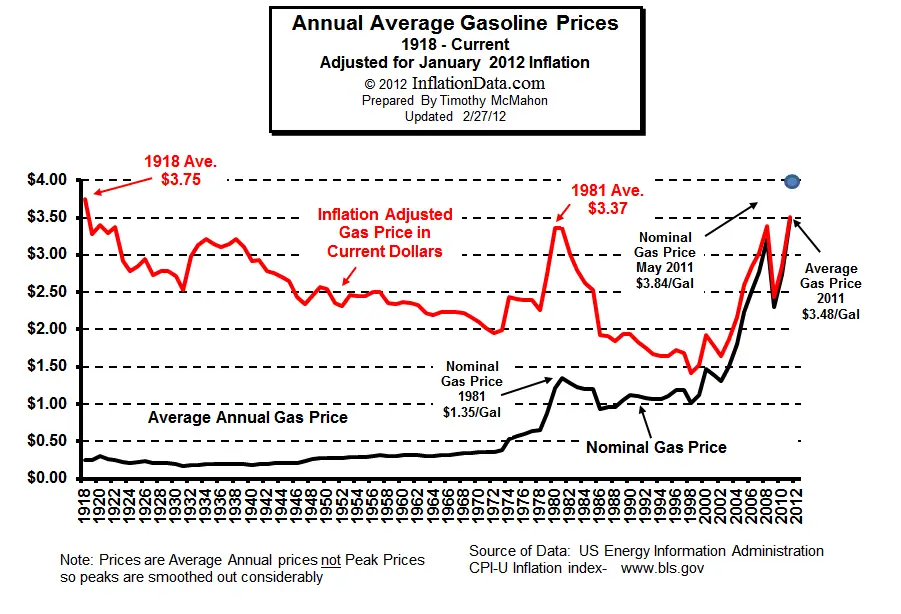
Well, take a look at this chart.

Or, look at the one from the Department of Energy:

In constant dollars (i.e., adjusted for inflation), current gas prices do not yet approach the peak price attained around 1980. As I tell my students, a barrel of oil cost about $2.50 at the beginning of the 1970s and ended the decade at around $40. Soon after, there was a glut of oil on the market and prices collapsed.

Every now and then, someone gets it right. Here's Kris Axtman reporting in the Christian Science Monitor from April 19, 2005:
The fact is, oil is still relatively inexpensive. By one measure tracked by Dow Jones, we are still far from matching an April 1980 spike in US oil prices. The $39.50 per barrel price that month exceeds $90 in today's dollars.
In 1980, gas prices were $2.87 per gallon, in constant dollars. We're almost there, but consider this, also from Axtman:
Even with the rising costs, economists say, energy still makes up a small percentage of a family's budget, about 4 percent. That's half what it was in the early 1980s.
Is that "scary"?

If current high prices prove anything, it is that Americans became addicted to cheap fuel in the 1990s, bought gas-guzzling SUVs and essentially forgot about conservation.

Oil prices will soar, one day, with scarcity limiting supply under conditions of high demand. We're not quite there yet, but the situation demands level-headed policy planning, not media scare stories.