Search This Blog

Showing posts with label missile defense. Show all posts

Monday, March 17, 2014

"Peace Through Strength"

Senator Kelly Ayotte

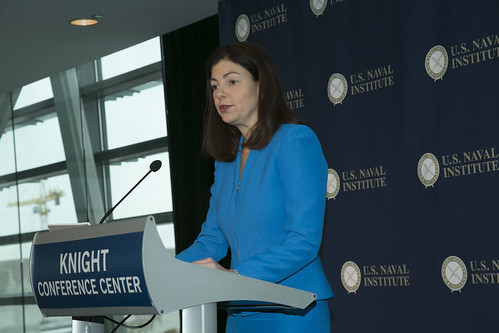
This morning, I attended a McConnell Center event featuring Senator Kelly Ayotte, Republican of New Hampshire. Though she recently sponsored popular bipartisan legislation, Ayotte delivered a highly partisan attack on the Obama administration's policy towards Russia.

Basically, Ayotte argued that the Obama's administration's "reset" policy toward Russia has been too conciliatory. Indeed, she said that this policy has failed and caused Vladimir Putin to take advantage of American weakness -- primarily in Ukraine. She emphasized these points as evidence of Barack Obama's weakness:
• "His decision in 2009 not to place NATO missile defense systems in Poland and the Czech Republic. 
• Obama’s choice in 2010 to “brush aside” the Russian invasion of Georgia, which happened during the George W. Bush administration, by pushing through a trade agreement with Russia.
• And Obama overlooking violations of one nuclear arms agreement at the same time the two countries were negotiating a new Strategic Arms Reduction Treaty."
She noted that despite American overtures to Russia, it has not been helpful in regard to the "humanitarian tragedy" in Syria or Iran's nuclear and missile programs. Plus, Russia has "a horrible record" on human rights.

In the question and answer session, Ayotte agreed with an audience member who claimed that the $17 trillion dollar national debt is America's number one concern. Indeed, Ayotte referenced Joint Chiefs Chair Admiral Mullen who said that the "biggest threat to our national security is our debt." Notably, the Senator's website has a debt meter on the front page.

Ayotte praised Ronald Reagan throughout her speech, but she definitely didn't emphasize either of the Bush presidencies.

Indeed, the partisan nature of the speech was as much about what Ayotte did not say as what she did say. Her attacks were pointed at the Obama administration, but she very carefully overlooked some pertinent details:
1. While Russia's attacks on Ukraine are a clear violation of international norms protecting state sovereignty, she did not mention the difficult rhetorical position the U.S. faces because of the Bush administration's adventure in Iraq. This has long been a problem, as I noted in 2008 in regard to Georgia.
2. Ayotte made passing reference to Georgia, but did not explain whether this Bush-era conflict should be tied to her overall argument about Russian adventurism, which she linked to American weakness. Was America weakened by more than a decade of fighting insurgents and terrorists in Iraq and Afghanistan? She didn't say.
3. Oh, about that debt. Ayotte didn't mention that Bush's tax cuts (which, granted, are mostly now Obama's as well), plus the wars in Iraq and Afghanistan, played a huge role in the accumulation of the $17 trillion debt -- and will play an even bigger role in the accumulation of future debt. Did that weaken the US and embolden Putin in 2008? 
4.  About those missile defenses and the alleged INF arms control violation, Ayotte didn't mention that the Bush administration unilaterally killed the anti-ballistic missile defense treaty with Russia in 2002. Would anyone want Russia to do that with the INF or START treaties? No. All signs suggest both the US and Russia are implementing the new START accord. The INF allegation is new and the Obama team is attempting to sort out the details via diplomacy -- much like the Reagan administration did with an alleged violation of the ABM treaty in the 1980s. 
By the way, Western European states favored the decision to scrap the missile defense system she mentions, primarily because the U.S. is aiming to deploy instead an alternative technology that many defense experts believe will be superior technology (Aegis on land).
5. Ayotte also didn't mention Russia's help in getting Syria to agree to eliminate its chemical arsenal. Or the role it plays in trying to prevent Iran nuclear weapons. Russia doesn't want a nuclear-armed Iran. 
Finally, Ayotte's policy suggestions didn't really offer new ideas to the debate -- or even ideas that are significantly different from the status quo. Today was all about carping about alleged weakness, not suggesting actual policy that would provide new leverage over Russia:
In response to Russia’s actions in Ukraine, Ayotte stopped short of calling for military intervention, but she urged Obama to order a series of economic and diplomatic sanctions sanctions on Russia.
Ayotte called for the U.S. and the world community to “alienate” Putin, to increase natural gas production in an effort to cut off Russia economically and to “revisit” the decision not to put missile defense systems in Poland and the Czech Republic.
Ayotte also backed freezing bank accounts and blocking visas for Putin’s top aides — which Obama had done earlier in the day.
The G-8, a group of the top industrialized nations, also may expel Russia in response to its invasion of Ukraine.
Ayotte did call for more American military assistance to Ukraine, so that the country could defend itself -- and opposed the proposed defense cuts that are under discussion in Washington as part of planned deficit reduction.

The Senator openly agreed with many policies already taken -- she would not take military action, approves of some US signals with its military, etc. Indeed, the links I included above in her proposals point to policies the U.S. is already taking or considering.

Really, the conclusion was very bland given the "peace through strength" vision of Reagan she offered throughout the speech. It was as if an '80s defense hawk had ended a talk on the "window of vulnerability" by emphasizing that the U.S. should build bomber aircraft and nuclear submarines to supplement its arsenal....Oh wait, we already had those, so land-based missile vulnerability probably wouldn't cause world war III. .


Visit this blog's homepage.

For 140 character IR and foreign policy talk, follow me on twitter.

Or for basketball, baseball, movies or other stuff, follow this personal twitter account.

Saturday, March 19, 2011

Hot Duck

Today, on the Duck of Minerva group IR blog, I posted "Libya: R2P or Regime Change?" R2P means responsibility to protect, a framing of the authorized intervention that is too rarely used by American media.

On Thursday, I posted "Nuclear Disarmament: Looking Back at Reykjavik." Nearly 25 years ago, Ronald Reagan and Mikhail Gorbachev both offered proposals to disarm offensive nuclear arsenals within 10 years. Declassified documents reveal that this aim was prevented by U.S. desire to research and potentially deploy anti-ballistic missile.


Visit this blog's homepage.

Wednesday, June 06, 2007

Deterrence 101

Does President Bush understand deterrence theory -- and the implications of the so-called US "missile shield"?

The United States and Soviet Union long ago effectively banned missile defenses (or Anti-Ballistic Missiles) in the ABM Treaty of 1972. Defense analysts widely interpreted that agreement as a ratification of MAD (mutually assured destruction). Neither the US nor the Soviet Union could strike the other because of certain catastrophic retaliation.

However, a missile defense would undermine the effectiveness and thus the certainty of retaliation. Even Ronald Reagan acknowledged that defenses can be viewed as threatening in his famous 1983 "Star Wars" address:
I clearly recognize that defensive systems have limitations and raise certain problems and ambiguities. If paired with offensive systems, they can be viewed as fostering an aggressive policy, and no one wants that.
Nonetheless, George W. Bush unilaterally ended the ABM Treaty in 2001.

For some months now, Russian officials, including President Vladimir Putin, have been making noises about a new cold war. Russia has been especially angry about America's announced plans to deploy a missile defense system in Europe. Putin views the system as a threat to Russia's nuclear deterrent, assuring it only a "ragged" retaliatory capability.

Could MAD be threatened by the missile shield?

Given recent changes in the arsenals of the two former superpowers, the US will, in the words of Keir Lieber and Daryl Press, "probably soon" have the ability "to destroy the long-range nuclear arsenals of Russia or China with a first strike."

A missile defense looks kind of like a scary fail-safe mechanism in that context, eh?

In a roundtable event earlier today, in Germany, President Bush made a series of arguments that reveal a decent understanding of deterrence. However, I doubt they will dispel Russian fears.

Indeed, key clauses seem to be aimed more at reassuring his European hosts -- a journalist had just asked the about the importance of Russia again targeting Europe with its nuclear missiles -- rather than the Russian listeners:
Russia is not a threat. Nor is the missile defense we're proposing a threat to Russia...Russia is not going to attack Europe. The missile defense system is not aimed at Russia...

By the way, a missile defense system that is deployed in Europe can handle one or two rocket launchers. It can't handle a multiple launch regime. Russia has got an inventory that could overpower any missile defense system. The practicality is, is that this aimed at a country like Iran [sic], if they ended up with a nuclear weapon, so that they couldn't blackmail the free world.

I will continue to work with President Putin, Vladimir Putin, to explain to him that this is not aimed at him. And there's all kinds of ways you can do that. One is total transparency between our militaries and scientists -- military people and scientists, which I'm more than happy to do.
Hmmm. Maybe the President intends to have American "military people" and scientists assure Putin that the US defenses won't work?


Visit this blog's homepage.

Monday, February 12, 2007

Is great power conflict back?

Since the end of the cold war, the world has not featured much great power competition. Moreover, the 9/11 attacks and fall 2001 anthrax scare focused tremendous attention on threats from transnational terrorism and small states with "weapons of mass destruction." Virtually all the world's major powers aligned together in a "war on terrorism."

Indeed, scholars of international relations have starting debating whether or not balancing behavior is a relic of the past. The United States is so powerful relative to other states, some argue, that balancing behavior is NOT to be expected.

Recently, however, there have been some signs that great power competition may be returning.

China recently tested an ASAT, for example, which may one day pose a threat to US space dominance.

This past week, Russia made some noise too.

Consider this statement from President Vladimir Putin in his address to the annual Munich security summit. As the BBC reported February 10:
Mr Putin told senior security officials from around the world that nations were "witnessing an almost uncontained hyper use of force in international relations".

"One state, the United States, has overstepped its national borders in every way," he said, speaking through a translator.

"This is very dangerous. Nobody feels secure anymore because nobody can hide behind international law.

"This is nourishing an arms race with the desire of countries to get nuclear weapons."
As Council on Foreign Relations senior fellow Ray Takeyh points out, the US and Russia have serious differences concerning Iran.

February 9, the New York Times reported that Russian defense minister Sergei B. Ivanov warned a NATO group meeting in Spain that Russia might initiate a new arms competition if the US deploys radars and defensive missiles in Poland and the Czech Republic. Those states are a long way from North Korea, though the US claims Iran is the potential threat.

In Munich, some Americans also had great power competition in mind. The BBC quoted Senator John McCain:
"Moscow must understand that it cannot enjoy a genuine partnership with the West so long as its actions at home and abroad conflict fundamentally with the core values of the Euro-Atlantic democracies. In today's multi-polar world there is no place for needless confrontation."
McCain's Senate colleague Joseph Lieberman declared that Putin's "provocative" address "sounded more like the Cold War."

News reports suggested that Defense Secretary Robert Gates tried to deflate this rhetoric in his Munich speech, but he had his own concerns as well:
Looking eastward, China is a country at a strategic crossroads. All of us seek a constructive relationship with China, but we also wonder about the strategic choices China may make. We note with concern their recent test of an anti-satellite weapon.

Russia is a partner in endeavors. But we wonder, too, about some Russian policies that seem to work against international stability, such as its arms transfers and its temptation to use energy resources for political coercion.
I don't think a new cold war is on the immediate horizon, but the Bush administration hasn't worked very hard to build a sense of shared interests in international community.

Whether one is worried about global warming, the Geneva conventions, or a potential "preemptive" war on Iran, other great powers continue to wonder about the prospects of American unilateralism.


Visit this blog's homepage.

Wednesday, May 25, 2005

Death star

National security and defense debates never seem to die -- but they sometimes become more colorful.

More than twenty years ago, I wrote my undergraduate thesis on "Managing the Perils of Nuclear Proliferation." I'd like to say it was ahead of its time, but Lewis Dunn had just published Controlling the Bomb (Yale, 1982). My library research was thorough, but ultimately derivative. Hell, in 1980-81, Dartmouth's top debate team (actually, they were ranked as the best team in the country) advocated that the US pass along PALs and other technological protections to potential new proliferants. The biggest risks could be mitigated by making the new proliferant forces invulnerable to rival first strike and safe from unauthorized use and theft. By the end of that year, my sophomore season, my colleague and I occasionally argued that case too.**

A few years later, spurred by Ronald Reagan's "Star Wars" address, I set about studying the Strategic Defense Initiative (SDI). Because there wasn't too much new to say about missile defenses -- after all, "anti-ballistic missiles" (ABM) were thoroughly debated in the 1960s by defense intellectuals -- I decided to focus on the recurrence of the debate itself, and the arguments employed by the various advocates. Hence, my dissertation concerned "Communication Strategy and 'Strategic' Weapons: Case Studies of ABM Decisions." I also explored some of the Reagan administration's threat inflation concerning SDI.

Last week, the New York Times (I read the same story in the International Herald Tribune), reported that the Air Force is now recommending variants of missile defense that focus directly on the proliferation problem. This is not a new idea either. Robert McNamara's 1967 ABM proposal was designed to mitigate threats from China's new atomic threat.
The air force believes "we must establish and maintain space superiority," General Lance Lord, who leads the U.S. Air Force Space Command, told Congress recently. "Simply put, it's the American way of fighting."

...A new air force strategy, called Global Strike, calls for a military space plane carrying precision-guided weapons armed with a half-ton of munitions. Lord told Congress last month that Global Strike would be "an incredible capability" to destroy command centers or missile bases "anywhere in the world."

Pentagon documents say the weapon could strike from halfway around the world in 45 minutes. "This is the type of prompt Global Strike I have identified as a top priority for our space and missile force," Lord said.
Opponents have rallied quickly. Just as foes of Reagan's plans used the phrase "Star Wars" to frame opposition to SDI, current skeptics have again borrowed from the imagination of George Lucas. This time, the weaponry of Lord Darth Vader comes more directly to mind:
Another space program, nicknamed Rods From God, aims to hurl cylinders of tungsten, titanium or uranium from the edge of space to destroy targets on the ground, striking at speeds of about 7,200 miles an hour, or 11,500 kilometers an hour, with the force of a small nuclear weapon...No nation will "accept the U.S. developing something they see as the death star," Teresa Hitchens of the Center for Defense Information, a policy-analysis group in Washington, said at a meeting of the Council on Foreign Relations. "I don't think the United States would find it very comforting if China were to develop a death star, a 24/7 on-orbit weapon that could strike at targets on the ground anywhere in 90 minutes."
Academically, I may have to return to this colorful new debate. After all, as other bloggers have noted, the neoconservative right openly admires Vader's empire. And Bush has selected a General named Lord to oversee a program dubbed Rods from God? Incredible.


---------------------
** My ultimate career choices were strongly influenced by that 1980-1981 debate season. In response to teams that wanted to ratify the SALT accords, I developed an argument called "The Russian Revolution" that claimed the Soviet Union and its empire was going to collapse under the weight of the arms race. Most of the key pieces of evidence came somewhat dubiously from a Taiwanese magazine and more reasonably from the book, Will the Soviet Union Survive Until 1984? Remember, Poland was cracking at the seams that year.

By the end of the 1981 season, my colleague and I were arguing that the 1980 death of Marshall Tito meant that civil war in Yugoslavia was inevitable. The US needed to act then to prevent that violence. This was all based on secondary research in scholarly journals and books. Retired NATO General John Hackett had published The Third World War, which also considered the implosion of Yugoslavia.

Kids, do you understand why I think debate was so valuable?

Tuesday, June 08, 2004

Reagan

I don't have much to say about the passing of Ronald Wilson Reagan. Instead, I'll write a little bit about how his life influenced mine (it is my blog after all).

My graduate career (and, thus, my professional life) started in 1983, well into the Reagan presidency.

Ultimately, my dissertation was inspired by the Reagan administration. My thesis focused primarily on missile defenses (and the importance of public audiences in shaping policy), as did a few of my earliest journal articles. One piece, in fact, specifically analyzed a speech delivered by Reagan on March 23, 1983. At the time, this was known as the "Star Wars" speech, even though the President didn't use that term.

In fact, the average listener probably wasn't exactly sure what Reagan was discussing when he turned somewhat ambiguously to strategic defenses. Reagan included the relevant paragraphs at the end of a lengthy speech on "Defense and National Security." Throughout the overwhelming majority of this speech, Reagan outlined the need for elevated defense spending. As you might expect, a great deal of the speech was dedicated to outlining Soviet weaponry. That's how the arms race was justified in the US: they build, so we have to build.

Of course, as in the recent debate about Iraqi WMD, the threats were often inflated.

Here's an interesting quote from the March 23, 1983, speech that might have been useful in the 2002-2003 Iraq debate:
The defense policy of the United States is based on a simple premise: The United States does not start fights. We will never be an aggressor.
Then again, America's actions have long been justified as defensive even when many observers might see them as offensive. In this address, Reagan mentioned US concerns about an airfield in Grenada with a 10,000-foot runway built with Soviet financing. In October of that year, American forces invaded Grenada and deposed Maurice Bishop.

Perhaps you saw the mediocre Clint Eastwood movie about it.

Anyway, back to the March 23 speech. Reagan was accusing the Soviets of "acquiring what can only be considered an offensive military force" and calling for greater American defense forces to counter it. Ultimately, he proposed strategic defenses:
After careful consultation with my advisers, including the Joint Chiefs of Staff, I believe there is a way. Let me share with you a vision of the future which offers hope. It is that we embark on a program to counter the awesome Soviet missile threat with measures that are defensive. Let us turn to the very strengths in technology that spawned our great industrial base and that have given us the quality of life we enjoy today.

What if free people could live secure in the knowledge that their security did not rest upon the threat of instant U.S. retaliation to deter a Soviet attack, that we could intercept and destroy strategic ballistic missiles before they reached our own soil or that of our allies?

I know this is a formidable, technical task, one that may not be accomplished before the end of this century. Yet, current technology has attained a level of sophistication where it's reasonable for us to begin this effort. It will take years, probably decades of effort on many fronts. There will be failures and setbacks, just as there will be successes and breakthroughs. And as we proceed, we must remain constant in preserving the nuclear deterrent and maintaining a solid capability for flexible response. But isn't it worth every investment necessary to free the world from the threat of nuclear war? We know it is.

In the meantime, we will continue to pursue real reductions in nuclear arms, negotiating from a position of strength that can be ensured only by modernizing our strategic forces. At the same time, we must take steps to reduce the risk of a conventional military conflict escalating to nuclear war by improving our nonnuclear capabilities.

America does possess -- now -- the technologies to attain very significant improvements in the effectiveness of our conventional, nonnuclear forces. Proceeding boldly with these new technologies, we can significantly reduce any incentive that the Soviet Union may have to threaten attack against the United States or its allies.

As we pursue our goal of defensive technologies, we recognize that our allies rely upon our strategic offensive power to deter attacks against them. Their vital interests and ours are inextricably linked. Their safety and ours are one. And no change in technology can or will alter that reality. We must and shall continue to honor our commitments.

I clearly recognize that defensive systems have limitations and raise certain problems and ambiguities. If paired with offensive systems, they can be viewed as fostering an aggressive policy, and no one wants that. But with these considerations firmly in mind, I call upon the scientific community in our country, those who gave us nuclear weapons, to turn their great talents now to the cause of mankind and world peace, to give us the means of rendering these nuclear weapons impotent and obsolete.

Tonight, consistent with our obligations of the ABM treaty and recognizing the need for closer consultation with our allies, I'm taking an important first step. I am directing a comprehensive and intensive effort to define a long-term research and development program to begin to achieve our ultimate goal of eliminating the threat posed by strategic nuclear missiles. This could pave the way for arms control measures to eliminate the weapons themselves. We seek neither military superiority nor political advantage. Our only purpose -- one all people share -- is to search for ways to reduce the danger of nuclear war.

My fellow Americans, tonight we're launching an effort which holds the promise of changing the course of human history. There will be risks, and results take time. But I believe we can do it. As we cross this threshold, I ask for your prayers and your support.

Thank you, good night, and God bless you.
Despite what Christopher Hitchens wrote at Salon, Reagan did not end this speech "with the lame quip, 'May the force be with you.'"

In fact, Reagan apparently used that line when astronauts were about to fly in the space shuttle, which actually seems appropriate. Even Reagan's "evil empire" speech does not use the phrase inspired by that movie. Reagan referred to totalitarians as evil, but did not utter the word "empire" in the address.

And it was Reagan's foes who called the program inspired by the March 23 speech "Star Wars." The administration called the program the Strategic Defense Initiative.

In short, the Reagan legacy is complicated; informed (like the former President was) by myths and half-truths. My coauthored journal article about the "Star Wars" speech argued that it was an excellent response to the nuclear freeze movement, but a poor way to initiate defense policy given the negative reaction that could be expected from significant numbers of "defense intellectuals" and allies. After all, supporters had been proposing "anti-missile missiles" since the Soviets launched Sputnik -- typically in the face of significant opposition that was able for decades to hold off repeated efforts to secure deployment.

Ultimately, the SDI program also died before deployment, but when urged to do so by political leaders, the US body politic still regularly engages in debates about whether to deploy missile defenses. One of the Clinton-Gingrich confrontations that closed the government was partly about the appropriation of funds to deploy missile defenses. Donald Rumsfeld may have been named Bush's Defense Secretary because of his misleading Commission Report that inflated missile threats from proliferants.

You get the idea.

I ultimately broadened my scholarly interests by turning to questions about global environmental politics and international institutions. But the public debates about threats in the nuclear age, and the appropriate US responses to them, are ongoing and interesting.

Wednesday, December 03, 2003

Japanese Missile Defense, Asian Missiles and Deterrence

Reuters has a story today reporting that Japan is likely soon to announce its intended deployment of missile defenses. It looks like Japan will be buying off-the-shelf US technology, which basically means it doesn't yet work very well:
Under a Defense Ministry plan, Japan would spend $4.62 billion from fiscal 2004/05 to 2007/08 to buy a two-stage system developed by the United States, Mainichi said.
Actually, the article says the Japanese are going to deploy the system that works on Aegis destroyers (as well as Patriots), so the technology is more promising than the fixed, land-based systems the US is planning to deploy in Alaska. It will be fully deployed in 2011-2012.

While the Japanese say these defenses are designed to stop North Korean missiles, they will also (if they work) stop Chinese missiles.

The Chinese are not likely to be happy about losing their deterrent (the US worries about Chinese missiles capable of hitting US forces at Okinawa), and will likely respond by increasing offensive missiles.

It's a simple recipe for a costly missile arms race in Asia. So says Axel Berkofsky, PhD, of the European Institute for Asian Studies.
A strong opponent of joint US-Japanese missile-defense projects, China is believed to have increased the number of missiles by 75 per year in an attempt to discourage the United States and Japan from working on a missile-defense system eventually unable to deal with the growing number of Chinese missiles. The opposite is the case, of course. The more the number of Chinese missiles grows, the more the US and Japan want to develop and deploy the system.

This looks like the beginning of a new arms race in East Asia to Chinese Defense Minister Cao Gangchuan, who met with his Japanese counterpart Shigeru Ishiba in Beijing last week. Missile defense, he complained, will lead to a new escalation in Japan's defense spending. And Cao certainly knows about rising military spending, given that China's defense budget has seen two-digit growth per year over at least the past decade.
With all the focus on Iraq, little attention is directed at China these days. But foreign policy wonks might want to note that the neocons from the Project for a New American Century (as well as Condi Rice in the 2000 Foreign Affairs piece) focused a great deal of hostile attention on China.

This is one of those issues that divides academics -- even on the same faculty.

Update: The BBC reports that Australia is commiting to missile defense too.