Search This Blog

Sunday, August 21, 2005

Framing Iraq: a Lesson from the Vietnam Experience

Iraq is not Vietnam. However, the political debate about Vietnam presents a number of valuable lessons that war opponents should be learning. Fast, as in before the 2008 presidential election process starts in earnest. Since candidates are already coming forward to fill what will almost certainly be an open seat (unless Dick Cheney has filled it for some reason), this means war opponents need to act now.

Anti-war activists have great difficulty convincing the majority of Americans that the US should simply abandon Iraq. Even those who opposed the March 2003 invasion of Iraq are now reluctant war supporters because of Colin Powell's "Pottery Barn" rule: "you break it, you own it."

If America withdraws prematurely, Iraq could experience a factional civil war, become a failed state, and/or serve as a future base for terrorists. For many, the US has a political and moral responsibility to rebuild Iraqi society and promote democratization.

War supporters are thus able to frame the debate as one between two simple choices: "stay the course" or withdraw. Many of these very same supporters framed the pre-war debate as a choice between war or appeasement.

This was obviously a false choice, especially given the success of the 1990s weapons inspections regime, which used sanctions to achieve disarmament.

The 1960s debate about Vietnam demonstrates that policymakers face more than two choices when combatting insurgency. At minimum, there is a third choice -- escalation. Indeed, many former military officers (and other hawks) believe that the US lost in Vietnam because it was unwilling to provide sufficient forces to win. The so-called "Powell Doctrine" was derived from the lessons of Vietnam: "force, when used, should be overwhelming and disproportionate to the force used by the enemy."

I'm not going to argue that the US should escalate the war, but I do think there's tremendous value in pushing the administration on this point. Put simply, war opponents can sizably increase their coalition if they can convince relatively hawkish Americans that the Bush administration really isn't serious about winning the war in Iraq.

The logic sounds backwards, but I'm serious about this. The war's most vehement supporters might be convinced to abandon Iraq altogether if they become convinced that the US isn't really fighting to win.

Consider this analysis of the populist "Jacksonian school" of American foreign policy, as developed by Walter Russell Mead:
For the first Jacksonian rule of war is that wars must be fought with all available force. The use of limited force is deeply repugnant. Jacksonians see war as a switch that is either "on" or "off." They do not like the idea of violence on a dimmer switch. Either the stakes are important enough to fight for—in which case you should fight with everything you have—or they are not, in which case you should mind your own business and stay home. To engage in a limited war is one of the costliest political decisions an American president can make—neither Truman nor Johnson survived it.
According to Mead, this political movement is "in many ways the most important in American politics...Jacksonians constitute a large political interest."

Senator John McCain is one of those Vietnam veterans who thinks the lesson of Vietnam is that the US cannot merely "stay the course" when facing stagnation:
We lost in Vietnam because we lost the will to fight, because we did not understand the nature of the war we were fighting and because we limited the tools at our disposal.
According to Mead, "John McCain is a Jacksonian."

Here's the challenge for the anti-war coalition: How can Jacksonians be convinced to withdraw from Iraq -- before a populist candidate for President like McCain comes along and rallies the base behind the idea of escalation?

My entire thesis is counterintuitive, I realize, but it is the key to adding Jacksonians to the anti-war coalition. They are "on" war, or "off," wrote Mead. It's quite a leap for them to join the anti-war crowd. How can they be convinced to flip-flop on this war?

The key, I think, is to prove that the Bush administration is not serious about winning the war in Iraq. For example, the administration refuses to provide the personnel and armor necessary to fight and win. War opponents have to be careful about their political strategy -- in April 1969, the US had 543,000 military personnel in Vietnam. Anti-war forces certainly don't want to see half a million Americans in Iraq.

On the other hand, 1968 and 1969 were years of great dissent and protest inside the US. Many Jacksonians then and now thought that the left "sold out" the US in Vietnam and prevented the possibility of victory. Protest and dissent, whatever their merits, are not the pathways to adding Jacksonians to the anti-war coalition.

These days, Bush administration officials repeatedly claim that they are merely listening to the Pentagon on the question of military power needed in Iraq. Here's President Bush from May 2004, for example:
General Abizaid and other commanders in Iraq are constantly assessing the level of troops they need to fulfill the mission. If they need more troops, I will send them.
Bush repeated this claim on June 28, 2005, but it is clear from the remarks that the political strategy is driving the decision:
If our commanders on the ground say we need more troops, I will send them. But our commanders tell me they have the number of troops they need to do their job. Sending more Americans would undermine our strategy of encouraging Iraqis to take the lead in this fight. And sending more Americans would suggest that we intend to stay forever, when we are, in fact, working for the day when Iraq can defend itself and we can leave.
Before the war, of course, then-Army chief of staff, General Eric Shinseki said that the US would need hundreds of thousands of troops in Iraq. Army Secretary Thomas White agreed with Shinseki and was soon canned. My blog entry, "Generals against the war" is one of the most-searched google entries presumably because a lot of people trust military officers to give them the "straight truth" -- and they recognize that the military isn't 100% certain that the Bush team is listening to them.

John Kerry tried to make this point at various times during the 2004 campaign, but he simply didn't pound it hard enough. He was trying, I think, to finesse the war issue so as to gain and retain support among anti-war Democrats, like those who propelled the Howard Dean campaign and dominated the early presidential primary season.

Maybe those opposed need to hold their noses for awhile and let Democrats like Joe Biden and Hilary Clinton talk about increasing the size of the US commitment to Iraq or reinstallation of conscription.
Sen. Joseph Biden Jr., appearing on ABC's "Good Morning America," disputed Bush's notion that sufficient troops are in place.

"I'm going to send him the phone numbers of the very generals and flag officers that I met on Memorial Day when I was in Iraq," the Delaware Democrat said. "There's not enough force on the ground now to mount a real counterinsurgency."
My suggestion would be more likely to work if some military leaders spoke out for increased troops and criticized the US warplan. I think the Bush administration would ignore or rebuff them, as they did Shinseki.

That's when the Jacksonians could be primed to jump ship.

Friday, August 19, 2005

New Report: Iraq WMD intell was willfully distorted

The University of Pittsburgh's Ridgway Center for International Security Studies has just published a Working Paper that purports to answer the question that the Senate Select Committee on Intelligence did not: Was the pre-war intelligence about Iraq WMD willfully distorted by the Bush administration?

"Yes," says the author of the new report, which focuses on the pre-war claims about Iraq's nuclear program.

Obviously, I agree with this conclusion, as anyone who has read my blog for the past two years knows. And in fact, I am the author of the Working paper: "Deliberating Preventative War: The Strange Case of Iraq’s Disappearing Nuclear Threat" (August 2005, #6).


I want to thank the Center's Gordon R. Mitchell for chairing the Working Group on Preemptive and Preventive Military Intervention and for alerting me to the recent publication of the Working Paper. Here is part of Gordon's summary of my work:
In this paper, Rodger [A. Payne] revisits the Iraq War timeline and notices something startling - Bush administration officials were exaggerating threat evidence on Iraq before the intelligence community completed its National Intelligence Estimate in October 2002. This is especially remarkable in light of the fact that key Bush officials were saying that Saddam Hussein was 'in check' and 'living on borrowed time' as late as February 2001. Noting that the "we were given bad intelligence" excuse does not account for the White House's exaggeration of threat evidence from February 2001 to October 2002, Payne searches for other explanations and discovers evidence of a systematic effort by Bush administration officials to manipulate public debate. With this effort, Payne picks up where the Senate Select Intelligence Committee dropped the ball...

Payne frames the significance of this strategic deception campaign by examining how it sharply contradicts portions of NSS 2002 that insist on the importance of public deliberation and debate as safeguards that limit preventive war options.
Hopefully, this will soon be a chapter in a new edited volume.


Update: Update: Thanks to commenter nadezhda for noting (at Duck of Minerva) that I incorrectly blamed the wrong Senate Committee for its lack of oversight on this issue.

Thursday, August 18, 2005

Outfoxed

Last night, I viewed the disturbing documentary about Fox News, "Outfoxed: Rupert Murdoch's War on Journalism." If you haven't seen it, I recommend that you do. Indeed, watch it as part of a double feature with "Control Room," the documentary about Arabic network, al-Jazeera.

Frankly, after seeing both films, I'd rather my cable company carry al-Jazeera than Fox News Channel.

This week, I'm hard at work on my syllabi for this fall's classes, which begin for me next Tuesday. While viewing "Outfoxed," I kept wondering if it would be acceptable to show it during classtime for the section on media in my American Foreign Policy course.

The first hour of the documentary is very good. The film relies heavily upon memos written by Fox News executives and interviews with former Fox News employees -- both behind-the-scenes producers and on-air figures. Some of the more analytical portions come from David Brock of Media Matters and Jeff Cohen of FAIR (Fairness and Accuracy in Reporting).

A.O. Scott, writing in the NY Times gets it about right:
The story they tell is of the systematic and deliberate dismantling of journalistic norms, and of an outfit that has become not merely a voice of conservatism but a cheerleader for the Republican Party.
The film also shows a lot of snippets from Fox News broadcasts that demonstrate the veracity of the claims -- that Fox talking heads use "some say" to "report" rumor as news, for example, and they repeat (again and again and again) Republican talking points (such as, "John Kerry is a French-looking flip-flopper").

An awful lot of the film is about Fox's coverage of the Iraq war and the Bush administration. Given the importance of the presidency in American foreign policy, I think the documentary is on topic. Plus, a portion of the film speaks to the issue of corporate ownership of media and thereby extends the critique beyond Fox to GE (which owns NBC) and other news outlets.

The film's last 10 or 15 minutes, however, address a question central to director Robert Greenwald's politics: How can "we" fight back against Fox? Some of the respondents are overtly left-leaning and their analysis is as far to the left as Fox is to the right.

In any event, I think I'm going to use it this term, but would be eager to read feedback in the comments.

Wednesday, August 17, 2005

Foreign Policy and Political Speech

I'm fairly interested in the meaning and importance of political speech, so this academic analysis stood out when I read it, even though I was looking for something else altogether when I found it:
There is no denying that some American policies, such as our support for Israel and sanctions against Iraq, are unpopular. But it is important to analyze anti-Americanism and anti-Zionism in the Arab world as political speech. When leaders in our own country justify particular policies on the basis of their deep commitment to freedom and democracy, no serious political analyst would take these statements at face value. The statements would be interpreted against the backdrop of the domestic political debate, national interests, etc. But when Arab political actors invoke opposition to Israel and the United States, we tend to take what they say at face value.

In my view, much of the discussion in the Arab world about Palestine, Iraq and America's role in both is not only about those three issues. It is also about other things.
Let me explain why this is interesting on many levels.

First, it obviously speaks to important ongoing debates. Critics of the Bush administration's prosecution of the war on terror, such as former "Anonymous" CIA analyst Michael Scheuer, say that al Qaeda attacks the US because of its policies effecting Muslims around the world -- especially "unqualified support for Israel" and "Probably the most damaging of all is our 30-year support for police states across the Islamic world." Scheuer puts great weight on bin Laden's words:
Bin Laden has been precise in telling America the reasons he is waging war on us. None of the reasons have anything to do with our freedom, liberty and democracy, but have everything to do with U.S. policies and actions in the Muslim world.
However, the scholar quoted above doesn't agree with Scheuer's analysis:
An important example is the Palestine question, which has a strong symbolic role in Arab and Muslim political speech. Palestine as a symbol means, among other things, the disregard that the West has for Arab and Muslim suffering. Obviously, when a Palestinian talks about Palestine, he or she is talking about the situation at home. But when, for instance, Saudis, Egyptians or Iranians invoke Palestine, they are often discussing their own circumstances as well.

Rightly or wrongly, most Arabs perceive Washington as the guardian of the current Arab political and economic order, which, quite frankly, stinks. Consider, for instance, Saudi Arabia, whose problems are typical. Nearly 50 percent of the Saudis are under the age of 15. While the population has been increasing at more than 3 percent a year, the average real income in the kingdom has decreased precipitously -- perhaps by as much as 50 percent in the last decade. The monarchy, like most Arab governments, does not permit freedom of expression or of assembly. In my view, the extreme anger that many Saudis are expressing toward America has its roots in that dismal state of affairs rather than on this or that policy that Washington might be pursuing.
No, the scholar isn't Bernard Lewis, though that might have been a good guess. Indeed, the speaker is someone sometimes identified as a protégé of Lewis -- Michael Scott Doran.

Doran's identity is the second reason this is interesting. The Princeton Middle East studies junior professor is apparently favored by the Bush administration and was recently said to be in line for a job at the National Security Council. However, I haven't read anything about that -- and I searched the web widely, including the whitehouse.gov site. Anyone? I know Abu Aardvark has followed Doran's career a bit.

Third, the quote is interesting because of the sentence I have put in bold. Let's look at it alone:
When leaders in our own country justify particular policies on the basis of their deep commitment to freedom and democracy, no serious political analyst would take these statements at face value.
Maybe Doran hasn't been named to the NSC because someone in the Bush administration dug up this quote -- printed in the Princeton Weekly Bulletin, January 14, 2002?

After all, the President is committed to freedom and democracy.

Isn't he?

Tuesday, August 16, 2005

Blogroll: August 2005 Update

Once again, I've been playing around with the blogroll to make it reflect what I actually read -- or what I'd like to read if I had more time.

Thus, I try to check in on these blogs when I can. Many are written by people I know, or who are kind enough to read my blog. This page can be found easily by clicking the link for "My Blogroll" in the sidebar.

Blogroll

Roger Ailes
Ambiguous Adventure
Amygdala
Bad Attitudes
bazzfazz
blogAmy
Bloggermann
BlueGrassRoots
Bobs Newswire
Bush2004.com
but, .....I repeat myself
Cardinal Philosophy
cofound
colonel sturgeon
common prejudice
Corpus Callosum
Counterspin Central
Davos Newbies
Dear Editor
Dullard's Gazette
Dear Editor...
elementropy
Foreign Affairs Blog
Steve Gilliard
Globalize This!
Micah Holmquist
Howard Labs
iddybud
Jumping to Conclusions
Just World News
The Kentucky Democrat
KentuckyDems
Lean Left
Left coaster
The Leviathan and The Republic
Lotus
Nuclear Iran
Open Source Politics
Pandagon
political theory daily review
Politics Among Nations
Politus
Progressive Blog Alliance
Public Opinion
Rain Storm
Samuel Taylor Coleridge Foundation
The Honest Truth
The Raw Story
Sid's Fishbowl
Something's rotten in the state of Denmark
Undelay
UnFairWitness
unfutz
Unknown News
Vanessa's Zimbabwe Journal
Weapons of Mass Destruction
With a Grain of Salt!

Some of these blogs has been taken down or have been silent for months, but I'm keeping the links here in case they return.

Monday, August 15, 2005

A "Gentleman's C" for Iraq Policy?

Much of blogtopia has been talking about the sobering article by Robin Wright and Ellen Knickmeyer in Sunday's Washington Post. I don't have time to comment right now -- the kids actually start school Tuesday (!) -- but the piece is definitely worth a complete read. The title accurately sums up the story: "U.S. Lowers Sights On What Can Be Achieved in Iraq." Here are the first few paragraphs:
The Bush administration is significantly lowering expectations of what can be achieved in Iraq, recognizing that the United States will have to settle for far less progress than originally envisioned during the transition due to end in four months, according to U.S. officials in Washington and Baghdad.

The United States no longer expects to see a model new democracy, a self-supporting oil industry or a society in which the majority of people are free from serious security or economic challenges, U.S. officials say.

"What we expected to achieve was never realistic given the timetable or what unfolded on the ground," said a senior official involved in policy since the 2003 invasion. "We are in a process of absorbing the factors of the situation we're in and shedding the unreality that dominated at the beginning."
Is this code for theocracy?
"We set out to establish a democracy, but we're slowly realizing we will have some form of Islamic republic," said another U.S. official familiar with policymaking from the beginning, who like some others interviewed would speak candidly only on the condition of anonymity
A couple of former government officials are quoted on the record, including Stanford's Larry Diamond. He says the US is "cutting corners" and that both Iraq and the US are lowering ambitions.

Judith S. Yaphe, a former CIA analyst on Iraq now at the National Defense University, says the Bush administration had "unrealistic expectations at the start" and is now trying to fashion at least a "partial exit strategy."

Finally, consider this from Wayne White, former head of the State Department's Iraq intelligence team, now at the Middle East Institute:
"The administration says Saddam ran down the country. But most damage was from looting [after the invasion], which took down state industries, large private manufacturing, the national electric" system.

Ironically, White said, the initial ambitions may have complicated the U.S. mission: "In order to get out earlier, expectations are going to have to be lower, even much lower. The higher your expectation, the longer you have to stay. Getting out is going to be a more important consideration than the original goals were. They were unrealistic."
It's sort of like a long, national nightmare.


8/16/05 Update: I thought of a better title for this post and used it on the Duck of Minerva group IR blog: "The soft bigotry of low expectations: Iraq edition."

Sunday, August 14, 2005

Commercial peace update

On June 27, I blogged about Thomas Friedman's old claim that "no two countries that have McDonald's have ever fought a war since each got McDonald's."

That was falsified by the NATO/US bombing of the former Yugoslavia.

Now, it seems, Friedman's new book, The World is Flat makes a similar claim. This quote by the author is from a book review in the July Progressive:
"“The Dell Theory stipulates: No two countries that are both part of a major global supply chain, like Dell'’s, will ever fight a war against each other as long as they are both part of the same global supply chain. Because people embedded in major global supply chains don'’t want to fight old-time wars any more,"”
The critic, Amitabh Pal writes that this theory too "will also quite likely be proven wrong in the coming years."

Obviously, the thesis is simply another variant of the old argument that economically interdependent states don't make war with one another.

Yawn.

Feel free to discuss this, I'm going to do something else.

Saturday, August 13, 2005

Gas Price Mediocy

Years ago, I sometimes read the usenet group rec.sport.baseball. Many of the posters on that board used a word that I hadn't seen before, but it was one I soon embraced: "mediocy." According to baseballthinkfactory.org, the word was coined "by Dave Kirsch and defined by David M. Tate":
It is a portmanteau word, combining 'media' and 'idiot' to denote a member of the print or broadcast media who hasn't a clue. 'Mediocy' is derived by analogy with 'idiocy'.
Today, while watching a report on rising gasoline prices on MSNBC, this term immediately came to mind.

The reporter declared that crude oil and gasoline prices were at new highs, noted that even in the early 1970s gas prices had not exceeded $2 per gallon, and declared the entire situation "scary."

Given these facts, why am I using this as an example of "mediocy"?

Well, take a look at this chart.

Or, look at the one from the Department of Energy:

In constant dollars (i.e., adjusted for inflation), current gas prices do not yet approach the peak price attained around 1980. As I tell my students, a barrel of oil cost about $2.50 at the beginning of the 1970s and ended the decade at around $40. Soon after, there was a glut of oil on the market and prices collapsed.

Every now and then, someone gets it right. Here's Kris Axtman reporting in the Christian Science Monitor from April 19, 2005:
The fact is, oil is still relatively inexpensive. By one measure tracked by Dow Jones, we are still far from matching an April 1980 spike in US oil prices. The $39.50 per barrel price that month exceeds $90 in today's dollars.
In 1980, gas prices were $2.87 per gallon, in constant dollars. We're almost there, but consider this, also from Axtman:
Even with the rising costs, economists say, energy still makes up a small percentage of a family's budget, about 4 percent. That's half what it was in the early 1980s.
Is that "scary"?

If current high prices prove anything, it is that Americans became addicted to cheap fuel in the 1990s, bought gas-guzzling SUVs and essentially forgot about conservation.

Oil prices will soar, one day, with scarcity limiting supply under conditions of high demand. We're not quite there yet, but the situation demands level-headed policy planning, not media scare stories.

Friday, August 12, 2005

Evidence of global warming

It's nearly 100 degrees Fahrenheit in Louisville today. I've complained about this summer's heat previously, and there's been no improvement.

Is today's heat (and this summer's heatwave) evidence of global warming?

Probably not.

However, there is plenty of evidence that the earth is warming -- and major scientific organizations agree. Chris Mooney wrote this in his June 2005 piece for Mother Jones:
In 1988, under the auspices of the United Nations, scientists and government officials inaugurated the Intergovernmental Panel on Climate Change (IPCC), a global scientific body that would eventually pull together thousands of experts to evaluate the issue, becoming the gold standard of climate science. In the IPCC’s first assessment report, published in 1990, the science remained open to reasonable doubt. But the IPCC’s second report, completed in 1995, concluded that amid purely natural factors shaping the climate, humankind’s distinctive fingerprint was evident. And with the release of the IPCC’s third assessment in 2001, a strong consensus had emerged: Notwithstanding some role for natural variability, human-created greenhouse gas emissions could, if left unchecked, ramp up global average temperatures by as much as 5.8 degrees Celsius (or 10.4 degrees Fahrenheit) by the year 2100. “Consensus as strong as the one that has developed around this topic is rare in science,” wrote Science Editor-in-Chief Donald Kennedy in a 2001 editorial.
In another article in that issue, Ross Gelbspan wrote:
The IPCC’s conclusions, that the burning of fossil fuels is indeed causing significant shifts in the earth’s climate, have been corroborated by the American Academy for the Advancement of Science, the American Geophysical Union, the American Meteorological Society, and the National Academy of Sciences. D. James Baker, former administrator of the National Oceanic and Atmospheric Administration, echoed many scientists when he said, “There is a better scientific consensus on this than on any other issue I know—except maybe Newton’s second law of dynamics.”
Non-scientists perhaps prefer anecdotes, which is why I began this post with today's temperature.

An accompanying map provides such anecdotal evidence to highlight many of the numerous changes scientists have noted. All indicate that global warming is occurring. However, this is by far the funniest:
A melting glacier in the Yukon revealed an 8-foot-tall, half-mile-long pile of ancient caribou dung.
It's scatalogical and old news in blogtopia, but think about the poor scientist who came across that discovery.

In its 10 day forecast for Louisville, the National Weather Service predicts temperatures greater than 90 degrees Fahrenheit every day through August 21.

Thursday, August 11, 2005

Who provided Iraq's biological weapons?

Deep Blade, among others, recently pointed me to this interesting August 9 story from the Times of London: "Saddam's germ war plot is traced back to one Oxford cow."

The first three paragraphs summarize the key facts:
A BRITISH cow that died in an Oxfordshire field in 1937 has emerged as the source of Saddam Hussain’s “weapons of mass destruction” programme that led to the Iraq war.

An ear from the cow was sent to an English laboratory, where scientists discovered anthrax spores that were later used in secret biological warfare tests by Winston Churchill.

The culture was sent to the United States, which exported samples to Iraq during Saddam’s war against Iran in the 1980s. Inspectors have found that this batch of anthrax was the dictator’s choice in his attempts to create biological weapons.
The Times credits Geoffrey Holland, a politics student at the University of Sussex with getting to the bottom of this story. A previous congressional investigation found that the anthrax was shipped to Iraq between 1986-1988.

For those a little hazy on history, that would be the last years of the Reagan administration. Maybe you've seen this photo? See anyone familiar?

Wednesday, August 10, 2005

Plame Affair: Neo-Khan connection?

I've been thinking about something for a few days, and decided to blog about it -- just in case someone out there has any comments or information.

NY Times journalist Judith Miller is in jail because she refuses to talk to US Attorney Patrick Fitzgerald's grand jury investigating the leaking of Valerie Plame's former secret identity as a CIA operative.

It has been widely reported that Fitzgerald's legal brief about Miller includes something very secret (classified) about the case. Thus, lots of people following the case are really curious about
"those crucial redacted eight pages of court documents that persuaded one judge after another to hold her in contempt in the first place. What's in those pages is obviously key to the whole Miller case."
Circuit Court Judge David Tatel referenced these "classified filings" in his ruling and noted that he might have been tempted to keep Miller out of jail but for the harmful national security implications of the leak.

Note, the judge's comments in the ruling are also secret!

So what is this secret information available to the prosecutor and the judges? Do those pages identify the person or persons who leaked Plame's name? Do they divulge Miller's source?

Maybe, but why would those be matters of national security? After all, the judge talked about the security implications.

One interesting theory is that those pages discuss Plame's status at the CIA and perhaps her secret work. Remember, this is what Robert Novak originally wrote on July 14, 2003:
[Amb. Joseph] Wilson never worked for the CIA, but his wife, Valerie Plame, is an Agency operative on weapons of mass destruction.
So, I've been thinking about what we know -- and about what we'd like to know.

Valerie Plame had non-official cover as an employee of a CIA-front company called Brewster Jennings and Associates (apparently also known as Jennings, Brewster and Associates). After Novak's piece, the NY Times revealed that Plame had a nearly 20-year undercover career. The newspaper quoted Melissa Boyle Mahle, a former C.I.A. case officer and a friend of Plame-Wilson: Thanks to Novak's disclosure, "you removed from the playing field a very knowledgeable counterproliferation officer."

Anything else to know? Well, Joe Klein reported in Time, June 26, 2004 that Plame "may have been active in a sting operation involving the trafficking of WMD components."

A WMD sting? Really? Now, that's interesting.

In the field of counterproliferation, the big threats (ahem, after Iraq) are Iran and North Korea. Hmm. Oh, also in the recent past, the negotiations with Libya and the exposure of A.Q. Khan's network (Pakistan) have earned major headlines in this issue area.

Could Plame have worked on counterprolif toward any of these states? Wayne Madsen says yes: that Brewster Jennings was hot on the trail of A.Q. Khan's network!

Who then is Wayne Madsen and why isn't this story on the front pages? Well, according to Michael Froomkin (U of Miami Law Professor) at Discourse.net, he's not a wacko, but he's not always right either:
I don’t think Wayne Madsen is a nut. I’ve met Wayne a few times over the years at privacy-oriented events. He’s sometimes rumpled, often a little intense, has a spook-like love for conspiracy theory (forgivable since he is a sometime spook himself). He’s definitely out there on the fringe where left meets right, and we’re not always on the same page politically, but I have found him to be very well informed....I know this guy. Yes, he’s over-alarmist sometimes. But sometimes he’s right.
Madsen seems to link Brewster Jennings to this bust.

What do we think?

Was the leak of Valerie Plame's identity important because it ruined the Brewster Jennings CIA front that helped nail A.Q. Khan?

I'd like to know more, how about you?

Sunday, August 07, 2005

Simplifying progressive rhetoric

Walter Russell Mead's fine book Special Providence has a disturbing chapter about the "enormous" influence of the populist "Jacksonian" "folk community" on American foreign policy. Jacksonians have a "warlike disposition," practice "cowboy diplomacy," have little regard for international law and institutions, and typically reject foreign aid.

Sound like anyone we know?

In this post, however, I'm not going to discuss Jacksonian political culture. Instead, I want to focus on something Mead says about how popular politicians -- from Andrew Jackson to Ronald Reagan -- talk successfully to the American people. This is from a Winter 1999 article in The National Interest, but the ideas are essentially the same as in chapter 7 of his book:
The profoundly populist world-view of Jacksonian Americans contributes to one of the most important elements in their politics: the belief that while problems are complicated, solutions are simple. False idols are many; the True God is One. Jacksonians believe that Gordian Knots are there to be cut. In public controversies, the side that is always giving you reasons why something can't be done, and is endlessly telling you that the popular view isn't sufficiently "sophisticated" or "nuanced"--that is the side that doesn't want you to know what it is doing, and it is not to be trusted. If politicians have honest intentions, they will tell you straight up what they plan to do. If it's a good idea, you will like it as soon as they explain the whole package. For most of the other [foreign policy] schools [of thought], "complex" is a positive term when applied either to policies or to situations; for Jacksonians it is a negative.
John McCain was praised for being a "straight shooter" in the 2000 presidential election campaign. George W. Bush also garners praise for his rhetorical simplifications. People and nations are either "good" or "evil." Here's Bush from the first 2004 presidential debate with John Kerry:
But by speaking clearly and sending messages that we mean what we say, we've affected the world in a positive way.
Indeed, throughout the 2004 election campaign, Bush and Vice President Dick Cheney repeatedly reminded American voters that John Kerry was not a Jacksonian.

Here's Vice President Cheney, July 16, 2004:
Earlier this week, Senator Kerry told us he is proud that he and Senator Edwards voted against funding for the troops. Later he explained that his decision to oppose funding for our military personnel was "complicated." Funding American troops in combat should not be a complicated choice. (Applause.) We need a President who will back our troops 100 percent, and that's exactly the kind of President we have. (Applause.)
Search the White House website and learn that Cheney used these applause lines again and again and again -- to great effect. Bush also used them on numerous occasions.

Those wanting to unseat the Republicans currently in power have already devoted a great deal of attention to "framing" political discussion. Democrats, for example, must figure out how to talk about politics in a way that will appeal to a majority of voters, especially so-called "swing" voters (in "purple" states).

For the rest of this blog post, based on Mead's view of populist Jacksonian rhetoric, I'm going to list some topics that progressives might use to paint their political opponents into an unpopular corner. Specifically, I'll look at topics that the Bush White House considers complicated -- or complex. Most importantly, what topics require complex solutions? According to Mead, that's what gets politicians in trouble.

Here are some issues that Bush's political foes should use in the near future. I quoted in a few cases, linked in others. I probably should have been consistent, but I wanted to give examples and didn't want the post to get too long.

First, domestically, personal privacy is complicated. Republicans opened a problematic can of words by emphasizing the Terry Schiavo case earlier this year. Press Secretary Scott McClellan said this when asked whether the President and his allies were "over-reaching" in this case.:
MR. McCLELLAN: This is a complex case where serious questions and significant doubts have been raised. And the President believes the presumption ought to be in favor of life. We ought to err on the side of life in a case like this. And so this legislation, my understanding, is narrowly tailored, it would give her parents another opportunity to save their daughter's life through the federal courts.

Q You've used that same language repeatedly over the last few days, about it being a complex case and the serious questions and doubts and all that --

MR. McCLELLAN: That's the President's view.
More of the same can be found here. McClellan tries to simplify by talking about a "culture of life," but his slogan breaks down in the specifics. Why was the government interfering in this family's decision?

Similar problem: Stem cell research. Some cell research lines are OK, some aren't. That sounds complicated compared to legalization of research.

Here's another good one: Health care! Ask a Republican what to do about health care. Then, ask why the solution isn't simply to guarantee that everyone has coverage.

On the foreign policy front, which is more important to me, US policy toward Russia is complicated. Here's Bush, December 20, 2004::
[Vladimir Putin] probably has disagreements over some of the decisions I've made. Clearly, one such decision was in Iraq. But this is a vital and important relationship.

And it's a relationship where it's complicated -- it's complex, rather than complicated. It's complex because we have joint efforts when it comes to sharing intelligence to fight terrorism. We've got work to do to secure nuclear materials.
Loss of Russian democracy is complex?

Also: Immigration. Bush has acknowledged the "complexity" of the issue since before 9/11. All of the proposed plans to address the issue raise difficult issues.

For Republicans, global warming is too complicated even to address. How about simply admitting it is a problem and finding ways to cut emissions?

Finally, on occasion, the Bush administration even says that America's role in Iraq is gosh darn complex. Perhaps opponents would have it easier if they embraced a simple solution: withdrawal.


Note: Progressives should mostly ignore the tax code. The Bush White House regularly declares that the tax code is too complicated. However, they urge simplification. Can their opponents beat this frame? I doubt it.

Saturday, August 06, 2005

Making the rubble bounce

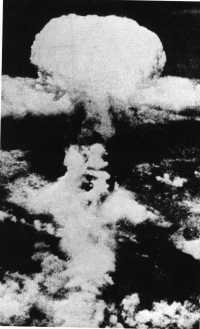
Today, August 6, 2005, is the 60th anniversary of the U.S. atomic bombing of Hiroshima, Japan.


Bernard Brodie, The Absolute Weapon, 1946:
"Thus far the chief purpose of our military establishment has been to win wars. From now on its chief purpose must be to avert them. It can have almost no other useful purpose."
Winston Churchill, quoted in Reader's Digest, December 1954:
"If you go on with this nuclear arms race, all you are going to do is make the rubble bounce."
The single atomic bomb dropped on Hiroshima had a yield of 15 KT (kiloton), which means it had the equivalent destructive power of 15 thousand tons of TNT.

Today, long after the end of the cold war, the U.S. "strategic" nuclear arsenal remains vast:
510 land-based missiles outfitted with 1,150 warheads;

889 submarine-based missiles outfitted with 2,016 warheads;

115 cruise missiles and other aircraft bombs outfitted with 1,050 warheads.
All these strategic systems have ranges of at least 7,360 kilometers and their warheads have yields of at least 100 KT. Every nuclear warhead deployed on land-based missile systems has a yield at least 10 times as big as the Hiroshima bomb (the smallest is a 170 KT warhead on the 200 Minuteman III systems).

Each MX missile carries 10 independently-targetable warheads, each with a yield of 300 KT. Just 10 of these MX missiles could target 100 cities, greeting each with a bomb 20-times as destructive as the Hiroshima bomb. Jimmy Carter declared in his 1979 "State of the Union" address:
For example, just one of our relatively invulnerable Poseidon submarines--comprising less than 2 percent of our total nuclear force of submarines, aircraft, and land-based missiles--carries enough warheads to destroy every large- and medium-sized city in the Soviet Union.
Poseidon was replaced by the "far more capable...in number of missiles carried and destructive capability" Trident sub.

The total U.S. strategic arsenal comprises 1,039 launchers, with 4,216 warheads. These bombs have a total destructive capacity of 1,813 MT. The U.S. also has hundreds of non-strategic weapons.

One caution. By highlighting the destructiveness of the atomic bomb, and the vast size of the U.S. arsenal, I don't mean to blame the bomb for the militarization of American foreign policy. Reflect on the power of the bomb, yes, but do not forget the destructive power of non-nuclear arsenals and war.

The "Jacksonian" strain has long-influenced American foreign policy and the US prosecution of "conventional" war has been plenty deadly.

Walter Russell Mead, The National Interest, Winter 1999/2000:
In the last five months of World War II, American bombing raids claimed the lives of more than 900,000 Japanese civilians—not counting the casualties from the atomic strikes against Hiroshima and Nagasaki. This is more than twice the total number of combat deaths that the United States has suffered in all its foreign wars combined...

Since the Second World War, the United States has continued to employ devastating force against both civilian and military targets. Out of a pre-war population of 9.49 million, an estimated 1 million North Korean civilians are believed to have died as a result of U.S. actions during the 1950-53 conflict.... The United States dropped almost three times as much explosive tonnage in the Vietnam War as was used in the Second World War...

[T]he American war record should make us think. An observer who thinks of American foreign policy only in terms of the commercial realism of the Hamiltonians, the crusading moralism of Wilsonian transcendentalists, and the supple pacifism of the principled but slippery Jeffersonians would be at a loss to account for American ruthlessness at war.
Next time someone advocates the use of U.S. military force to achieve a specific foreign policy objective, without fully considering and debating other policy options, be sure to speak out about the horrifically high costs of war.

And think about Bernard Brodie's admonition about the ultimate risk.

Friday, August 05, 2005

Bush struggling with the war on terror

Last week, I blogged about the G-SAVE: global struggle against violent extremists. Reportedly, the Bush administration decided to toss aside the "war on terror" for this new "catchphrase." Secretary of Defense Donald Rumsfeld has been using some variant of SAVE for over a year, and Joint Chiefs Chair Richard Myers says that the new phrasing recognizes that the threat must be met by diplomatic, economic, and political tools, as well as military power.

Wednesday, August 3, President George W. Bush seemingly canned this new catchphrase:
Make no mistake about it, we are at war. We're at war with an enemy that attacked us on September the 11th, 2001. We're at war against an enemy that, since that day, has continued to kill. They have killed in Madrid and Istanbul and Jakarta and Casablanca and Riyadh and Bali and London and elsewhere.
Bush used the phrase "war on terror" five times in this talk (in Grapevine, Texas). Today, NPR had a nice piece on this topic by Stanford linguist Geoff Nunberg.

Did the President really try to shoot down his underlings? The NY Times reports that the President was unhappy about the new phrasing. Really? The President declared this on August 6, 2004 (link via Atrios):
We actually misnamed the war on terror, it ought to be the struggle against ideological extremists who do not believe in free societies who happen to use terror as a weapon to try to shake the conscience of the free world.
More recently, the White House website has a document called, "Joint Declaration of the United States-Afghanistan Strategic Partnership," which mentions both "the war against international terror and the struggle against violent extremism." August 18, 2004, Bush discussed the "struggle against ideological extremists who have hijacked a great religion and used terror as a weapon."

Actually, if you google the White House website with the exact search term "struggle against," you are rewarded with an interesting idea of the American jihad:
We "struggle against this evil" (actually, "a very long struggle against evil"), a struggle against "these thugs," against "hateful groups that exploit poverty and despair," against "a determined enemy. They're nothing but a bunch of cold-blooded killers," and "suiciders."
I left out the struggles against domestic problems like drugs, breast or prostate cancer, HIV/AIDS, poverty, or substance abuse and the historic struggles against the Soviets, slavery and Nazis.

This is perhaps the President's most complicated image of America's foe -- the "struggle against the violent minority who want to impose a future of darkness across the Middle East."

The Vice President is more blunt. For him, we "struggle against evil." Sometimes, Dick Cheney limits that to a "struggle against the evil of a few."

As early as April 6, 2003, then-National Security Advisor Condoleezza Rice emphasized the "struggle against the proliferation of chemical, biological and nuclear weapons."

Before I get further side-tracked by google, let me return to the main point. I think Bush's advisors recognized that they need the war because to talk otherwise would be to acknowledge what I wrote last week. His critics are correct, the "war on terror" should include greater use of non-military tools of American foreign policy. And as Peter Howard writes, using the old "war on terror" language allows Bush to "claim significant powers and the mantle of a Wartime President....Bush has successfully used the language of War to legitimize much of his policy agenda."

Does all this make you long for the simpler days, when all we had were wars on poverty or drugs? Or maybe the days when the energy crisis was the "moral equivalent of war"? In Jimmy Carter's era, we were "uniting our efforts to build and not destroy."

Maybe that's what General Myers wants to do too? And the President doesn't like it.

Thursday, August 04, 2005

In local news....

1. It's hot as hell here. According to WHAS-11 chief meterologist Ken Schulz, Louisville has had 27 days of 90 degrees or above this summer. Ugh.

2. So, what to do? Maybe...drink up! Perhaps to provide citizens with something to do over the weekend, the City Council of Louisville just voted (15-7) to allow Sunday sales of liquor.
The new law allows package stores as well as drugstores and other retailers to sell liquor or wine from 1 to 9 p.m. on Sundays.
This weekend will feature the first Sunday of liquor sales in this city since before Prohibition!

3. Who will be drinking? I don't know if he's a teetotaler or not, but one person that might be in a celebratory mood is the President of the University of Louisville, James Ramsey. He just got a big raise:
University of Louisville President James Ramsey received a glowing evaluation, a 5 percent raise and a potential bonus of nearly $98,000 yesterday from the board of trustees.

The package would bring Ramsey's compensation to just over $500,000 for the year if he gets the bonus.
One reason I find this interesting: According to the August 1 Daily Crimson, Harvard President Larry "Summers made $522,714 in salary in the fiscal year ended June 30." One member of Harvard's board thought this sum was outrageous, especially given the year Summers just had, and resigned in protest.

If you do the math, it works out that Ramsey's pay this coming year could be about 96% of Summers's annual pay.

That's good work if you can get it.

Wednesday, August 03, 2005

Iran: A decade to defy proliferation norms?

The point of Dafna Linzer's front page story in Tuesday's Washington Post (August 2) is clear from the headline: "Iran Is Judged 10 Years From Nuclear Bomb."
A major U.S. intelligence review has projected that Iran is about a decade away from manufacturing the key ingredient for a nuclear weapon, roughly doubling the previous estimate of five years, according to government sources with firsthand knowledge of the new analysis.
In the next sentence, Linzer calls the National Intelligence Assessment (NIE) "carefully hedged," but reflective of a "consensus among U.S. intelligence agencies."

This NIE, however, is at odds with the political view held by members of the Bush administration.
Until recently, Iran was judged, according to February testimony by Vice Adm. Lowell E. Jacoby, director of the Defense Intelligence Agency, to be within five years of the capability to make a nuclear weapon. Since 1995, U.S. officials have continually estimated Iran to be "within five years" from reaching that same capability....

In January, before the review, Vice President Cheney suggested Iranian nuclear advances were so pressing that Israel may be forced to attack facilities, as it had done 23 years earlier in Iraq.

In an April 2004 speech, John R. Bolton -- then the administration's point man on weapons of mass destruction and now Bush's temporarily appointed U.N. ambassador -- said: "If we permit Iran's deception to go on much longer, it will be too late. Iran will have nuclear weapons."
The Post apparently got at least four (!) sources familiar with the secret NIE to talk about it.

Note, even the 10 year estimate is based on some worst-case assumptions:
The timeline is portrayed as a minimum designed to reflect a program moving full speed ahead without major technical obstacles. It does not take into account that Iran has suspended much of its uranium-enrichment work as part of a tenuous deal with Britain, France and Germany.
Just over two months ago, I reported that many security experts are convinced that the US will attack Iran's nuclear facilities. Maybe this NIE will put any war on hold.

Tuesday, August 02, 2005

Novak: Diligent researcher?

Still wondering about the leak of Valerie Plame's identity?

Right-leaning blogs are currently buzzing about a somewhat interesting NY Times report from today (August 2) by Anne E. Kornblut.
Mr. Novak offered a possible explanation for the disconnect on Monday, suggesting in his column that he could have obtained Ms. Wilson's maiden name from the directory Who's Who in America, which used that name in identifying her as the wife of Joseph C. Wilson IV, a former ambassador.

Mr. Novak did not explicitly cite the directory as his source. Nor was this his first public reference to the Who's Who listing. In a column in October 2003, three months after he had first disclosed Ms. Wilson's name and her role, Mr. Novak cited the published listing as evidence that Ms. Wilson's identity was "no secret."
Read the right's blogs, and the accompanying comments, and you come to the conclusion that "the left" (which includes the media in their world), has made a big deal of nothing.

Valerie Plame's name wasn't a secret. After all, Ambassador Joe Wilson listed it right there in Who's Who.

I don't now how to put this diplomatically, so I'll be blunt: this line of thinking is stupid.

The question about Plame's identity is not about her name per se. It is about the fact that she was a CIA operative. That is the key piece of information revealed in Novak's original July 14, 2003 editorial. That is the reason for the Fitzgerald grand jury and that is the fact that was included in the secret State Department memo I discussed here last week, which may have circulated on Air Force One during the President's trip to Africa.

Obviously, anyone learning that Joe Wilson's wife was a secret agent could search any number of sources for her name. It might be on her marriage license, in her church bulletin, or on her junkmail (as an aside, the FBI started searching Albert Einstein's trash in 1933). Is it really so unusual to find a former Ambassador in Who's Who? I've sent student research assistants to the library to search this volume to help me find information about people. They don't always find the people I'm looking for, but it's a good place to start. After all, it includes listings for 100,000 "high achievers," plus, typically, their spouses and children.

Valerie Plame's status at CIA was NOC (non-official cover), which is the most covert status. To observers, she had a normal job and life that required her to travel and/or work abroad. Frankly, marriage to former diplomat Joe Wilson probably helped -- all the more reason for her to travel abroad. This was her cover story, and Novak blew it.

Someone told him.

Monday, August 01, 2005

Starburst?

On Friday, July 15, Rafael Palmeiro of the Baltimore Orioles was on top of the world. On that evening, he registered his 3000th major league hit. Only 25 other men in history have achieved that feat.

Some sportswriters noted that Palmeiro became an immortal on that night. His place in Cooperstown, NY, at the Baseball Hall of Fame was assured. Of course, serious baseball fans would likely say that his place was already secured. After all, Palmeiro hit his 500th home run in early May, 2003. He was only the 19th player ever to achieve that milestone.

Only a few stars have both 3000 hits and 500 HRs, and two of them are considered "inner circle" HOFers: Hank Aaron, Willie Mays, and Eddie Murray.

Today, Palmeiro broke new ground. He became the first star player to be suspended because of baseball's anti-steroid policy. Blogcritics call him a "cheat and a liar."

Fans remember that Palmeiro, after being named as a steroid user by Jose Canseco in the former teammate's bestselling book Juice, looked members of a congressional committee in the eye and denied ever using steroids. Former star slugger Mark McGwire would not do the same.

Today, he repeated those denials. However, he also acknowledged that he had exhausted his appeals and would serve his 10 game suspension.

You know this is serious because Palmeiro already has his apologists, including a minority owner of his former team, George W. Bush:
"He's a friend," the president said in a White House roundtable interview with several Texas reporters. "He's testified in public, and I believe him."
Bush, recall, mentioned the scourge of steroids in the 2004 State of the Union address.

There are others who think Palmeiro's denials could be truthful, though they base their position on science rather than character. From the AP:
The director of Baltimore's Office of Substance Abuse studies says a baseball player could test positive for steroids without knowingly ingesting the drug.

Anthony Tommasello, who's also an associate professor at the University of Maryland School of Pharmacy, says substances called prohormones are found in over-the-counter protein supplements.

Tommasello says prohormones could be found in sufficient amounts in protein supplements to trigger a positive test for steroid use.
Saddened by this news, I tried to cheer myself up tonight by watching Bernie Mac in "Mr. 3000."

In that film, a retired former player attempts a comeback to the game because a statistician has learned that he has erroneously been credited with 3 extra hits (a suspended game's stats were double counted). Because "Mr. 3000" had been viewed as selfish, baseball writers refused to admit him to the HOF despite his key credential.

I won't spoil the ending, but will say that at the very end of the movie, the 47-year old former athlete is shown advertising Viagra. Coincidentally, Rafael Palmeiro already spent two years as a spokesman for that performance-enhancing drug.

So I'm left where I started. Will Palmeiro's new image problem ruin his all-but-certain HOF case? We'll have to wait 5 years after he retires to find out.