Search This Blog

Showing posts with label shameless self promotion. Show all posts

Monday, August 24, 2026

Updates Fall 2026

The academic term started last week at the University of Louisville and I've returned to teaching after a full-year of sabbatical. This semester I'm offering an Honors seminar on Global Politics Through Film and a graduate (master's level) seminar on International Politics. Sabbatical was wonderful and reinvigorating.

After the departure of a very talented colleague to Boston College, I agreed to co-direct the Center for Asian Democracy through this academic year. I may blog in the coming months about some events CAD will host and Asia-related news. In the near term, I need to recommend edits for the CAD webpage (it is administered centrally by the College of A&S).

To reflect all these changes, I finally edited my "About Me" page on this blog and updated my list of academic publications. Currently, I have several additional potential publications under review at journals, tied to work I completed on sabbatical. All the pieces are about the politics of climate change, which has been my research focus these past few years. 


Visit this blog's homepage.

For 280 character IR and foreign policy talk, follow me on Bluesky.

Saturday, November 22, 2025

Life Updates

This blog has not been the site of much posting for many years -- but this year I have said even less than usual. These days, I am far more likely to post about global politics on BlueSky. I post short film reviews on Letterboxd and Book reviews on Goodreads. Fellow beer drinkers that I know in some way can also connect at Untappd where I have been checking in beers since 2013!

As readers may know, I am in the midst of a full-year sabbatical. I read and reviewed Ronald Kramer's Apocalyptic Crimes: Why Nuclear Weapons Are Illegal and Must Be Abolished. You can find that review here (that's a link to the journal Peace & Change). Soon I expect to post a link to an article that is "in press" on "Evaluating the Resilience of US and Canadian Climate Policy" for American Review of Canadian Studies. I submitted page proof corrections October 30 but the journal has not updated online articles since early October. My contribution was meant to be part of a special issue on Canada-U.S. Environmental Relations and focuses on the Electric Vehicle policies that Joe Biden and Justin Trudeau pursued a few years ago. 

What else?

In October, my wife and I took a short road trip to Indianapolis to see a film at the Heartland International Film Festival which was recently named a top 25 film festival in the world. I imagine we'll find our way back up there again in the future though we only managed to see one movie this year: Hello Out There! We intended to go another evening but the remaining tickets at the venues of interest were less than ideal (front row in small theaters). Next year we'll plan better. HIFF does not really have daytime screenings Monday-Friday. We saw Roofman at a mall while we awaited our film the next night. Coincidentally, both of these films featured actors from the TV series Ted Lasso. 

For unfortunate health reasons, a planned October-November sabbatical visit to the Copernicus Institute of Sustainable Development at Utrecht University in The Netherlands had to be postponed until 2026. I'm looking forward to it and my spouse is gradually recovering from an unexpected procedure. I'll post more about the project in the future. 

Meanwhile, I've been revising a conference paper on climate change politics from the Midwest Political Science conference from 2024 and working with Kurt Mills on version 2.0 of our 2020 article on America First and the Human Rights Regime. 

Now anyone who follows me on BlueSky probably has a better understanding of what I've been focusing on these past few months -- lots of climate change and Trump foreign policy -- and actions that seem to threaten American democratic norms and traditions. 


Visit this blog's homepage.

For 280 character IR and foreign policy talk, follow me on Bluesky.


Thursday, October 22, 2020

Another America First piece

Kurt Mills and I have published another piece about America First and human rights. This is a short "engagement" style article for The Conversation, a widely read academic blog written for a broader readership.

This is the piece published today: "How Donald Trump’s ‘America first’ agenda has damaged global human rights."

Incidentally, because of this online piece and the approaching US presidential election, publisher Taylor and Francis has made the longer Journal of Human Rights article available for free reading (and downloading) through October 31: "America First and the Human Rights Regime."

These articles are both tied to my May-June 2019 Global Scholar gig at University of Dundee at the Institute for Social Science Research.


Visit this blog's homepage.

For 280 character IR and foreign policy talk, follow me on twitter.

Or for basketball, baseball, movies or other stuff, follow this personal twitter account.

Wednesday, September 23, 2020

America First and the Human Rights Regime

Last week, Journal of Human Rights published online my new article coauthored with Kurt Mills, "America First and the Human Rights Regime." This week, it already appeared in print! 

This is the citation:

Kurt Mills & Rodger A. Payne (2020) America First and the human rights regime, Journal of Human Rights, 19:4, 399-424, DOI: 10.1080/14754835.2020.1809362 

And this is the Abstract

Donald Trump’s populist, nationalist “America First” agenda advocates a transactional, zero-sum, hypercompetitive, and sovereigntist view of US foreign policy, which many scholars and policymakers conclude poses a considerable challenge to multilateralism. We explore the threat America First presents to the international human rights regime as reflected in important institutions and norms. We survey America First policies regarding immigration and refugee norms as well as norms prohibiting torture and war crimes. We examine its position on the UN Human Rights Commission and the International Criminal Court, consider Trump’s sympathies for autocratic governments, and explore the development of the Commission on Unalienable Rights. Finally, we explain why the America First norm transgressions pose a novel threat to the human rights regime, potentially more worrisome than prior US norm violations. America First’s performative element risks reconstituting US identity as an outsider state, if not an outlaw, vis-à-vis the international community.

Regular readers may recall that this piece was tied to my Global Scholar appointment at University of Dundee in May-June 2019, when I was on sabbatical. 

If you want to read it and don't have access, let me know. I have a pdf and I have a link for up to 50 readers online. 


Visit this blog's homepage.

For 280 character IR and foreign policy talk, follow me on twitter.

Or for basketball, baseball, movies or other stuff, follow this personal twitter account.

Tuesday, February 11, 2020

Research update


In the last year, I've had several publications appear online and/or in-print.

1. Rodger A. Payne (2020) Canada, the America First agenda, and the western security community, Canadian Foreign Policy Journal, DOI: 10.1080/11926422.2020.1712219. 

If you want access, the journal publisher provided an eprint link I can share with 50 people. Send me a note.

2. Rodger A. Payne (2020) Stigmatization by Ridicule: From Dr. Strangelove to Donald Trump, in Non-Nuclear Peace; Beyond the Nuclear Ban Treaty, ed by Tom Sauer, Jorg Kustermans, and Barbara Segaert (Palgrave Macmillan), pp 87-113. DOI: 10.1007/978-3-030-26688-2_5.

I have a pdf if you are interested. This was tied to the conference I attended in Antwerp, Belgium, in May 2019.

3. Rodger A Payne (2019), Grappling with Dr. Strangelove’s “Wargasm” Fantasy, International Studies Review, , viz018, https://doi.org/10.1093/isr/viz018 

This one is a bit older (online March 2019), but it remains forthcoming in print afaik. Any members of ISA can download this.

4. Rodger A. Payne (2019), “America First” and U.S.–Canadian Relations, in Canada–US Relations
Sovereignty or Shared Institutions? ed. by David Carment and Christopher Sands (Palgrave Macmillan), pp. 61-83. DOI: 10.1007/978-3-030-05036-8_4

This was related to my fall 2018 Fulbright in Canada, but I actually delivered the paper at a workshop at Johns Hopkins SAIS in June 2018.  It's already been downloaded over 200 times, so I presume it was used in some courses over the last year. That's one primary purpose of the Canada Among Nations annual volume. I think I have a pdf of this too.


Visit this blog's homepage.

For 280 character IR and foreign policy talk, follow me on twitter.

Or for basketball, baseball, movies or other stuff, follow this personal twitter account.

Wednesday, June 26, 2019

Dundee Events

I've just returned from my month in the UK, most of it spent in Scotland at University of Dundee. I had 25 nights in Dundee -- 17 initially, then a conference in London (3 nights) and a short personal trip (2 nights in Brighton and 1 in Edinburgh), followed by 8 additional nights in Dundee.

On June 6, just about a week after I delivered my Masterclass on "Re-imagining World Order in the Age of Trump," Kurt Mills hosted a workshop on "America First, International Law, and the Human Rights Regime." I gave a truncated version of my research on America First and Multilateralism:

From June 12-14, I was in London for the British International Studies Association Annual Meeting. I'll write a separate post about my presentation ("An Alliance for Multilateralists: Foolish Fantasy or Practical Necessity?") and my intellectual experiences attending panels and talking to UK IR scholars. Oh, I also plan to post another entry about some of the tourism I managed to enjoy in Scotland and London.

On June 24, I gave a talk on "America First and the Human Rights Regime" at the third annual Institute for Social Sciences Research Forum, held at Discovery Point in Dundee:
The trip was terrific intellectually and Kurt Mills and I are preparing a manuscript for a conference and then submission to a peer-reviewed journal.


Visit this blog's homepage.

For 280 character IR and foreign policy talk, follow me on twitter.

Or for basketball, baseball, movies or other stuff, follow this personal twitter account.

Saturday, March 16, 2019

America First Project Update

Last week, I traveled to Iowa State University in Ames to attend a conference on "Canadian-American Relations in the Era of Nationalism and Populism." I reconnected with many of the colleagues I met at Carleton last fall and had a good time at the meeting. It was interesting and informative.

The conference organizers, Professor Jim McCormick of Iowa State, together with independent scholar Dr. Gerry Schmitz, intend to produce a special issue of Canadian Foreign Policy Journal. Jim held the same Fulbright research chair at Carleton as I did, but during fall 2017. Gerry has his hand in many interesting projects, including an annual international film festival and a film blog. He used to work as a film critic and as Principal Analyst for the Parliamentary Information and Research Service.

A draft of my paper on "Canada, the Multilateral Order, and the America First Agenda" can be found here.  Comments would be welcome as our submission target is mid-May.

I tweeted a picture of the last panel at the end of the conference:
Fellow attendee Frédérick Gagnon from University of Quebec tweeted several pictures as well, including a photo of the opening keynote speaker Colin Robertson:

Soon, I will discuss additional news about my America First project, including a related paper accepted for delivery at the British International Studies Association Annual Meeting in London in mid-June and a new collaboration on "America First, Multilateralism, and the Human Rights Regime."

Visit this blog's homepage.

For 280 character IR and foreign policy talk, follow me on twitter.

Or for basketball, baseball, movies or other stuff, follow this personal twitter account.

Thursday, December 13, 2018

NPSIA Presentation

Today at noon, I gave a talk on "America First, Canada, and the Prospects for Multilateralism." The room seats 18-20 comfortably and my spouse counted 24 people in the NPSIA (Norman Paterson School of International Affairs) Boardroom. I talked for about 40 minutes and then we had roughly 45 minutes of Q&A.

The audience was mostly students and faculty at NPSIA, though a Fulbright Canada program officer, a former principal analyst on international affairs on Parliament Hill, and at least three people from Global Affairs Canada were also in attendance.

The audience members peppered me with good questions that will help with the writing as I move forward on my project. I have a paper due in March when I attend a conference on "Canadian-US Relations" at Iowa State.

Steve Saideman of NPSIA tweeted about the event and snapped a couple of pictures:


This was not actually my research question, but we did discuss this:

The faculty and staff at NPSIA were terrific hosts and I have really enjoyed my time in Ottawa. I'm grateful to Fulbright Canada and to the many patient and accommodating academics at both Carleton and University of Ottawa.

If you are an IR scholar with some level of interest in Canada's relations with the U S, then I recommend you think about applying for this Fulbright opportunity in the future.


Visit this blog's homepage.

For 280 character IR and foreign policy talk, follow me on twitter.

Or for basketball, baseball, movies or other stuff, follow this personal twitter account.

Saturday, November 17, 2018

September events

I've been in Ottawa for months and have barely blogged about my experiences. If you follow me on twitter, then you have a good idea of some of the things I've done.

This post will note a few September highlights.

I arrived in Ottawa on Labour Day weekend and stayed for the first 10 days at a hotel near the airport. Or near this intersection:


On the 14th-15th, I attended Fulbright Orientation at the Lord Elgin hotel just a few minutes walk from my rental house.  This is the view of Ottawa from my hotel room. The building that looks like a castle is a prominent hotel and the multicolored building is an Arts Center.


The group toured various local sights, including Parliament. The bottom photo was taken from the Peace Tower.


On September 27, I attended an event at the Macdonald Laurier Institute for Public Policy (a Canadian think tank) focusing on Russia's Challenge to North American and European Security. The main speaker was Tom Nichols of the Naval War College.


During the month, my spouse and I also took a brief road trip to Hartford, CT, to visit our youngest daughter, who is working in a theater there. I submitted a book chapter that is now in page proofs (more on that soon), and I worked on a revise and resubmit manuscript for a journal.


Visit this blog's homepage.

For 280 character IR and foreign policy talk, follow me on twitter.

Or for basketball, baseball, movies or other stuff, follow this personal twitter account.

Thursday, November 16, 2017

Climate change political update

The new issue of Sustain magazine includes my brief article "Global Politics of Climate Change."  I submitted it in late summer, so it includes some analysis  of the remarkable G20 statement by 19 of the member states that vowed to remain committed to the Paris Climate Accord even though President Trump announced just prior to the G20 meeting that the U.S. would withdraw.

With that link, interested readers can also view other pieces in the "Political Will" themed issue. The issue includes articles by my colleague Melissa Merry (on framing environmental communication), activist-writer Bill McKibben, Environmental Defense Fund's Fred Krupp, and Louisville Mayor Greg Fischer.


Visit this blog's homepage.

For 140 character IR and foreign policy talk, follow me on twitter.

Or for basketball, baseball, movies or other stuff, follow this personal twitter account.

Saturday, February 25, 2017

ISA 2017

Harbor view from Hyatt Regency
I attended the 2017 ISA conference in Baltimore this past week. It's enormous and I have ambivalent feelings about it. There are 75 to 80 panels at a time, with at least 5 people usually on each panel (4 or 5 papers is typical on "regular" panels, plus a chair/discussant). Lots of people complain about under-attended panels, but many show up for roundtables featuring prominent scholars in the discipline.

I managed to see a few old friends from academia and from the "real" world. I visited a brewpub and a craft beer bar, walked around Camden Yards, and took the commuter train to DC in order to do some work tied to my job as department chair. Soon, I'll try to upload a few pictures with this post.

Pictured below left: the Babe Ruth statue outside Camden Yards and the beer menu from The Brewer's Art last Wednesday night.

Saturday morning, I presented a paper on "Trump and American Foreign Policy; A Threat to Peace and Prosperity?" I've uploaded it to my Academia.edu page and my Research Gate page. I'm grateful to Fabrizio Coticchia for his helpful comments. I'm not sure what to do with the paper, but Fabrizio had helpful insights about Silvio Berlusconi that seem directly applicable to Trump and about the literature on political "outsiders" who assume executive power.

If anyone reads the paper and has comments, please send them along. Also, I'm genuinely looking for ideas about what to do with it. At minimum, it has prepared me for teaching about Trump in class.

Note: "The Voice" TV program was conducting auditions just around the corner from my hotel and near the conference. I've included a photo of the line:

The Voice auditions


Visit this blog's homepage.

For 140 character IR and foreign policy talk, follow me on twitter.

Or for basketball, baseball, movies or other stuff, follow this personal twitter account.

Thursday, February 04, 2016

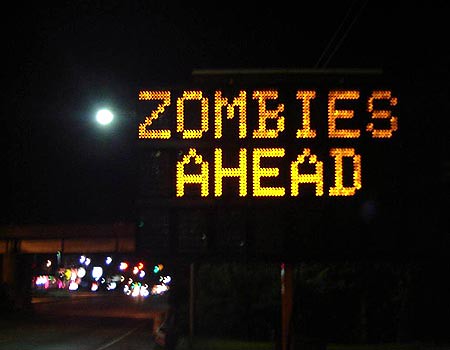
Laughing off a Zombie Apocalypse

Zombies Ahead
Photo credit: *Keith
Ready for some shameless self promotion? A revised version of my 2014 ISA conference paper (which was itself based on a blog post) has now been published as an advanced access 2016 journal article. Here's the full citation, with a working link to the Oxford University press website:


Rodger A. Payne, "Laughing off a Zombie Apocalypse: The Value of Comedic and Satirical Narratives,"  International Studies Perspectives 2016; doi: 10.1093/isp/ekv026. 


Kudos to Dan Drezner for making me think about this.


These are parts of Oxford's permission note:
Sending a free-access URL
There are several advantages to providing you with a free-access link to your article instead of a PDF file, including:
• Access to both the HTML and PDF versions of an article (where available).
• You (and your co-authors) plus any users of your own personal/institutional web sites will get free access to the finally published and authoritative version of the article that is available from our site whether or not they are a subscriber to the journal;
• We guarantee that you (and your co-authors) will have continued access to your article without the responsibility of maintaining and updating these files;
• All the linking and other functionality for the article remains in place;
• We can continue to gather accurate usage statistics for the journal to help us ensure that we continue to provide a good service for authors and readers.
Distribution of the link 
You may wish to include these links in your list of publications. As with an offprint, following these links allows interested readers free access to the full text of your paper whether or not they are a subscriber to the journal. However, in distributing the link, we request that you consider the following points:
• The article should only be viewed from the Oxford Journals site, and not hosted by your own personal/institutional web site or that of other third parties, though you or your co-authors may post the URLs on your own sites or those of your institutions/organizations;
• Single copies of the article can be printed and distributed to interested colleagues who wish to use the article for personal research/study purposes only. For those wishing to make commercial use of the article, please direct them to journals.permissions@oup.com for permissions information or see the website. 


Visit this blog's homepage.

For 140 character IR and foreign policy talk, follow me on twitter.

Or for basketball, baseball, movies or other stuff, follow this personal twitter account.

Friday, July 03, 2015

Scholar Social Networks and Copyright.

Copyright Symbols
Credit: Mike Seyfang on Flickr.
I recently joined ResearchGate, a social network for scholars. Its stated mission "is to connect researchers and make it easy for them to share and access scientific output, knowledge, and expertise. On ResearchGate they find what they need to advance their research." I previously joined Academia.edu, which kind of looks like Facebook for scholars. The link to my home page has been in the right-hand sidebar for some years. Many of my recent conference papers have been uploaded to that site.

Since joining ResearchGate, I've been bombarded with requests to upload copies of my published articles (and books). Unfortunately, as most scholars know, I do not own the copyright to these works. They were typically transferred as a condition of publication when the pieces were originally accepted.

There are exceptions. For example, a coauthored piece on the biological weapons taboo was published in a security journal produced by the U.S. military. Since the publication is produced by the government, no third party holds the copyright. I also published a piece on "The Geopolitics of Global Climate Change" in Sustain Magazine, which is published locally by the Kentucky Institute for the Environment and Sustainable Development. Their back issues are open access. My article begins on p. 9, immediately following a piece by NASA's Jim Hansen.

I've been checking and some of the commercial publishing companies allow me to upload a pdf to my personal or departmental website, so long as I meet several conditions. Cambridge University Press allows this, for instance, though at least one copyright in a Cambridge journal belongs to the American Political Science Association because the article is published in one of their organizational journals.

Unfortunately, I do not have direct control over my departmental webpage.  Thus, I'm planning to upload files to Google Drive and then post direct links here at the blog. This is my primary personal website and I've already had various links in the right-hand column that can ultimately lead you to my work. I'll probably start a page today and add links and necessary information as I check copyrights.


Visit this blog's homepage.

For 140 character IR and foreign policy talk, follow me on twitter.

Or for basketball, baseball, movies or other stuff, follow this personal twitter account.

Wednesday, October 22, 2014

Iraq's New Old Chemical Arsenal

Yesterday, a student asked me about the recent news reports indicating that Iraq did, in fact, have "weapons of mass destruction" back in 2002 and 2003 when the U.S. was attempting to justify a "preemptive" war. The New York Times reported that American soldiers were injured in the past decade by chemically-armed munitions found in Iraq.

Already, a slew of articles in the media have debunked the claim that this vindicates George W. Bush and his Iraq misadventure. This Washington Post piece is perhaps the best since it primarily quotes Bush administration claims from the pre-war period.

The Times piece certainly does not try to claim that Bush is vindicated:
The discoveries of these chemical weapons did not support the government’s invasion rationale. 
After the terrorist attacks of Sept. 11, 2001, Mr. Bush insisted that Mr. Hussein was hiding an active weapons of mass destruction program, in defiance of international will and at the world’s risk. United Nations inspectors said they could not find evidence for these claims. 
Then, during the long occupation, American troops began encountering old chemical munitions in hidden caches and roadside bombs. Typically 155-millimeter artillery shells or 122-millimeter rockets, they were remnants of an arms program Iraq had rushed into production in the 1980s during the Iran-Iraq war. 
All had been manufactured before 1991, participants said. Filthy, rusty or corroded, a large fraction of them could not be readily identified as chemical weapons at all. Some were empty, though many of them still contained potent mustard agent or residual sarin. Most could not have been used as designed, and when they ruptured dispersed the chemical agents over a limited area, according to those who collected the majority of them. 
In case after case, participants said, analysis of these warheads and shells reaffirmed intelligence failures. First, the American government did not find what it had been looking for at the war’s outset, then it failed to prepare its troops and medical corps for the aged weapons it did find.
Read the piece and it offers more reason to believe that these revelations do not help the save the Bush administration's reputation:
Participants in the chemical weapons discoveries said the United States suppressed knowledge of finds for multiple reasons, including that the government bristled at further acknowledgment it had been wrong. “They needed something to say that after Sept. 11 Saddam used chemical rounds,” Mr. Lampier [“a recently retired Army major who was present for the largest chemical weapons discovery of the war”] said. “And all of this was from the pre-1991 era.” 
Others pointed to another embarrassment. In five of six incidents in which troops were wounded by chemical agents, the munitions appeared to have been designed in the United States, manufactured in Europe and filled in chemical agent production lines built in Iraq by Western companies.
A decade ago, when I was blogging regularly about this, the media would occasionally report about old chemical munitions found it Iraq. I posted this passage on May 19, 2004:
What is very clear is that there was no vast infrastructure of WMD programs and no readily deployable arsenal. The nuclear program was dead. No one denies Iraq had chemical weapons in the 1980s and that scientists could again make them. What is the appropriate level of threat justifying preventive war? 
I ended up writing and publishing a number of pieces about that question and the so-called "Bush Doctrine" of "preemptive war." In one of them, I quoted from this exchange involving David Kay, who was the head of the Iraq Survey Group in 2003 (the original team looking for WMD) and then-U.S. Senator Mark Dayton:
DAYTON: Which weapons of mass destruction qualify in that upper echelon of truly mass destruction? 
KAY: Well, I think all of us have and would continue to put the nuclear weapons in a different category. It's a single weapon that can do tremendous damage, as opposed to multiple weapons that can do the same order of damage. As you know, the fire-bombing of Tokyo, in terms of number of people killed, was roughly equivalent to a single bomb in Nagasaki, but it took a lot more aircraft to do it. 
So I still treat, and I think we should politically treat, nuclear as a difference. But I must say, the revolution of biology, some developments in cyber -- I think we're going to have a blurring out there of capabilities. And that makes the control and makes the intelligence problem far more difficult to estimate. 
DAYTON: Just based on your general knowledge, how many countries would you say in the world today would qualify under the category of developing weapons of mass destruction-related program activities or having such activities?
KAY: Senator Dayton, I hesitate to give you an off-the-cuff number because I know it'll probably is going to be like the 85 percent; I'm going to have to live with it for longer than I want to.I would say that in the nuclear area, in addition to those that we know have possessed nuclear weapons, that includes India... 
DAYTON: I want to go to the vernacular that we're using in this broader category. 
KAY: The broader category. Oh, I suspect you're talking about probably 50 countries that have programs that would fall somewhere in that broader vernacular. 
DAYTON: So if we're going to take out those countries or their governments which are engaged in what we would call weapons of mass destruction-related program activities, we're going to be cutting quite a world swathe. 
KAY: Well, Senator Dayton, I think you're on to the issue. We no longer are going to be living in a world in which we can control capabilities. Intentions are what are going to be important.
Kay is correct. The war was primarily justified based on the threat allegedly posed by Iraq's nuclear program. If the bar for preemptive war is lowered to justify attacks against states with potentially menacing chemical or biological capabilities, then states with such preemptive doctrines could launch attacks against thousands of universities or industries in dozens of states.


Visit this blog's homepage.

For 140 character IR and foreign policy talk, follow me on twitter.

Or for basketball, baseball, movies or other stuff, follow this personal twitter account.
Sunday, August 31, 2014

New Sally Ride Book


Sally Ride

Lynn Sherr's book about Sally Ride has now been published, but I have not yet seen it. I have read a couple of reviews, including this one in the July/August The American Prospect.

Sally Ride and I were both fellows at Stanford's Center for International Security and Cooperation beginning in September 1987 and Sherr interviewed me about the experience some time ago. Google Books tells me that my interview figured into a page or two of the book (see chapter 9).

I'm not sure if Sherr recounted my favorite story, but Ride really embarrassed a Reagan administration official visiting CISAC and selling a version of the Strategic Defense Initiative. He was talking about elements of a space-based system that would have required payloads larger than the U.S. boosters had. Ride nailed him with a couple of simple questions.


Visit this blog's homepage.

For 140 character IR and foreign policy talk, follow me on twitter.

Or for basketball, baseball, movies or other stuff, follow this personal twitter account.
Wednesday, January 23, 2013

International Organizations and Power


Though we missed the print deadline for the 12-volume International Studies Encyclopedia (Wiley-Blackwell, 2010), Nayef Samhat and I completed our essay "International Organizations and Power" some time ago. I just learned this week that it was recently published in the online edition of the work sometimes known as the ISA Compendium. The project was completed with the cooperation of the International Studies Association leadership and membership.

Apparently, the Payne and Samhat (2012) piece may also appear in a future hard-copy supplement to the encyclopedia. Meanwhile, I'd like to see an electronic copy of the piece. My institution does not subscribe, the one-year of free access granted to ISA members expired, and Wiley-Blackwell has not yet sent me a copy.

As ISA members know, all ISA publications are now "published" electronically and regular membership does not include hard copies of the journals. Thus, it is possible that this piece will never appear anywhere other than in this online form. I guess I'm comfortable with that, but it would be better if more scholars and students had easy access. The piece might be useful for a class...


Visit this blog's homepage.

For 140 character IR and foreign policy talk, follow me on twitter.

Or for basketball, baseball, movies or other stuff, follow this personal twitter account.

Sunday, December 04, 2011

Baseball Prospectus

A few days ago, the good folks at Baseball Prospectus announced that they are soon releasing a 2-volume Best of Baseball Prospectus: 1996-2011. I think it is going to include a mix of web articles and book pieces, as well as some new essays. It would likely make an excellent Christmas gift.

So far as I know, unfortunately, it will not include my two old pieces written for BP many years ago. One of those articles is still available on-line at the BP website: "Do Top Prospects Get Traded?" It was posted April 8, 1999.

However, the other one is apparently not to be found anywhere. It was a defense of then-KC Royals manager Bob Boone, written in response to a piece by Rany Jazayerli. On the Wayback Machine, I found Rany's critique of Bob Boone posted March 3, 1997: "Is There a 12-Step Program for Overmanagement?"

Rany and I are both KC fans and we co-authored the Royals team comments for the Davenport Translations published exclusively on the web (in the group rec.sports.baseball.analysis) during the 1994-1995 winter. Unfortunately, I cannot find those team comments on the web either -- though I did find them for nearly 20 other teams. And I have the February 1995 files on my hard drive.


Visit this blog's homepage.

Follow me on twitter.

Friday, January 07, 2011

Other writing

Posting here has been slow this past month, but I have written for other blogs.

At Duck of Minerva, I posted on January 5, 2011, a "Last call: 2012 Grawemeyer Award Nominations." In the article, you can find instructions for applying for the prize -- by next Friday.

On December 28, 2010, I posted "Dr. Strangelove's Mineshafts" in reference to the latest U.S. government report on surviving a nuclear blast.

At my e-IR blog on Climate Politics: IR and the Environment, I added a December 18 post called "American Doubt." As the title suggests, I discuss the declining U.S. public knowledge of climate change science.

Finally, in 2011, CQ Press published the 4th edition of Ralph Carter's Contemporary Cases in U.S. Foreign Policy: From Terrorism to Trade. Former student Sean Payne (no relation) and I have a chapter in that volume called, "The Politics of Climate Change: A Consensus for Copenhagen?"


Visit this blog's homepage.

Saturday, December 04, 2010

Critical IR Theory

It has been awhile since I visited their webpage, so I only recently learned that State University of New York (SUNY) Press has posted a pdf of chapter 1 from Democratizing Global Politics (2004), my coauthored book written with Nayef Samhat.

The chapter is "Critical Theory, Habermas, and Internatioanal Relations."


Visit this blog's homepage.

Friday, March 19, 2010

Read these posts...

Today, on the Duck of Minerva group IR blog, I posted "The Latest on U.S. Militarism," concerning the high profile positions attained by many former generals and admirals within the civilian foreign policy bureaucracy.

March 10, I posted "The Hurt Locker, again," which is my interpretation (and review) of the Oscar-winning film.

On March 8, I blogged "Foreign Policy Charade" about the ongoing Israeli occupation of Palestine and the indirect U.S. support of that policy.

February 27, you can find "Biological Weapons," which is a bit of shameless self-promotion concerning my latest coauthored journal article, "The Illogic of the Biological Weapons Taboo." I wrote the piece for Strategic Studies Quarterly with former student (and biochemist) Phil McCauley. It considers whether the Bush Doctrine is still alive and well and ready to take the U.S. to war over bioweapons.

Finally, on March 12, I posted about "Comic book sensibility" at the Climate Change blog I write for e-IR. You know, "one for all and all for one." The phrase was used in an important climate speech by chief U.S. negotiator Todd Stern.


Visit this blog's homepage.