Search This Blog

Saturday, August 13, 2011

From Hollywood: The antigenocide paparazzi

George Clooney in southern SudanPhoto credit: Australian Department of Defence.

Thanks to a busy summer travel schedule, I neglected to mention in mid-July new photographic data about ongoing violence in Sudan, acquired and released by partners affiliated with actor George Clooney's Satellite Sentinel Project.
The Harvard Humanitarian Initiative collects and analyzes images from commercial satellites, feeding them through a web platform designed by Google and the open-source software firm Trellon and comparing them with on-the-ground reports from The Enough Project, a human rights group. The group's work is especially vital in places like South Kordofan, where neither the U.N., outside aid groups nor journalists are allowed....

Yesterday, the group published a report on its latest images. As evidence of mass graves, the Satellite Sentinel Project points to the three freshly excavated areas pictured in the lead image above and to the white objects below, which it suspects are white plastic tarp body bags. A witness tells the organization that he saw 100 bodies or more put into one of the pits.

Based on these images and eyewitness reports, the organization concludes that the Sudanese military and pro-Khartoum militias "have apparently engaged in a campaign of systematic mass killing of civilians in Kadugli."
Obviously, this is potentially vital human rights work conducted by a celebrity-backed non-governmental organization.

SSP16 Fig3: Central Kadugli TownPhoto credit: ENOUGH Project.

Earlier this year, in news reports about the project, the Hollywood icon emphasized the potential deterrent effect of transparency:

"We are the antigenocide paparazzi," Clooney tells TIME. "We want them to enjoy the level of celebrity attention that I usually get. If you know your actions are going to be covered, you tend to behave much differently than when you operate in a vacuum."
If the group's July report is accurate, then Sudanese leaders have obviously not yet been deterred by the eyes in the skies.

However, anyone who has seen "Hotel Rwanda" understands the implicit threat Clooney is directing at human rights abusers. In a scene roughly two-thirds of the way into the film, the Paul Rusesabagina character played by Don Cheadle (involved with Clooney in the Satellite Sentinel Project) attempts to influence corrupt Rwandan General Bizimungu:
GENERAL BIZIMUNGU

Your white friends have abandoned you,
Paul.

PAUL
The United Nations are still here.

GENERAL BIZIMUNGU
(laughs) The United Nations. Madmen are
on the streets, Paul. But I will take
care of you. (chugs his drink) Your
cellar is well-stocked, right?

PAUL
Yes, General. I am glad you came by. I
overheard something that I think you
should know about.

GENERAL BIZIMUNGU
What did you overhear?

PAUL
A discussion between an American Embassy
official and a UN Colonel.

GENERAL BIZIMUNGU
What did they say?

PAUL
The American assured the colonel that
they would watch everything.

GENERAL BIZIMUNGU
Watch everything? How? They are gone.

Paul points surreptitiously to the sky. The General looks up.

PAUL
Satellites.

GENERAL BIZIMUNGU
Satellites?

PAUL
Yes, they can photograph the epaulets on
your shoulder.

GENERAL BIZIMUNGU
And what will they do with these
satellites?

PAUL
The American said intervention is too
costly, better to get photographic
evidence and snatch up the high command.

GENERAL BIZIMUNGU
The high command? Our high command?

PAUL
'Snatch them up and put on a war crimes
trial. Lock them all away forever. No
political risk, and big publicity.'
That's what he said. (a beat) I thought
I'd better tell you.

The General looks again to the sky then.
Given what Duck of Minerva co-blogger Alana Tiemessen has recently noted about the international reaction to events in Syria (likely tied to ongoing intervention in Libya), Clooney's data might not yield any tangible action.

Note: My film class typically views "Hotel Rwanda" near the end of the term.


Visit this blog's homepage.

Follow me on twitter.

Friday, August 12, 2011

Film: "Made in U.S.A."

Made in U.S.A (Jean-Luc Godard)

“We were in a political movie ... Walt Disney with blood.”

I generally do not discuss films unless I enjoy them and intend to recommend them without hesitation. Jean-Luc Godard's "Made in U.S.A." is an exception, worth mentioning in part because it has so rarely been viewed in the US. Godard made the film in 1966, during an incredibly prolific period of his career. Ostensibly, the film pays homage to "The Big Sleep," a Humphrey Bogart-Lauren Bacall detective story based on a book by Raymond Chandler. That earlier film classic is well-known for the sizzling chemistry between Bogart and Bacall, as well as the convoluted plot and ambiguous resolution of the murder mystery.

For his source material, Godard used a book (The Jugger) by Donald Westlake. It is one of Westlake's Parker novels, penned pseudonymously as Richard Stark. Since Westlake did not authorize the use of his book and was not paid for his ideas, he sued successfully to prevent the film from being distributed commercially in the United States. The film premiered briefly at the New York Film Festival n 1967, but was not then shown again stateside until 2009 -- very soon after Westlake died. TCM recently broadcast the movie and I recorded it.

Artistically, the film is interesting, colorful, and quite odd. Westlake's Parker, a ruthless killer and efficient criminal in the book series, is renamed Paula Nelson and played by the beautiful Anna Karina (Godard's soon-to-be ex-wife). As the film's colors and ideas are clearly embedded in the 1960s, this bit of gender-bending is obviously just one element of the broader social and cultural commentary addressed in the film. At one point, Paula says advertizing is fascism. On another occasion, she explains her cartoon-like experiences as if she is in a "film by Walt Disney, but played by Humphrey Bogart--therefore a political film." A dirty cop twice talks in the voice of Tweety Bird and many of the colorful pop images in the film certainly add a cartoonish quality to the film.

As the New York Times explained in April 2009:

...while this film is far from a lost masterpiece, it is nonetheless a bright and jagged piece of the jigsaw puzzle of Mr. Godard’s career.

...There is, for one thing, a pouting and lovely Marianne Faithfull singing an a capella version of “As Tears Go By.” There are skinny young men smoking and arguing. There are the bright Pop colors of modernity juxtaposed with the weathered, handsome ordinariness of Old France, all of it beautifully photographed by Raoul Coutard. There are political speeches delivered via squawk box.

And of course there is a maddening, liberating indifference to conventions of narrative coherence, psychological verisimilitude or emotional accessibility.

As assaultive as “Made in U.S.A” can be, it also seems to have been made in a spirit of insouciance, improvisation and fun.
The Times does not devote much attention to the film's explicit and implicit political agenda. The plot, such as it is, revolves around the disappearance and presumed murder of a young communist writer -- the former lover of the film's protagonist. Various characters in the film compare murder to war and the cold war to hot war. One ticks off a list of past battles, culminating in Hanoi, and suggests that all these wars have been essentially the same. Overtly leftist themes and slogans are woven into the dialogue and some characters seem to see a "vast right-wing conspiracy" almost everywhere.

Some critics interpret a strange bar scene as an example of Hegelian dialectic and the communist slogans emanating from the squawk box might suggest a Marxist dialectic at work. Whatever the preferred method, the title "Made in U.S.A." almost certainly has a double meaning and arguably suggests the need for a double reading.

First, Godard's homage to "The Big Sleep" says that American artists deserve credit and praise for the genre of film noir. And hard-boiled detective fiction as well -- one character, a writer, is named David Goodis. These dark stories cover important themes often ignored in the mainstream. Of course, the mainstream is represented by Disney cartoons and advertizing and Godard speaks fairly explicitly and critically about these elements of pop culture. Even in "The Big Sleep," the murderer's identity is made ambiguous (and other important plot points are changed) because Chandler's original story would not have been compliant with Hollywood morality codes of the time.

The second meaning of the title suggests that then-contemporary cold war conspiracies, whether overt like Vietnam or covert like a real mystery referenced in the film, were literally "made in America." Again, the criticism is not especially subtle. Young thuggish characters named Robert McNamara and Richard Nixon briefly appear towards the conclusion of the main story. One proclaims that he enjoys killing and the other clearly assents.

Keep in mind that McNamara was Secretary of Defense at the time of this film serving under one of the most progressive Democratic administrations of the last century. LBJ's "Great Society" produced important civil rights legislation, Medicare, Medicaid, new environmental laws, anti-poverty efforts, etc. But, of course, Johnson and McNamara also prosecuted and escalated the war in Vietnam.

Nixon was technically just a former Vice President (under Dwight Eisenhower), private citizen and corporate lawyer at the time this film was made. However, Nixon was an active party leader in 1966, meeting with foreign leaders while traveling abroad and campaigning for Republicans in midterm elections. Nixon had been a notable cold war hawk for some time and was a key figure on the House Committee on Un-American Activities. In his first campaign, he defeated a female incumbent by implying she was a "pink lady" harboring "communist sympathies."

In the ending shot, Paula tellingly opines that "The Right and the Left are the same. We have years of struggle ahead, mostly within ourselves.”

This film remains important because the struggle against pervasive commercialism is far from over and the cold war's end failed to kill the national security state.


Visit this blog's homepage.

Thursday, August 11, 2011

Syria, R2P, & the Obama Doctrine

Syrian protesters in front of the Syrian embassy in Cairo
Photo credit: Maggie Osama at the Syrian embassy in Cairo.

Given the brutal crackdown against anti-regime demonstrators in Syria, many analysts concerned about human rights are calling for external intervention. If the world had the responsibility to protect innocents in Libya, they argue, then the same logic applies for Syria. Thousands have already died as people stand up to their government.

However, as many other analysts have noted, nation-states view R2P (as it is known) as an ideal that must be considered on a case-by-case basis -- in the context of the just war doctrine and in conjunction with the views of relevant regional organizations.

Yes, such selectivity potentially weakens the norm's deterrent power, but it is more pragmatic and reflective of international politics as it is actually practiced. One major problem limiting new application of R2P is a lingering suspicion that this framing is used by western powers to justify broader intervention -- for regime change in Libya, for example.

As I have argued previously, US policy (doctrine?) during Barack Obama's presidency arguably reflects something like pragmatic cosmopolitanism. The US will apply its resources to avoid catastrophe when the benefits outweigh costs and the action has multilateral support.

Even if the UN Security Council, which can obviously act only with at least tacit support of the US, could cobble together the material resources to move more forcefully against the Syrian regime, it is not clear that such action would meet these standards for intervention. The US would want to see support from Russia, Turkey, India and perhaps China. And all these nations would need to be convinced that more coercive action would be narrowly targeted and likely to succeed.


Visit this blog's homepage.

Saturday, July 30, 2011

Nuclear savings

As the August 2 debt ceiling deadline approaches, members of Congress have floated all sorts of ideas to cut future spending because (tea party-backed) House Republicans say they won't vote for an increase without the cuts. Thanks to Grover Norquist, new tax revenues are deemed unacceptable because nearly every Republican in Congress has pledged not to increase taxes. They even oppose ending the Bush tax cuts on the wealthy even though Norquist himself apparently said that expiration of the Bush tax cuts (responsible for a significant share of the recent deficit growth) would not amount to a tax increase.

Republicans demand "entitlement reform," which is often their code phrase for long-sought policy changes they favor for ideological reasons -- including privatization and thus a huge reduction in guaranteed benefits paid by government. Democrats do not want that sort of "reform" and are not eager to slash the social safety net any further.

In the past few days, Democrats in the Senate have been working on a package of spending cuts that is actually larger than the $900 Billion in discretionary spending cuts offered in the latest plan pushed by the Speaker of the House, John Boehner. This is because Senator Harry Reid's plan pockets $1.3 Trillion in anticipated security-sector savings from the troop reductions in Afghanistan and Iraq. That is over a decade and includes future debt service related to the spending.

Earlier this week, I read a book review by Joseph Cirincione that outlined a potential additional source of $300 billion in savings. A nuclear freeze, which would only be a baby step toward President Obama's call for "global zero," would create these big savings:
Pentagon programs...will spend $300 billion over the next decade on the very [nuclear] weapons Obama says he wants to make less relevant.
I've often blogged about the need to include defense cuts in any deficit-reduction package. In addition to the concrete savings from de-escalation in Iraq and Afghanistan, why not pocket some money by stopping the development of new nuclear weapons?


Visit this blog's homepage.

Thursday, July 28, 2011

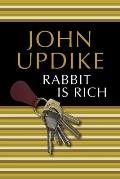
Summer Read: Rabbit is Rich

Rabbit is Rich is the third book in John Updike's series about Harry "Rabbit" Angstrom. There's plenty of angst to go around in this Pulitzer-prize winning novel set in 1979.

Rabbit, now in his mid-40s, oversees the car dealership formerly owned by his now-deceased father-in-law, Fred Springer. Gas prices are soaring in the wake of the Iranian revolution, the embassy hostage crisis, and the Soviet intervention in Afghanistan. His son Nelson has dropped out of college (Kent State!) and impregnated a secretary at the university. Both are now living with Rabbit, his wife Janice, and her mother. To top it off, Harry is convinced that his dalliance with Ruth Leonard 20 years ago produced a daughter, who visits the car lot early in the book. At the country club, Rabbit develops a strong lust for Cindy Murkett, the young trophy wife of his golfing buddy Webb.

This a terrific novel, though I recommend reading the prior two books first.

I suppose this work was particularly compelling for me because of the temporal setting and Rabbit's age. Updike includes lots of references to real events from 1979, which included the end of my senior year in high school and the start of my freshman year in college. I remember most of the events quite well and like Rabbit often thought of the implications. We both spent a lot of time thinking about energy policy, for example, though Rabbit does not dwell much on Three Mile Island. He is much more concerned about gasoline prices. Rabbit knows he is incredibly fortunate to be peddling Toyota products -- and not, say, Chrysler autos.

I'm a few years older now than Rabbit is in this novel, but I too will have a child in college in Ohio this fall. Rabbit has been married 22 years; my spouse and I just celebrated our 20th anniversary. He's in a management position at the car lot -- he's rich enough to speculate in gold and silver -- and I'll be Department chair beginning in January, after my fall sabbatical. The other important elements in Rabbit's life are not especially well paralleled in my own, but many people in their late 40s begin to think about some of the big issues Harry ponders in this novel. He thinks periodically about how his past has shaped his present world, worries somewhat about his future, and considers the meaning of various relationships in his life. Are he and the people around him stuck in a rut? Can they change? Does he want anything to change?


Visit this blog's homepage.

Wednesday, July 27, 2011

YERT

Thursday night, I'm attending the Louisville premier of "YERT: Your Environmental Road Trip." Here's a short description from the webpage:
YERT (Your Environmental Road Trip): 50 States. 1 Year. Zero Garbage? Called to action by a planet in peril, three friends hit the road - traveling with hope, humor, and all of their garbage - to explore every state in America (the good, the bad...and the weird) in search of the extraordinary innovators and citizens who are tackling humanity's greatest environmental crises. As the YERT team layers outlandish eco-challenges onto their year-long quest, an unexpected turn of events pushes them to the brink in this award-winning docu-comedy. Featuring Bill McKibben, Wes Jackson, Will Allen, Janine Benyus, Joel Salatin, David Orr, and others.
IMDB information here.

Here's the trailer:


Some tickets remain for the 9:15 showtime. It's free, but they are asking for donations to support the project. The film is showing at the Louisville Science Center,
727 West Main Street.


Visit this blog's homepage.

Wednesday, July 20, 2011

Finding truth in the debt ceiling debate

Sorry for the recent silence. I went to a wedding in Boston and then spent a little more than a week at Fenwick Island, Deleware. I attended a minor league baseball game (Delmarva Shorebirds vs. Asheville Tourists), consumed a great deal of seafood and my fair share of Dogfish 60 IPA, and swam virtually every day. It was fun and relaxing.

Today, I spent some time at the Duck of Minerva blog catching up on national politics. Josh Busby, who is very interested in climate change (and thus mentioned it in passing), wrote a very good post on the debt ceiling debate.

One commenter (Ht) reacted in a highly partisan way -- dismissing climate change science as fraudulent, calling Democrats Marxists, labeling the Obama administration as socialist, etc.

I felt compelled to reply:
This comment illustrates a frequent problem with public debate in the US. People throw around terms like "socialism," "Marxist," and "crony capitalism" (disclosure: I've used that one) without always grounding them in facts.

Dan pointed out that even the DoD accepts climate science. Almost every "real" scientist does -- certainly major national science organizations, atmospheric scientists, other specialists, etc. Still, there's some room for doubt about specifics given modeling, projections, assumptions, etc.

There's very little doubt, however, about other factual inaccuracies in this comment. Obama most certainly did not triple spending.


Tax rates are much, much lower than they have been, historically. Indeed, the Obama era not only saw the extension of the Bush tax cuts, additional tax cuts targeted at lower and middle income people were passed (payroll taxes, for instance). Tax rates were higher under almost any "ideal" past (at least since FDR). They were higher under Ike, JFK, Nixon, Reagan, etc.

Likewise, as a portion of GDP, federal spending is *not* at historic highs. There was a blip peak for TARP (passed under Bush), but the overwhelming majority of that was repaid. Also, federal spending was still relatively low compared to Depression-era initiatives. Indeed, the stimulus only temporarily increased spending and it was pretty tame for the remarkable economic crisis of 2008. Also, it included one-third tax cuts. The spending surge was temporary and mostly ended by now.

The "Marxist" regimes the US opposed during the cold war had economic and political systems not at all like the US systems. The somewhat more socialist *western* European states have historically taxed and spent at much higher levels than the US has done. And I would note that they have superior social welfare systems -- without really posing any threat to political liberty.

Now crony capitalism, particularly in the defense sector, there's a problem...
I added some relevant links, obviously, and fixed a minor error.

Visit this blog's homepage.

Saturday, July 02, 2011

On Wikileaks and Lies

Julian Assange, WikiLeaks, at New Media Days 09

Over the past six or eight months, I've put aside a number of interesting newspaper and magazine articles about WikiLeaks and I'm writing this post in order to pull together a number of quotes and examples from those pieces just in case I need them for teaching or research purposes.

Let's begin with some analysis from former British diplomat Carne Ross in The New Statesman, December 6, 2010. He claims that WikiLeaks has changed world politics forever:
what we have witnessed is something very dramatic in the world of diplomacy - and thus in the way that the world runs its business. We may now date the history of world politics as pre- or post-WikiLeaks....The presumption that governments can conduct their business with one another in secret, away from the prying eyes of the public, died when the leaks started to emerge on 28 November. Diplomats and officials around the world are now realising that anything they say may hit the public sphere - ie, the internet....From now on, it will be ever more difficult for governments to claim one thing and do ­another.
Indeed, as readers of John Mearsheimer's book Why Leaders Lie found out, governments have historically been far more likely to lie to their own people than to other states. It was easier to get away with it.

Micah Sifry asserted in The Nation, March 21, 2011, that domestic lies about foreign policy are pervasive:
Unfortunately there is a large gap between what American officials have told the public about their actions and what they have actually done.
Some of my old blogging about the Iraq war certainly suggested a fair measure of lying.

For a more recent example of an important lie told by the US, in December 2010 journalist Jeremy Scahill found one in WikiLeaks:
Ambassador Richard Holbrooke lied to the world when he said bluntly in July 2010: "People think that the US has troops in Pakistan, well, we don't."

A US special operations veteran who worked on Pakistan issues in 2009 reviewed the Wikileaks cables for The Nation. He said he was taken aback that the cable was not classified higher than "SECRET" given that it confirms the active involvement of US soldiers from the highly-secretive, elite Joint Special Operations Command engaging in combat—not just training—in Pakistan. And offensive combat at that. JSOC operations are compartmentalized and highly classified.
Former Marine company commander Matthew Hoh told an interviewer in October 2010 that US personnel on the ground in Afghanistan and Iraq have almost pathologically misled American visitors:
For the bigger picture, reporters are briefed at headquarters by people like me, civilian or military, who do dog and pony shows...PowerPoint presentations and windshield tours to areas of progress. We also show them to Congressional delegations, administration or military staff, academics, development firms and think tanks. There are multiple varieties of briefings and tours, which are updated and tailored depending on the visitor. But the briefings are almost always rosy: acknowledging some difficulties, but predicting success....If you [visitors] do speak with Afghans, they’re on our side or payroll, and tell stories we want to hear. It is extremely rare for a visitor to ever speak to Afghans with a different point of view.

If delegations go out, we take them to what you can call Potemkin villages. These are the places we want people to see, like a school or road we built. Meanwhile, what’s happening a kilometer away is totally different. The Soviets did this. We did this in Iraq and probably in Vietnam.

...The presentations are really for Washington consumption...Congress. You’re not going to tell the ones who fund the war that things aren’t going well.
The US, of course, isn't the only country that lies to its own people. This particular lie, also reported by Scahill last December, may have helped spark internal revolt in Yemen:
"We'll continue saying the bombs are ours, not yours," President Saleh told Petraeus during a meeting in early January 2010, according to one cable. Yemen's Deputy Prime Minister Rashad al-Alimi then boasted that he had just "lied" by telling Parliament "that the bombs...were American-made but deployed by" Yemen. According to US Special Operations sources, US teams also conduct targeted killing operations and raids inside Yemen.
Yemeni officials likely regret that decision

However, as former Secretary of Defense Robert Gates admitted in October 2010, WikeLeaks apparently hasn't hurt US security very much:
"...the review to date has not revealed any sensitive intelligence sources and methods compromised by the disclosure."
Obviously, this story is to be continued.


Visit this blog's homepage.

Wednesday, June 29, 2011

Climate blog updates

Opening Plenary (22) Today, at Climate Politics: IR and the Environment, please find my article "Scaling down climate action." The post examines the new conventional wisdom "that smaller groups than the UNFCCC are needed for serious climate" action. I discuss actions of the World Bank, the C40 collection of world mega-cities (currently chaired by NYC Mayor Michael Bloomberg), the Clinton Climate Initiative, and a group of 16 former Republican public officials, including 4 former EPA Administrators.

On May 6, I posted "Protestant Doubt about Climate Change." As the title suggests, the post discusses some survey research linking a pastor's religious affiliation to climate skepticism. Perhaps more importantly, the survey shows a relationship between pastor party identification and climate skepticism. Republican pastors do not "believe" the science.


Visit this blog's homepage.

Friday, June 24, 2011

Carlos

119

I've now watched the first two parts of "Carlos," a three-part French-produced television miniseries that was broadcast on Sundance this past month. Édgar Ramírez is terrific in the title (star-making) role, though his character is hardly sympathetic. The notorious terrorist is portrayed as an unusual killer -- part playboy, part-diplomat, and part-frustrated middle-manager. Carlos is shown meeting with prominent international leaders and is called a celebrity by his fellow terrorists after the 1975 kidnappings at the Vienna OPEC convention. That event takes up a good portion of part 2.

Part 1 of the film opens with a statement warning that it is a fictionalized account and that only certain specific crimes were factually confirmed at trial. Thus, I was not sure of what to make of an alleged meeting in Baghdad involving Yuri Andropov (then-head of the KGB), Carlos and other desperadoes (one actor looked like Tariq Aziz). Allegedly, Andropov put a price on Anwar Sadat's head at this meeting.

Indeed, one important element of "Carlos" is the relatively clear state sponsorship the terrorist and his various organizations enjoy throughout most of his career. Support from Libya, Syria, Iraq, Algeria, East Germany and the Soviet Union all figure into the terror incidents portrayed on screen. It is no wonder that the Bush administration, circa 2001, believed that state sponsorship was the key element of its anti-terror campaign (despite facts suggesting a completely different kind of threat). This was not a matter of IR theory privileging states.

As a movie, the Golden-Globe winning production is quite unusual:
The film’s scope, range and ambition are incredible; it’s set in at least 16 countries over a 21-year period, and at all times features the characters speaking the languages they would have spoken in the relevant situations—Carlos himself shifts effortlessly among Spanish, English, French, German, Russian and Arabic. An untold number of supporting and bit players pop vividly to life for however many moments they’re onscreen, and the film maintains an exceptional balance between a relentless forward movement and a certain artistic stability...

...the film is so convincing that it persuades you this is essentially the way it was. There are few so completely transporting historical movies, in that it drops the viewer down in another world and time without evident artifice, doctoring, nostalgia, revisionist thinking or overt political agenda. Those with a continuing stake in the causes involved or their own memories of the times can be counted upon to dispute this or that, but as a time machine “Carlos” functions brilliantly.
I can't wait to watch part 3 -- the decline and fall of Carlos, apparently.


Visit this blog's homepage.

Sunday, June 12, 2011

Palin vs. Perry

Rick Perry(R) and Sarah Palin(L),Sarah Palin accepting a plaque from Rick Perry making her an honorary Texan.

There are already a number of Republican candidates for President, but it is difficult to take most of them very seriously. For example, Newt Gingrich's staff quit en masse this past week, basically because of his comment that Paul Ryan's Medicare plan amounted to "right wing social engineering." Then, Steven Colbert destroyed Herman Cain's idea that Congress should only pass bills limited to 3 pages in length.

Many Republicans are likely hoping that more promising candidates will declare their intentions to pursue the presidency, such as former Alaska Governor Sarah Palin or Texas Governor Rick Perry.

This weekend, I read two interesting pieces about these politicians and came away somewhat surprised about their relative strengths and weaknesses.

Joshua Green has a fairly sympathetic story about Sarah Palin in the June 2011 Atlantic Monthly. As Green notes, Palin genuinely did face down special interests during her truncated term as Alaska governor. Specifically, she confronted oil companies by proposing and getting both a new gas pipeline ("bid out" without oil company cooperation under the Alaska Gasline Inducement Act) and a new oil resource tax -- dubbed Alaska’s Clear and Equitable Share (ACES). The latter has meant billions of dollars for the Alaskan Treasury, though Sean Parnell, the Republican Governor that followed Palin, is working to gut it. Palin seemed to support the oil tax because of a populist urge -- the oil belonged to Alaskans, but they were not getting their fair share.

Green points out that Republican legislators in Alaska were opposed to Palin's ACES plan, so she had to turn to Democrats to get a bill passed. And thanks to that effort, the resulting law was more progressive than the one she originally proposed (and Republicans already opposed). It generates more revenues because of a higher base rate and accelerates that rate more quickly when oil prices surge.

That actually sounds like the achievement of a bipartisan maverick.

By contrast, Bob Moser has a devastating story about Perry in the May 30, 2011, issue of The Nation. While Texas has significant oil resources, Texas under Perry's leadership has taken the standard Republican line these days -- business deregulation, tax cuts for the wealthy (and for business), and a conservative social agenda. This has meant huge deficits followed by gutting public services -- $23 billion cut in this case, which is about a quarter of the state's spending.

Worse, in comparison to Palin, Perry's "tax swap" reform plan led directly to $5 billion in structural deficits. Moser even quotes some Republicans in Texas who think the state has gone too far. Critics have not been kind at all, referencing some very disturbing data:
It makes little sense that for all of Texas’ abundant wealth and corporate bling, the state would rank thirty-eighth in per student spending, forty-fifth in SAT scores, third in teen pregnancies and dead last in the percentage of adults with high school diplomas. “Texas is setting a new standard by setting new lows,” says East Texas blogger Susan DuQuesnay Bankston....

“If you wanted to destroy an enemy,” says former Lieutenant Governor Bill Hobby, a Democrat, “you would do exactly what the Republicans are doing to the State of Texas.”
Moser points to a Business Insider piece by Joe Wiesenthal and Gus Lubin that refers to Texas as "America's Ireland." It originally looked like neoliberal economics was going to create an impressive economic leader, but then the state's wealth collapsed.

One shouldn't read too much into this comparison of Palin and Perry. It is certainly possible that a President Perry could govern as a "uniter, not a divider." Moreover, Green's piece is called "The Tragedy of Sarah Palin" because the Fox News talking head has basically rejected all that she achieved in Alaska in order to build on the image she developed in the 2008 campaign -- as a hard-right Republican ideologue. She may occasionally refer to herself as a maverick, but she does not trump her record raising taxes or working with Democrats. Also, many other observers have noted her problems with the truth.


Visit this blog's homepage.

Friday, June 10, 2011

The Godfather Doctrine

I sometimes teach "Global Politics Thru Film" and was hopeful that The Godfather Doctrine: A Foreign Policy Parable (Princeton University Press, 2009) by John C. Hulsman and A. Wess Mitchell might make a useful companion to that class. After all, The Godfather is a terrific film and my class already considers (and reads about) mafia "protection rackets" as a metaphor for basic state practices.

However, as the title suggests, this little book is very much an exercise in the application of some basic plot elements of The Godfather films to American foreign policy rather than IR theory. One of the three foreign policy "schools" discussed in the very short book is neoconservatism, which is not ordinarily viewed as an international relations theory per se. It has been influential on policy, of course.

Moreover, the authors' view of liberal institutionalism is very narrow, stressing the potential ability of negotiations and carrots to achieve American goals. It does not really address the potential of international institutions to solve global problems jointly or to achieve broader cosmopolitan ends. Cooperative institutions can be an important means for assuring legitimacy in global politics.

In the conclusion, the authors embrace a view of realism that does not much match standard academic conceptions of the theory. They describe the "carrot of capitalism" (p. 79) as a realist incentive for managing rising powers. Likewise, Hulsman and Mitchell refer to "the stick of commonly dealing with an al-Qaeda that rejects all states as well as the current system" as a "good place to start to look for broader agreements" (pp. 79-80). Those arguments may well have merit, but most IR theorists would likely regard them as neoliberal, not realist.


Visit this blog's homepage.

Wednesday, June 08, 2011

Afghanistan

U.S. Defense Secretary Robert Gates visits ISAF Joint Command Weary of war in Afghanistan? If so, you are not alone. Osama bin Laden has been dead for five weeks, but the US soldiers attempting to link that fact to America's ongoing presence in Afghanistan found no sympathy when they recently questioned visiting Defense Secretary Bob Gates. As reported in the LA Times June 7:
Over and over again, soldiers and Marines on the punishing front lines across Afghanistan had the same question for Defense Secretary Robert M. Gates: Does Osama bin Laden's death mean the U.S. can finally wind down a nearly decade-long war?

Not yet, Gates replied.
Why not?

For years, the Bush administration's "theory of the case" about terrorism, so to speak, was that terrorists were a big problem if they had state sponsors -- especially if those sponsors could provide them with weapons of mass destruction. Afghanistan had been a safe haven for terrorism, OBL was experimenting with some chemicals and talking to nuclear scientists, so the US had to be in Afghanistan. And, of course, this was the primary justification for the Iraq war.

Does anyone really still believe the US is in Afghanistan because of those original fears? Last August, Steven Metz of the Army War College explained very succinctly the flawed assumptions of US strategy in Afghanistan.

And for many years, analysts like Peter Bergen have pointed out the obvious -- terrorists don't really need a state sponsor:
consider the most spectacular acts of terrorism of the past decade: the first Trade Center attack ha 1993; the satin gas attack in the Tokyo subway in 1995; the destruction of the federal building in Oklahoma City in 1996; the two simultaneous bombings on U.S. embassies in Africa in 1998; the USS Cole attack in 2000; 9/11 itself; the 2002 assault in Bail that killed 202; and the commuter train bombings ha Madrid this year that killed 191. All were carried out by groups or individuals that did not have state sponsorship.
I expect more and more security analysts to call for prompt US withdrawal from Afghanistan. Bob Gates is leaving -- why listen to him?


Visit this blog's homepage.

Monday, June 06, 2011

Republicans and taxes

Yesterday, The Washington Post had a terrific article by Lori Montgomery about the Republican Party's anti-"tax orthodoxy." Virtually all Republicans in both the House and Senate have signed Grover Norquist's "no new taxes" pledge, an idea he apparently came up with when he was 14 years old.

The article points out that after decades of cutting taxes, debt has soared and revenues have cratered during recent economic hardship. Norquist would disagree, but there's not much fat to cut in the federal budget either -- unless politicians want to go after defense spending, middle class subsidies (mortgage interest deduction) or big government subsidies (in energy, agriculture, mining, etc.). Those benefits are favored by many of their donors and voters -- as are tax cuts on the affluent.

Alan Greenspan

Nonetheless, the article includes several quotes from Republicans calling for tax increases, including former Fed chair Alan Greenspan:
Former Federal Reserve chairman Alan Greenspan joined the chorus Friday, dropping his support for the 2001 George W. Bush tax cuts. Greenspan told CNBC he’s so “scared” by the debt that he now favors a return to the higher rates of the Clinton administration.
Greenspan was part of Ayn Rand's posse, though I doubt that will influence Rand Paul's thinking much.


Visit this blog's homepage.

Saturday, June 04, 2011

Run scoring: NL edition 2011

Yesterday, the graphic I posted to highlight the decline in run scoring in 2011 major league baseball was based only on American League data. This is the chart from the National League -- and the results are very similar:


Run scoring in the 2011 NL is about the same as the league's run scoring in 1990. NL offense never reached the same heights as it did in the AL, but runs per game are down almost a full run from 1999-2000. This is the lowest scoring NL season since 1992.


Visit this blog's homepage.

Friday, June 03, 2011

Baseball 2011: Runs are Scarce

The baseball season is roughly one-third completed and a number of observers are calling this "the year of the pitcher." Of course, many analysts used the same phrase last season primarily because an unusually large number of pitchers threw no-hitters in 2010.

This year, the phrase is being tossed around because teams are scoring many fewer runs. Indeed, baseball 2011 looks a lot like baseball 1988-1992. Look at the runs scored per game in this chart, which I created at the invaluable baseball-reference.com.

Long-time fans might remember that 1987 was an unusual summer -- rookie Mark McGwire hit 49 homers (he was on my very first fantasy baseball team that year), Andre Dawson of the Cubs also hit 49, and Toronto's George Bell hit 47. More importantly, a lot of guys unexpectedly hit for power -- the kind of power fans started to take for granted from the mid-1990s through the next decade. My first fantasy team featured Milwaukee's Dale Sveum at SS. He hit 25 homers in 1987 -- after hitting 7 in 1986. He would hit 9 in 1988. In a dozen major league seasons, he hit over one-third of his home runs in 1987.

These unusual homer numbers from 1987 signaled a new era for power, though that era (primed by performance enhancing drugs) didn't really arrive for a few seasons. And the influence of PEDs was hard to pinpoint given that most major league teams built new stadiums, announcers provided a lot of talk about rabbit baseballs (and corked bats), and the summers were very hot (which is conducive to home run hitting). Whatever the cause, between 1994 and 2000, teams often scored a full run more per game than they are now. That may seem small, but the difference is 160 runs over a full season.

Baseball implemented its first PED testing regime in 2001, for minor leaguers only. The major league program began in 2003 and was toughened in 2005. Presumably, the stigma associated with links to steroids has had a deterrent effect on some potential users.

I'm beginning to wonder if the latest data truly signal the end of the PED era? While there are a couple of individuals who are raising some eyebrows, the scoring numbers reveal that major league baseball is changing at a steady pace -- reverting to a game fans have seen not-so-long ago.


Visit this blog's homepage.