Search This Blog

Showing posts with label zombies. Show all posts

Thursday, April 04, 2019

Google Trends: Zombie Edition

I'm giving a couple of talks next week at Wofford College. One of them will be about my 2017 article "Laughing off a Zombie Apocalypse: The Value of Comedic and Satirical Narratives." Preparing for the talk, I became curious as to the continued popularity of zombies. Scholars who study popular culture have to be on the alert for changes that might leave them studying an unpopular phenomenon.

I know "The Walking Dead" (which started in 2010) is still on television, though I have not watched it in several years. Likewise, AMC has a spinoff series called "Fear the Walking Dead" and other zombie-themed shows are still on TV: "iZombie" (I have viewed season 1 and part of 2) and "Santa Clarita Diet." Today, I discovered that the long-promised sequel to "Zombieland" is set for release this October.

This would seem to indicate that the undead are not yet dead in popular culture.

For less anecdotal evidence, I turned to Google Trends. In case you are not familar with that phrase, it is a Google application that measures "Interest over time" in particular search terms. Consider this chart of searches for "zombie" since April 4, 2007 (12 years ago today):


Google says that "Numbers represent search interest relative to the highest point on the chart for the given region and time. A value of 100 is the peak popularity for the term. A value of 50 means that the term is half as popular. A score of 0 means there was not enough data for this term."

This means that the peak time for popular interest in zombies was June 2012. There's been a steady decline, which seems worrisome.

For relative interest, I added the search term "Barack Obama"and the results were somewhat startling.


So, basically, people have for many years searched more frequently for information about zombies than they have for the President of the US through eight of those twelve years. Obama's rise to fame early in this period is the only real exception. Did people in the US take him for granted?

I added the search terms "Tom Brady" and "Beyoncé" to get a feel for relative differences with a prominent athlete and pop singer. The results are perhaps not surprising, at least to me:


Beyoncé is generally the most popular through this time, but Tom Brady and zombie occasionally emerge. Again, Obama was very popular when he burst on the presidential politics scene.

Then, I wondered how would this chart look if I added "Donald Trump"?


Trump's peak when he emerged as a presidential candidate set incredible new heights of popular attention. And since that date, Trump has maintained his lead over the other terms by a decent margin.

I played around with assorted celebrities, products, and ideas and discovered that Trump's peak isn't necessarily so impressive when considered against various non-political terms. For example, consider amazon, sex, and iPhone:


Through much of the period, zombie and Trump are neck-and-neck. Neither of those search terms are ever as popular as amazon, sex, or iPhone through this twelve year period.  It's not close.

Not all of that is good news.


Visit this blog's homepage.

For 280 character IR and foreign policy talk, follow me on twitter.

Or for basketball, baseball, movies or other stuff, follow this personal twitter account.

Thursday, February 04, 2016

Laughing off a Zombie Apocalypse

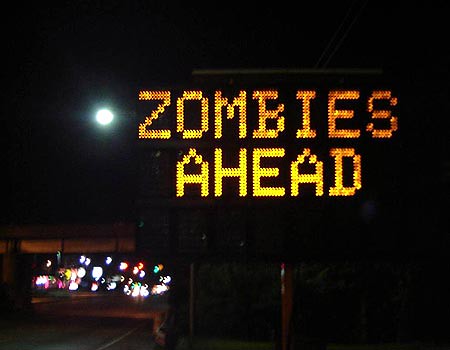
Zombies Ahead
Photo credit: *Keith
Ready for some shameless self promotion? A revised version of my 2014 ISA conference paper (which was itself based on a blog post) has now been published as an advanced access 2016 journal article. Here's the full citation, with a working link to the Oxford University press website:


Rodger A. Payne, "Laughing off a Zombie Apocalypse: The Value of Comedic and Satirical Narratives,"  International Studies Perspectives 2016; doi: 10.1093/isp/ekv026. 


Kudos to Dan Drezner for making me think about this.


These are parts of Oxford's permission note:
Sending a free-access URL
There are several advantages to providing you with a free-access link to your article instead of a PDF file, including:
• Access to both the HTML and PDF versions of an article (where available).
• You (and your co-authors) plus any users of your own personal/institutional web sites will get free access to the finally published and authoritative version of the article that is available from our site whether or not they are a subscriber to the journal;
• We guarantee that you (and your co-authors) will have continued access to your article without the responsibility of maintaining and updating these files;
• All the linking and other functionality for the article remains in place;
• We can continue to gather accurate usage statistics for the journal to help us ensure that we continue to provide a good service for authors and readers.
Distribution of the link 
You may wish to include these links in your list of publications. As with an offprint, following these links allows interested readers free access to the full text of your paper whether or not they are a subscriber to the journal. However, in distributing the link, we request that you consider the following points:
• The article should only be viewed from the Oxford Journals site, and not hosted by your own personal/institutional web site or that of other third parties, though you or your co-authors may post the URLs on your own sites or those of your institutions/organizations;
• Single copies of the article can be printed and distributed to interested colleagues who wish to use the article for personal research/study purposes only. For those wishing to make commercial use of the article, please direct them to journals.permissions@oup.com for permissions information or see the website. 


Visit this blog's homepage.

For 140 character IR and foreign policy talk, follow me on twitter.

Or for basketball, baseball, movies or other stuff, follow this personal twitter account.

Thursday, March 27, 2014

Zombie Comedy at ISA 2014


This morning at 8:15, I participated in an Active Learning panel at the 2014 International Studies Association  Annual Meeting. Specifically, I presented a paper on "Using Zombie Comedies to Teach Critical International Relations Theory." That link takes you to my academia.edu page, where you can also find previous papers from my "Comedy of Global Politics" project, including a couple on teaching.

Feedback welcome. Basically, I argue that zombie comedies undermine the standard narrative employed in the genre. The stories are not dominated by survival under anarchy. Rather, the characters in Zombieland, Shaun of the Dead, and Warm Bodies seek stronger family and communal ties and deal with zombie threats rather easily (and cooperatively, as in a security community). Elite lifestyles turn out to be unsustainable.


Visit this blog's homepage.

For 140 character IR and foreign policy talk, follow me on twitter.

Or for basketball, baseball, movies or other stuff, follow this personal twitter account.
Tuesday, December 31, 2013

Films of 2013


As I note every December, I watch a lot of movies, though most are viewed on my television -- on DVD, or from DVR recordings, or streamed from Netflix. Because I simply do not see that many new films in the theater, I cannot today write a credible post on the best movies of 2013. After all, I have not yet seen most of the highly touted films released in late December. Eventually, of course, I will watch them.

This year, I missed many of the summer blockbusters as well.

Indeed, most of the best films I saw this past year were recent films that I originally missed in the theaters -- or were late 2012 films that I viewed in theaters during early 2013.

To make this abbreviated 2013 list (split, as usual, into two sub-lists), I scanned the top grossing movies of the year, as well as IMDB's most popular titles for 2013. In rank order of my preference, these were the best 2013 films I saw this year, so far as I can recall:

American Hustle **
Mud
The Hunger Games: Catching Fire **
Side Effects
The Way Way Back **
Blackfish (documentary)
Elysium
Europa Report
Upstream Color

I must say that this is a fairly weak crop of films and genuinely reflects the fact that I did not yet see most of the Oscar-bait movies that are in theaters right now.

The exception is American Hustle, which I wrote about last week. When I exited the theater, I overheard some of the younger viewers complaining about the film being too slow and boring. My daughters had friends who walked out or witnessed people walking out while they were seeing it.

But I liked it.

Mud might garner some attention by the Academy Awards, but I seriously doubt that any of the rest of my top list will be noticed (except, perhaps, in special effects or other technical categories, such as costuming or sound).

The second Hunger Games film is very good, fairly loyal to the book, and sure to help Jennifer Lawrence make millions and millions in the future. The rest of the list includes some films with provocative social or political messages though they are not especially heavy-handed (for the most part). I recommend them and think most movie buffs will enjoy them.

The following list includes the remaining 2013 movies I viewed during the year. They are not ranked very carefully, though I think that the ones near the top are superior to the ones near the bottom.

Computer Chess
Room 237
We're the Millers **
Now You See Me
It's a Disaster
This is the End **
The World's End
Warm Bodies
The Heat
The Bling Ring

** I saw these films in the theater.

That's right, we went to the theater twice during the summer to view stupid comedies with lots of drug-related humor. Yawn.

I also saw a number of comedic post-apocalyptic films this year (one is also in the drug-humor category) and thought that It's a Disaster was the best of the bunch. Both This is the End and The World's End seemed promising at first, but the writing was not up to par once the disasters struck. Warm Bodies borrows greatly from Romeo and Juliet, which is about the best that can be said about it. I rarely laughed during The Heat, though my spouse seemed to enjoy it far more than I did.

Computer Chess is a nerdy period film that is quite quirky and well worth your time on Netflix. Room 237 is a sure-to-be-cult documentary that explores some really odd theories about Stanley Kubrick's The Shining.

I found The Bling Ring to be fairly tedious and lacking in story. It was like a prolonged music video -- but by a band that is not very interesting.

Here's the annual list of movies I intend to see in the future (hopefully in 2014): 12 Years a Slave, 42, 56 Up, Admission, All is Lost, Anchorman 2, Before Midnight, Blue Jasmine, Captain Phillips, Cockneys vs. Zombies, Dallas Buyers Club, Despicable Me 2, Dirty Wars, Don Jon, Drinking Buddies, The East, Ender's Game, Enough Said, Frances Ha, Fruitvale Station, Gravity, Her, How I Live Now, Inside Llewyn Davis, Iron Man 3, Lee Daniels' The Butler, Love is All You Need, Manhunt, Much Ado About Nothing, Nebraska, Oblivion, Our Nixon, Pacific Rim, Philomena, Place Beyond the Pines, Prisoners, Rush, Saving Mr. Banks, Short Term 12, Spectacular Now, Spring Breakers, Star Trek Into Darkness, Stories We Tell, The To Do List, Thor: The Dark World, Trance, You're Next, We Are What We Are, Wolf of Wall Street, and World War Z.

Hat tip there to Metacritic.

Keep in mind that I didn't get around to seeing many 2012 movies from last year's wishlist:  Amazing Spider-Man, Best Exotic Marigold Hotel, Bourne Legacy, Chronicle, Compliance, Cosmopolis, End of Watch, Farewell My Queen, Flight, Hitchcock, Holy Motors, How to Survive a Plague, The Impossible, John Dies at the End, Killer Joe, Lawless, Not Fade Away, Prometheus, Ruby Sparks, Rust and Bone, Seeking a Friend for the End of the World, This is Not a Film, To Rome With Love, and West of Memphis.


Visit this blog's homepage.

For 140 character IR and foreign policy talk, follow me on twitter.

Or for basketball, baseball, movies or other stuff, follow this personal twitter account.
Monday, June 24, 2013

World War Z


If you're ready for a zombie apocalypse, then you're ready for any emergency. emergency.cdc.gov
Source: CDC
My local paper ran a feature McClatchy-Tribune News story about the new zombie film, World War Z. I read the book during the Christmas-New Year's break and enjoyed it, though I know that fans are a bit worried about the movie. Of course, readers are often worried that film directors will butcher their favorite book when it is translated to the big screen.

As everyone in IR knows, Dan Drezner's related book has made zombies a hot topic in the discipline. Zombies represent threats and provide a conveniently abstract way of thinking about how different IR theories explain and address threats. Zombies make for an interesting pop culture teaching tool.

Along these lines, Roger Moore's feature story included some on-point quotes from World War Z director Marc Forster:
“Zombies have always been a great metaphor for other things — trends in society, outcasts. And when they show up, the rest of us have to put aside our differences, don’t we?” ...
“We’re living in a time where there is a lot of fear out there — failing economies, job uncertainties, terrorists, an environmental future that seems very uncertain. The movies are reflecting that. We’re fictionalizing everybody’s anxieties with zombies, and these other catastrophes on film." 
As any viewer of The Walking Dead knows, not every zombie story leads the main characters to put aside their differences.

Disclosure: I've proposed a conference paper based on this 2011 blog post: "Understanding Zombie Comedy." Thus, you might see more zombie blogging in coming months as I watch ParaNorman and Warm Bodies.


Visit this blog's homepage.

For 140 character IR and foreign policy talk, follow me on twitter.

Or for basketball, baseball, movies or other stuff, follow this personal twitter account.

Thursday, May 23, 2013

TV Zombies?

Should parents allow their young children to watch television or play around on the internet?

Hanna Rosin described fears of the so-called "zombie effect" in her recent Atlantic article about the "touch screen generation":
Most parents can sympathize with the disturbing sight of a toddler, who five minutes earlier had been jumping off the couch, now subdued and staring at a screen, seemingly hypnotized. In the somewhat alarmist Endangered Minds: Why Children Don’t Think—and What We Can Do About It, author Jane Healy even gives the phenomenon a name, the “ ‘zombie’ effect,” and raises the possibility that television might “suppress mental activity by putting viewers in a trance.”
Should parents be worried? Rosin offers this reassuring info:
These findings have been largely discarded by the scientific community, but the myth persists that watching television is the mental equivalent of, as one Web site put it, “staring at a blank wall.” These common metaphors are misleading, argues Heather Kirkorian, who studies media and attention at the University of Wisconsin at Madison. A more accurate point of comparison for a TV viewer’s physiological state would be that of someone deep in a book, says Kirkorian, because during both activities we are still, undistracted, and mentally active... 
By now, “there is universal agreement that by at least age 2 and a half, children are very cognitively active when they are watching TV,” says Dan Anderson, a children’s-media expert at the University of Massachusetts at Amherst.
Hoorah! We didn't ruin our children. TV is like reading a book!


Visit this blog's homepage.

For 140 character IR and foreign policy talk, follow me on twitter.

Or for basketball, baseball, movies or other stuff, follow this personal twitter account.