Search This Blog

Showing posts with label threat inflation. Show all posts

Tuesday, September 20, 2016

Threat inflation in Russia

While America ponders and laments its 2016 presidential choices, I'm again sorting through old clippings torn from magazines. This snippet seems especially pertinent as it is from a profile of Vladimir Putin, published about a year ago in Time. As I've noted before, Putin's consolidation of power has depended at least in part upon fear appeals.

Donald Trump (and other conservatives and/or Republicans) have been praising Putin for a couple of years now -- and, arguably, forming new policy proposals that are oddly aligned with Russia's interests. For example, the Republicans platform went soft on Russian involvement in Ukraine and Trump often says NATO is obsolete.

Essentially, the Time story linked above notes that the bureaucratic structure Putin has created foments threat inflation:
Most of the top jobs in the security services, the government and the powerful state corporations went to the members of Putin’s St. Petersburg circle, which came to form the core of what Minchenko calls the Politburo 2.0. The structure of this body differs drastically from its Soviet incarnation. Whereas the old Communist Party bosses met regularly to decide the affairs of the state together, Putin keeps his circle divided into clans and factions that seldom meet all at once. This helps prevent any groups from creating a coalition against him, and it also “makes Putin indispensable as the point of balance,” says Minchenko. “Without him the system doesn’t work, because everyone is connected through him personally.” 
But there are major drawbacks. As the rival factions compete for Putin’s attention, they tend to exaggerate the threats that Russia faces. The intelligence services, for instance, might overstate the threat from foreign spies, while the oil and gas tycoons might play up the danger of competitors in the energy market. When Putin meets separately with each of these factions, “he hears from all sides that there are threats everywhere,” says the political consultant Kirill Petrov, who has worked with Minchenko in mapping the elites. “It’s not a healthy atmosphere.”
The story's main point is that Putin is an autocrat, which makes him a strange figure for Americans to emulate:
One of the figures in Minchenko’s diagram, the senior counselor to Putin who spoke on condition of anonymity, concedes that this informal system of relationships breeds paranoia. But the system’s bigger flaw is its total dependence on just one man. “It is power without institutions,” says the adviser. “It means we have no solid ground beneath us.” The state is Putin, and Putin is the state.


Visit this blog's homepage.

For 140 character IR and foreign policy talk, follow me on twitter.

Or for basketball, baseball, movies or other stuff, follow this personal twitter account.

Saturday, June 18, 2016

Fear, threats and anxiety

Realist international relations is a theory built upon fear of real and potential threats, typically defined in material terms. In the post-9/11 age, much of American foreign policy focuses on fear of various kinds of allegedly "existential" threats that seem less concrete than that. Just click on some of the labels below to get an idea of some of my past blogging on this topic. Obviously, various fears continue to resonate given Paris, San Bernardino, Brussels, and Orlando. Donald Trump's politics seem built on fear.

Or are they?

Some months ago, I pulled a page from the January 11/18 issue of The Nation where Simon Wolfe Taylor reviewed Joseph LeDoux's book Anxious. It was posted online in mid-December 2015. LeDoux is an expert in human emotions -- a neuroscientist, not an IR scholar. Neither the words "terrorism" or "war" appear in the piece:
Currently the Henry and Lucy Moses Professor of Science at New York University, LeDoux has been grappling for the better part of the last four decades with questions of how emotions are processed by human and animal brains. 
Indeed, much of the review has to do with anxiety rather than fear, though Taylor ultimately accuses LeDoux of failing to distinguish between them adequately. Taylor does credit LeDoux with his clear thinking on how the brain reacts to genuine threats (fear) because personal safety is at stake.

When reading the review originally, I circled these two passages that center explicitly on fear and the potential links to political science:
Contemporary scientists generally understand fear as the recognition of an identifiable and present threat, and anxiety as the anticipation of an undefined future threat: definitions that bear only the slightest resemblance to Kierkegaard’s and Freud’s conceptions of those states, which themselves differ considerably. 
If this distinction is meaningful, then IR realists and various contemporary politicians build much of theory and programs around uncertain future threats anticipated by anxiety rather than genuine current threats. The reviewer continues:
LeDoux does not consider the idea, advanced most persuasively by the political theorist Corey Robin, that fear is a political idea as much as a conscious state.
Maybe one might say that IR-relevant fears/threats are socially constructed?

I'm not really qualified to speak to how either Taylor or LeDoux discuss anxiety at the personal level, but Taylor credits LeDoux for gesturing towards a humanistic approach to understanding (and addressing) anxiety. This passage is interesting, suggesting that anxiety is actually a positive sign:
Although it could be debilitating, even terrifying, anxiety was regarded by the likes of Kierkegaard, Martin Heidegger, Kurt Goldstein, Paul Tillich, and Reinhold Niebuhr as the price we pay for some of the values we hold most dear, including freedom, imagination, and creativity. There is, according to the existentialists, a positive correlation between anxiety and human potentiality; as Kierkegaard put it, “the more profoundly he is in anxiety, the greater is the man.”
Here is Taylor's description of more humanistic approaches to anxiety:
Rollo May, a psychologist and the author of 1950’s The Meaning of Anxiety, declared: “One has anxiety because it is possible to create.” Patients, he continued, should be encouraged to recognize that the “presence of anxiety means a conflict is going on, and so long as this is true, a constructive solution is possible.” 
Any notion of a positive understanding of anxiety has almost entirely collapsed over the last three decades. To be sure, there are legitimate reasons to be skeptical of the kind of treatment advocated by May and other existentially oriented therapists. Merely asserting a link between anxiety and artistic fulfillment, for example, does little to help a patient in the grip of a panic attack. But the proposition that anxiety can be channeled into constructive behavior or activity is surely an idea worth considering—one with the potential to provide comfort and hope to many thousands of patients
I'm not sure there are lessons here for IR. How could we channel constructive creativity as a mass response to terrorism?


Visit this blog's homepage.

For 140 character IR and foreign policy talk, follow me on twitter.

Or for basketball, baseball, movies or other stuff, follow this personal twitter account.

Thursday, February 04, 2016

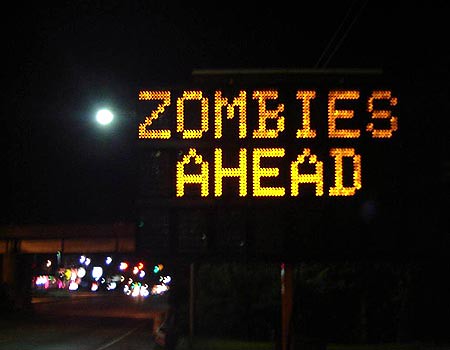
Laughing off a Zombie Apocalypse

Zombies Ahead
Photo credit: *Keith
Ready for some shameless self promotion? A revised version of my 2014 ISA conference paper (which was itself based on a blog post) has now been published as an advanced access 2016 journal article. Here's the full citation, with a working link to the Oxford University press website:


Rodger A. Payne, "Laughing off a Zombie Apocalypse: The Value of Comedic and Satirical Narratives,"  International Studies Perspectives 2016; doi: 10.1093/isp/ekv026. 


Kudos to Dan Drezner for making me think about this.


These are parts of Oxford's permission note:
Sending a free-access URL
There are several advantages to providing you with a free-access link to your article instead of a PDF file, including:
• Access to both the HTML and PDF versions of an article (where available).
• You (and your co-authors) plus any users of your own personal/institutional web sites will get free access to the finally published and authoritative version of the article that is available from our site whether or not they are a subscriber to the journal;
• We guarantee that you (and your co-authors) will have continued access to your article without the responsibility of maintaining and updating these files;
• All the linking and other functionality for the article remains in place;
• We can continue to gather accurate usage statistics for the journal to help us ensure that we continue to provide a good service for authors and readers.
Distribution of the link 
You may wish to include these links in your list of publications. As with an offprint, following these links allows interested readers free access to the full text of your paper whether or not they are a subscriber to the journal. However, in distributing the link, we request that you consider the following points:
• The article should only be viewed from the Oxford Journals site, and not hosted by your own personal/institutional web site or that of other third parties, though you or your co-authors may post the URLs on your own sites or those of your institutions/organizations;
• Single copies of the article can be printed and distributed to interested colleagues who wish to use the article for personal research/study purposes only. For those wishing to make commercial use of the article, please direct them to journals.permissions@oup.com for permissions information or see the website. 


Visit this blog's homepage.

For 140 character IR and foreign policy talk, follow me on twitter.

Or for basketball, baseball, movies or other stuff, follow this personal twitter account.

Sunday, October 25, 2015

Benghazi: Time to Think the Unthinkable?

Three weeks ago, I gave a paper on "Thinking the Unthinkable About National Security Narratives." It was inspired by the brief uproar over Seymour Hersch's claims about the Obama administration's tale about the killing of Osama bin Laden. Indeed, much of the paper tracks a long series of likely political deceptions and fabrications fomented by various U.S. national security elites over the years. I focus on threat inflation, misapplied analogies to justify war, stories to support the conduct of American wars, etc.

Ultimately, the paper will need to expand on the evidence, but it briefly considers the bomber gap, missile gap, and window of vulnerability. These cases largely led to unnecessary and costly increases in US military spending. It also considers inflated threats that helped lead to war -- the Gulf of Tonkin incident and the first Persian Gulf War, for example. I barely discussed the numerous deceptions allegedly employed to sell the most recent Iraq war, which was the subject of so much of my blogging and academic writing for a decade. Instead, I quote some scholars who argue that we won't know for certain about alleged Bush administration deceptions until additional critical materials are declassified.

There are plenty of other likely deceptions with more modest political goals and some are mentioned in the paper (Jessica Lynch, Pat Tillman). Remember, Secretary of Defense Robert McNamara didn't even think the deployment of Soviet Missiles in Cuba in October 1962 posed a new military threat to the US. He described it as a domestic political problem. That's not the way JFK framed it to the American public or to the Soviets.

Indeed, my "Unthinkable" paper describes the problem of deception about national security as endemic -- and especially problematic to study academically because of the huge advantages security elites have in the marketplace of ideas. They control information, largely thanks to secrecy, which gives them the ability to provide a particular narrative about threats, war, etc. They have the authority to speak, thanks to their position in power, which is accompanied by access to impressive material resources as well. The stories elites tell may endure for a long time, even as new evidence challenges some of it. My paper points out that historians and political scientists are still arguing about whether FDR tried to deceive Americans about the need for World War II. The relevant documents are ~75 years old.

Last weekend, the NY Times Magazine drew attention to some of the same questions I'm asking and problems I'm exploring, though Jonathan Mahler chose to focus on the Obama administration story about killing bin Laden.
It’s not that the truth about bin Laden’s death is unknowable; it’s that we don’t know it. And we can’t necessarily console ourselves with the hope that we will have more answers any time soon; to this day, the final volume of the C.I.A.’s official history of the Bay of Pigs remains classified. We don’t know what happened more than a half-century ago, much less in 2011. 
There are different ways to control a narrative. There’s the old-fashioned way: Classify documents that you don’t want seen and, as [Defense Secretary Robert] Gates said, ‘‘keep mum on the details.’’ But there’s also the more modern, social-media-savvy approach: Tell the story you want them to believe. Silence is one way to keep a secret. Talking is another. And they are not mutually exclusive.
In any case, this week, the world watched former Secretary of State Hillary Clinton testify for nearly 11 hours about the September 11, 2012, attack on the American diplomatic mission in Benghazi. The questions that Republicans wanted to ask were much like the ones I'm asking: Did the Obama administration, and especially Secretary Clinton, fabricate a political lie to the American people? Did they do this for reasons unrelated to genuine national security purposes (domestic politics)?

My paper included a number of caveats about the strength of the evidence about various alleged cases of deception because the ideas I'm exploring are ordinarily "unthinkable." Political opponents in the heat of a partisan struggle might accuse their foes of engaging in deception and political fabrication in the area of national security, but the wider reaction is usually much more cautious. And academics are especially cautious.

Critics are often not taken seriously if they argue that elites use national security matters to increase their popularity ("rally 'round the flag"), win elections, create jobs, or divert attention from personal political crisis. This is said to reflect paranoia and conspiracy theorizing.

And, in fact, Mahler's piece was attacked by critics as promoting "conspiracy theory."  Colleagues at the NY Times were apparently worried about the effect this story would have on the credibility of their newspaper's journalism. CNN's Peter Bergen called Mahler's story "bizarre."

So what is the story with Benghazi? Did Clinton seek to deceive? Or are conservatives serving up a juicy conspiracy theory based on thin evidence?

Based on my reading of various conservative twitter users, the question about Clinton's alleged deceptions now seem to be their primary concern. The critics argue that Clinton and others blamed an anti-Islamic video for the attack, when she and others in the administration knew it was an intentional act of terror. This is Clinton's entire statement of September 11, 2012, with the most controversial part in red:
 "I condemn in the strongest terms the attack on our mission in Benghazi today. As we work to secure our personnel and facilities, we have confirmed that one of our State Department officers was killed. We are heartbroken by this terrible loss. Our thoughts and prayers are with his family and those who have suffered in this attack.

This evening, I called Libyan President Magariaf to coordinate additional support to protect Americans in Libya. President Magariaf expressed his condemnation and condolences and pledged his government’s full cooperation.

Some have sought to justify this vicious behavior as a response to inflammatory material posted on the Internet. The United States deplores any intentional effort to denigrate the religious beliefs of others. Our commitment to religious tolerance goes back to the very beginning of our nation. But let me be clear: There is never any justification for violent acts of this kind.

In light of the events of today, the United States government is working with partner countries around the world to protect our personnel, our missions, and American citizens worldwide."
The debate over the years has often focused on a memo drafted by then-White House Deputy Strategic Communications Adviser Ben Rhodes a few days after this statement, which formulated the White House talking points to guide then-UN Ambassador Susan Rice on various Sunday TV programs. The administration wanted to sell the attack as “rooted in an Internet video, and not a failure of policy.” The presidential election was about 7 weeks away and the killing of bin Laden was a featured part of their story for reelection.

Essentially, conservatives claim that the evidence was soon clear that Benghazi was a predesigned terrorist attack and that there had been no anti-video protest at the mission in Libya. Nonetheless, the Obama administration blamed a video repeatedly.

This suggests a partisan deception about policy, right?

What is the evidence for the defense? Obama himself called the event an "act of terror" on September 12. The administration started acknowledging the premeditated terrorism by September 19.  That date is important because it turns out the intelligence agencies were apparently telling the administration that the video protest was the likely cause until September 24. In November 2014, the House Permanent Select Committee on Intelligence released a report that seemingly debunked the theory about political fabrication:


This week, conservatives are convinced that Clinton's same-night email to daughter Chelsea and phone call with Egyptian prime minister (September 12) constitute new smoking gun evidence about their original concerns. In a brief email reference, Clinton told Chelsea that the act was perpetrated by an al-Qaeda like group. She also told the Egyptian PM that “We know the attack in Libya had nothing to do with the film. It was a planned attack — not a protest.”

This sounds like fairly damning evidence and it might well be correct to blame Clinton and the Obama administration for playing politics with national security. However, this version of the narrative overlooks certain facts.

First, the Republicans still have not grappled with the intelligence reports. Was it wrong to say something publicly that was consistent with the intelligence? Readers may remember that this was essentially the defense of the Bush administration regarding Iraq, even though members of the administration often said things that seemed well beyond the intelligence findings. This reading doesn't explain the sentences Clinton apparently communicated to her daughter or to the Egyptians, but ask this question: Is it possible that those far more private instances simply reflect her going beyond the intelligence, perhaps based on unconfirmed evidence? I don't know, and neither do the conservative critics.

Second, Clinton's statement used the passive voice. She didn't say the video caused the attacks, she said some had claimed that. It's a classic Fox News tactic, of course. Indeed, Fox News was running with the video story on September 11, just as many other news agencies were. Susan Rice's statements on Sunday TV went further, but she wasn't the one being scrutinized this week. On those shows, Rice also repeatedly said, "we'll wait to see exactly what the investigation finally confirms." President Obama also made similar remarks that week about waiting for additional evidence to confirm what happened.

Third, the right's interpretations focused narrowly on Benghazi and ignores other important events occurring that day. The inflammatory video in question was provoking demonstrations at American embassies around the world. The US mission in Cairo was of special concern, though other attacks elsewhere led to deaths. The Obama administration was arguably trying to signal that the US would not tolerate this behavior. Perhaps they were thinking that there would be no replay of Iran 1979 on their watch.

I'm not creating this tale for them, I'm just providing a charitable reading of the situation. This is the story Clinton told the members of Congress this week:
FMR. SECRETARY OF STATE HILLARY CLINTON: During the day on September 11th, as you did mention, Congressman, there was a very large protest against our embassy in Cairo. Protesters breached the walls. They tore down the American flag. And it was of grave concern to us because the inflammatory video had been shown on Egyptian television, which has a broader reach than just inside Egypt. 
And if you look at what I said, I referred to the video that night in a very specific way. I said, some have sought to justify the attack because of the video. 
I used those words deliberately, not to ascribe a motive to every attacker but as a warning to those across the region that there was no justification for further attacks. 
And, in fact, during the course of that week, we had many attacks that were all about the video. We had people breaching the walls of our embassies in Tunis, in Khartoum; we had people, thankfully not Americans, dying at protests. But that's what was going on, Congressman. 
I'm not sure of Clinton's motives, but her story fits the words. Sure, the Republican story also seems to fit, but it presumes malfeasance without proving it. I'm willing to think about the unthinkable, but I want the evidence of deception to be as strong as it can be.

This post was motivated by several twitter exchanges I had yesterday with people on the right (linked above). I certainly agree that there's reason to be interested in this case, but it seems like a relatively mild instance of a much larger problem. Some people are quite worked up about it, but I didn't notice them screaming for heads to role because of Iraq. Or lies about Jessica Lynch. Or lies about Pat Tillman.

I know that Tom Nichols has a crafty argument about Bill Clinton's role in inflating the chemical weapons threat from Iraq, but Clinton wasn't the President who puffed up a nuclear threat to launch a war on Iraq. As I've written before, referencing David Kay, letting a chemical threat justify preventive war might spark dozens of such wars. 


Visit this blog's homepage.

For 140 character IR and foreign policy talk, follow me on twitter.

Or for basketball, baseball, movies or other stuff, follow this personal twitter account.
Saturday, October 17, 2015

ISSS-ISAC 2015: Springfield, MA


Source: http://images.delcampe.com/img_large/auction/000/215/412/058_001.jpg

Last weekend, I traveled to Springfield, MA, to attend the Annual Joint Meeting of the International Security Studies Section of ISA and the International Security and Arms Control Section of APSA.

For a panel "Thinking About Security," I presented a paper, "Thinking the Unthinkable About National Security Narratives," (latter requires ISA archive access) which considers the often-deceptive narratives constructed and employed by American national security elites to identify threats, justify policy actions (including war and intervention), and sustain support for policy -- including war and intervention. The field is characterized by secrecy and limited participation in both public debate and internal decision-making. Deception and secrecy are arguably endemic and enduring problems in national security affairs and not readily addressed by the ordinary "thinkable" solutions.

It's a very rough paper that needs a great deal of work. The empirical section of the paper is especially crude, only briefly surveying a lot of literature on threat inflation, the misapplication of the Munich analogy, and other instances when security elites employed deceptive narratives. Along with various cold war examples, I mention deceptions involving the Gulf of Tonkin incident, Persian Gulf War, and Iraq war. I also mention a few lesser deceptions, involving Jessica Lynch and Pat Tillman, for example.

Today, I just read a long and interesting piece in the New York Times Magazine by Jonathan Mahler that covers much the same ground (including many of the same examples and concerns about secrecy and deception) though with terrific reporting and analysis of the narrative about the killing of Osama bin Laden. As I said last weekend in Springfield (and this was in my conference proposal), my inspiration for the paper was the Seymour Hersh story about the killing of Osama bin Laden. My paper briefly mentions the various versions of the bin Laden story, but primarily emphasizes the difficulty of finding "truth" on any significant national security issue.

I ran out of time writing, but the paper concludes by arguing (as I often have) the need for more open and inclusive debate in the public sphere. A "marketplace of ideas" is likely not going to work if we want anything like democratic decision-making on national security affairs.

Among other avenues, I plan to look at what the US government used to say about Soviet "disinformation" and deception.


Visit this blog's homepage.

For 140 character IR and foreign policy talk, follow me on twitter.

Or for basketball, baseball, movies or other stuff, follow this personal twitter account.

Tuesday, September 01, 2015

Gulf of Tonkin: The Deceptions that Justified War

August 4 was the 51st anniversary of President Lyndon Johnson's speech about the so-called Gulf of Tonkin incidents that were used to justify the Vietnam war. Here's a brief excerpt describing his claim:


Here's former Secretary of Defense Robert McNamara years later in "Fog of War" admitting that the incident didn't happen:


In February 2008, U.S. Navy Lt. Commander Pat Paterson wrote about the historical evidence for the U.S. Naval Institute's Naval History Magazine:
But once-classified documents and tapes released in the past several years, combined with previously uncovered facts, make clear that high government officials distorted facts and deceived the American public about events that led to full U.S. involvement in the Vietnam War.

On 2 August 1964, North Vietnamese patrol torpedo boats attacked the USS Maddox (DD-731) while the destroyer was in international waters in the Gulf of Tonkin. There is no doubting that fact. But what happened in the Gulf during the late hours of 4 August—and the consequential actions taken by U.S. officials in Washington—has been seemingly cloaked in confusion and mystery ever since that night. 
Nearly 200 documents the National Security Agency (NSA) declassified and released in 2005 and 2006, however, have helped shed light on what transpired in the Gulf of Tonkin on 4 August. The papers, more than 140 of them classified top secret, include phone transcripts, oral-history interviews, signals intelligence (SIGINT) messages, and chronologies of the Tonkin events developed by Department of Defense and NSA officials. Combined with recently declassified tapes of phone calls from White House officials involved with the events and previously uncovered facts about Tonkin, these documents provide compelling evidence about the subsequent decisions that led to the full commitment of U.S. armed forces to the Vietnam War.... 
These new documents and tapes reveal what historians could not prove: There was not a second attack on U.S. Navy ships in the Tonkin Gulf in early August 1964. Furthermore, the evidence suggests a disturbing and deliberate attempt by Secretary of Defense McNamara to distort the evidence and mislead Congress.
Paterson explains in the article that the August 2 attack was provoked by US actions.  These are his final concluding sentences about the events and the Vietnam war:
The administration's zeal for aggressive action, motivated by President Johnson's election worries, created an atmosphere of recklessness and overenthusiasm in which it became easy to draw conclusions based on scanty evidence and to overlook normally prudent precautionary measures. Without the full picture, Congress could not offer the checks and balances it was designed to provide. Subsequently, the White House carried the nation into the longest and one of the most costly conflicts in our nation's history.

Visit this blog's homepage.

For 140 character IR and foreign policy talk, follow me on twitter.

Or for basketball, baseball, movies or other stuff, follow this personal twitter account.

Monday, August 31, 2015

Persian Gulf War: 25th Anniversary

This post is nearly a month late.

On August 2, 1990, Iraqi forces attacked Kuwait, reflecting what then-U.S. President George H.W. Bush a few days later called "brutal, naked aggression."

August 8, 2015, marked the 25th anniversary of  Bush's speech to the nation outlining the initial U.S. response. Bush emphasized America's commitment to Saudi Arabia:
I pledge here today that the United States will do its part to see that these sanctions are effective and to induce Iraq to withdraw without delay from Kuwait.
But we must recognize that Iraq may not stop using force to advance its ambitions. Iraq has massed an enormous war machine on the Saudi border capable of initiating hostilities with little or no additional preparation. Given the Iraqi government's history of aggression against its own citizens as well as its neighbors, to assume Iraq will not attack again would be unwise and unrealistic. 
And therefore, after consulting with King Fahd, I sent Secretary of Defense Dick Cheney to discuss cooperative measures we could take. Following those meetings, the Saudi Government requested our help, and I responded to that request by ordering U.S. air and ground forces to deploy to the Kingdom of Saudi Arabia. 
Let me be clear: The sovereign independence of Saudi Arabia is of vital interest to the United States. This decision, which I shared with the congressional leadership, grows out of the longstanding friendship and security relationship between the United States and Saudi Arabia. U.S. forces will work together with those of Saudi Arabia and other nations to preserve the integrity of Saudi Arabia and to deter further Iraqi aggression. Through their presence, as well as through training and exercises, these multinational forces will enhance the overall capability of Saudi Armed Forces to defend the Kingdom. 
I want to be clear about what we are doing and why. America does not seek conflict, nor do we seek to chart the destiny of other nations. But America will stand by her friends. The mission of our troops is wholly defensive. Hopefully, they will not be needed long. They will not initiate hostilities, but they will defend themselves, the Kingdom of Saudi Arabia, and other friends in the Persian Gulf.
Eventually, the Pentagon claimed that 250,000 Iraqi troops threatened Saudi Arabia.

A few months later, after obtaining Soviet satellite photos of the region, the St. Petersburg Times reported that Iraqi troops were NOT poised to strike Saudi Arabia. The headline of January 6, 1991, was simple: "Photos don't show buildup."

two American satellite imaging experts who examined the photos could find no evidence of a massive Iraqi presence in Kuwait in September. 
A Soviet commercial satellite took a photo of Saudi Arabia on Sept. 11 and a photo of Kuwait on Sept. 13. At the time the Defense Department was estimating there were as many as 250,000 Iraqi troops and 1,500 tanks in Kuwait. The photos were obtained by the St. Petersburg Times two weeks ago.
As of 2002, the Pentagon had never released its own satellite photographs, though US officials have admitted that they greatly overstated the size of the Iraqi military at the time.

That might not have been the largest lie told about the Iraqi threat. One personal narrative was especially powerful -- and pernicious.
 in the fall of 1990, members of Congress and the American public were swayed by the tearful testimony of a 15-year-old Kuwaiti girl, known only as Nayirah.
In the girl's testimony before a congressional caucus
, well-documented in MacArthur's book "Second Front" and elsewhere, she described how, as a volunteer in a Kuwait maternity ward, she had seen Iraqi troops storm her hospital, steal the incubators, and leave 312 babies "on the cold floor to die." 
Seven US Senators later referred to the story during debate; the motion for war passed by just five votes. In the weeks after Nayirah spoke, President Bush senior invoked the incident five times, saying that such "ghastly atrocities" were like "Hitler revisited." 
But just weeks before the US bombing campaign began in January, a few press reports began to raise questions about the validity of the incubator tale.
Later, it was learned that Nayirah was in fact the daughter of the Kuwaiti ambassador to Washington and had no connection to the Kuwait hospital. 
She had been coached – along with the handful of others who would "corroborate" the story – by senior executives of Hill and Knowlton in Washington, the biggest global PR firm at the time, which had a contract worth more than $10 million with the Kuwaitis to make the case for war.
President Bush's National Security Advisor, Brent Scowcroft later claimed not to know that the story was fabricated, but acknowledged that "it was useful in mobilizing public opinion."


Visit this blog's homepage.

For 140 character IR and foreign policy talk, follow me on twitter.

Or for basketball, baseball, movies or other stuff, follow this personal twitter account.

Wednesday, June 17, 2015

Imagining fear

In the May 2015 Atlantic, Princeton historian David A. Bell reviewed The Coming of the Terror in the French Revolution by Timothy Tackett and Phantom Terror by Adam Zamoyski. In his last paragraphs, Bell makes an interesting point about the way fears can be created in the public imagination despite the lack of genuine threats:
But imagined terrors, as he [Zamoyski] and Tackett very usefully remind us, can have even more political potency than real ones. While early-19th-century Europe had its share of real revolutionary conspirators, the “directing committee” was as much a figment of the imagination as was the nest of spies and traitors that Robespierre claimed, toward the end of the Terror, to have discovered at the heart of the revolutionary National Convention. Both fantasies stand in a long line that stretches straight through to our own day. 
There is nothing particularly unusual, then, about the fears of an “invasion” of illegal immigrants that have such a large place in the mind-set of American conservatives, or the Russian fears of fascism that Vladimir Putin exploited so successfully to generate support for his incursions into Ukraine. Such emotions are an integral part of modern political life, and tempting as it may be to dismiss them as irrational, hysterical, and not worthy of serious discussion, we cannot simply wish them away.


Visit this blog's homepage.

For 140 character IR and foreign policy talk, follow me on twitter.

Or for basketball, baseball, movies or other stuff, follow this personal twitter account.

Thursday, March 05, 2015

Netanyahu with a Comic Bulls-eye

On Tuesday night, The Daily Show directed its attention to Israeli Prime Minister Benjamin Netanyahu and his speech to Congress. The program is simply terrific at revealing hypocrisy, inconsistency, and hyperbole. In this case, the focus was on Iran and its alleged threat to Israel and the rest of the region. As a side benefit, there is some reminiscing about the buildup to the Iraq war:


Jon Stewart is an American institution and I'm going to miss him when he departs the award-winning program.


Visit this blog's homepage.

For 140 character IR and foreign policy talk, follow me on twitter.

Or for basketball, baseball, movies or other stuff, follow this personal twitter account.

Monday, July 28, 2014

At least he didn't mention Munich....

A few days ago, the chairman of the Joint Chiefs of Staff, Army General Martin E. Dempsey said the following at the Aspen Security Forum (full text here):
“You’ve got a Russian government that has made the conscious decision to use its military force inside of another sovereign nation to achieve its objectives -- first time, I think, probably, since 1939 or so that that’s been the case,”
To some readers, the remark fails the laugh test even though no one in the room apparently laughed.

In that last link, former Reagan Assistant Secretary of the Treasury Paul Craig Roberts is hot and bothered that the United States is demonizing Russia and Vlad Putin in apparent preparation for war -- and he means World War III, all caps and Roman numerals. The title of his post (which I received somehow in my email) is "The World Is Doomed By Western Insouciance; don’t expect to live much longer."

That title didn't fail the laugh test as I chuckled when reading it. That's why I put it in bold.

Anyway, Roberts notes that the U.S. has been using its military force inside of other countries a great deal just in the post-cold war era. Think Bush in Iraq or Obama's drone war in "Somalia, Pakistan, and Yemen." Thus, how could anyone say this is the first time a country has used its military inside another since 1939?

Is that what Dempsey meant? Was he saying that no state since 1939 had militarily intervened in another state like Putin's Russia has in Ukraine? If so, that would be profoundly stupid.

However, it's pretty clear that Dempsey was saying Russia hadn't intervened in this way since 1939.

In context, his statement was in a Q&A conducted by Lesley Stahl of CBS News. She had asked Dempsey about ISIS in the question before and then said:
MS. STAHL:  OK, let’s switch to Ukraine and Russia.  There were reports today that the Russians were firing from Russian territory into Ukraine.  How does that change the situation, if it does? 
GEN. DEMPSEY:  Well, I think it -- I think it does change the situation.  I mean, you’ve got -- you know, you’ve got a Russian government that has made the conscious decision to use its military force inside of another sovereign nation to achieve its objectives -- first time, I think, probably, since 1939 or so that that’s been the case.  So you’ve got -- you’ve got -- in my view, you’ve got a very different security environment inside of Eastern Europe. 
The problem for Dempsey is that even by more generous reading, the claim is still pretty stupid.

Just Russia now: Hungary 1956. Czechoslovakia 1968. Afghanistan 1979.

AFGHANISTAN 1979 until 1989.

Georgia 2008.

So maybe Roberts has a point about the laugh test.


Visit this blog's homepage.

For 140 character IR and foreign policy talk, follow me on twitter.

Or for basketball, baseball, movies or other stuff, follow this personal twitter account.

Sunday, January 06, 2013

America's Enemies

This weekend, I'm spending some time preparing for my graduate seminar on international politics. As many IR scholars do, I typically begin with realism in order for the students to wrap their minds around some of the discipline's core ideas: states, interests, power, threats, security, etc.

Many IR theories position themselves vis-à-vis realism in order to critique, deconstruct, etc.

One obvious problem: realists tend to focus on great power competition and we seem to be in an age that lacks that feature of international politics. In any case, the American public certainly seems to think so. Last February, Mother Jones reported these interesting results of a recent Gallup survey:


Less than a quarter of respondents think that China is America's greatest enemy. The general public is not alone, of course, as John Mearsheimer, perhaps the most prominent academic realist, has long lamented the fact that policymakers fail to treat China as a serious foe.

I'm using the label "threat inflation" for this post because I'm far from convinced that the realists are correct. China and the US have some competing interests, but it also seems pretty clear that they also share many interests and are essentially partners in many endeavors.


Visit this blog's homepage.

For 140 character IR and foreign policy talk, follow me on twitter.

Or for basketball, baseball, movies or other stuff, follow this personal twitter account.

Wednesday, October 13, 2010

Farce

My paper (“The Buildup to the Iraq War as Farce”) for the ISAC/ISSS conference in Providence is complete.

Based on the literature I reviewed in the section, here's my summary paragraph about farce:
A farce is a fast-paced and outrageous story featuring characters that freely employ hyperbole and make nonsensical claims about their situation. Protagonists and antagonists can often be described as reckless fools or devious knaves, though the regular instances of mistaken identity may blur the distinction for members of the audience. Frequently, the threat of physical violence or aggression looms over the story.
Hopefully, I've demonstrated that the buildup to the Iraq war can readily be viewed as farce.

The paper also gives some attention to critic Eric Bentley's "comic catharsis" thesis. Here's an old (March 10, 1961) story from the Harvard Crimson, published after a Bentley campus forum:
Bentley pointed out that by picturing an absurd situation, farce fulfills repressed wishes, although in disguise. "The contrast is between tone and context: the actor threatens murder in a playful tone, but the murderous wishes are true. Farce is a dialogue between aggressiveness and flippancy."

Farce cannot function without this aggressiveness. Bentley stated. He agreed with Freud that innocent jokes do not make us laugh. "We want satire, obscenity, and attack."
Obviously, the buildup to the Iraq war seemed pretty serious at the time, but I think much can be revealed and learned by reading it as farce. I'll try to have a link to the paper next week.

Update: I put a copy on Google Docs.


Visit this blog's homepage.

Friday, May 14, 2010

I briefly ducked out...

Recently, on the Duck of Minerva group international relations (IR) blog, I wrote these posts:

Thursday, May 13, "DVD review; 'Capitalism: A Love Story,'" which is obviously my take on Michael Moore's latest film. I'm a big fan of his work, but this movie was flawed.

Saturday, May 1, I posted "Threat inflation: intergalactic edition." The post considers whether IR scholars should take UFO/alien threats seriously. Some major scholars have taken UFOs seriously and Stephen Hawking suggests this might be a good idea.

April 22 featured my post "Information," which is about the problems of secrecy and mystery (in addition to "known unknowns," Rumsfeld's "unknown unknowns") in IR. The piece was specifically tied to the recent explosive sinking of a South Korean naval vessel near North Korean waters.


Visit this blog's homepage.

Sunday, August 03, 2008

Anthrax and Iraq

Michael Cohen of Democracy Arsenal argues that the anthrax attacks of fall 2001 were not especially meaningful in the Iraq debate:
They didn't use anthrax to sell the war; they used nukes! It simply belies reality to argue that the anthrax attacks and the White House spin that Iraq was responsible for them played a significant role in making the case for war. The evidence simply does not exist to make such a claim.
Is this correct?

Well, the fall 2001 anthrax attacks only killed a handful of people, but they provoked much wider fear, as that link to an AP poll reveals. A fall 2001 Newsweek poll also found significant concern -- linked directed to 9/11 and bin Laden:
MAJORITIES OF AMERICANS say it is at least somewhat likely that large numbers of people will die in future terrorist attacks, either through the use of conventional explosives (74 percent), anthrax mailings (57 percent), smallpox or some other disease (55 percent), according to the latest NEWSWEEK poll.

A clear majority (63 percent) of the public now attribute anthrax attacks throughout the world at least in part to Osama bin Laden’s terrorist network.
Moreover, the administration was able to draw upon that fear to accuse Iraq of making and storing literally tons of anthrax -- capable of killing millions, they asserted. Officials didn't have to accuse Iraq of making the 2001 attacks. The prior attacks had what media scholars call a "priming" effect on the story:

Consider this statement from President Bush in Cincinnati, October 2002. The following is his first substantive point in the address about the alleged threat from Iraq:
"Some ask how urgent this danger is to America and the world. The danger is already significant, and it only grows worse with time. If we know Saddam Hussein has dangerous weapons today -- and we do -- does it make any sense for the world to wait to confront him as he grows even stronger and develops even more dangerous weapons?

In 1995, after several years of deceit by the Iraqi regime, the head of Iraq's military industries defected. It was then that the regime was forced to admit that it had produced more than 30,000 liters of anthrax and other deadly biological agents. The inspectors, however, concluded that Iraq had likely produced two to four times that amount. This is a massive stockpile of biological weapons that has never been accounted for, and capable of killing millions."
Bush also pointed to Iraqi anthrax in the September 12, 2002, UN address and in his 2003 State of the Union address. Those were his three most significant speeches in the buildup to war. By March 19, his last pre-war speech more ambiguously referenced "weapons of mass murder."

Perhaps most importantly, anthrax played a very significant part in Colin Powell's UN Security Council presentation, which was itself critical in garnering editorial (and public) support for the war. Editor & Publisher found support on newspaper op-ed pages literally doubled overnight after Powell's presentation.
Iraq declared 8,500 liters of anthrax, but UNSCOM estimates that Saddam Hussein could have produced 25,000 liters. If concentrated into this dry form, this amount would be enough to fill tens upon tens upon tens of thousands of teaspoons. And Saddam Hussein has not verifiably accounted for even one teaspoon-full of this deadly material....

There can be no doubt that Saddam Hussein has biological weapons and the capability to rapidly produce more, many more. And he has the ability to dispense these lethal poisons and diseases in ways that can cause massive death and destruction.
Read back through Powell's remarks and you will quickly be reminded just how certain the threat was said to be -- and how colossally wrong they were.

In any case, I think it is safe to say that anthrax played an important role in the buildup to the Iraq war. These "weapons of mass destruction" were part of the fall 2001 hysteria and states like Iraq with WMD and linked to terrorists had to be stopped (NSS 2002).


Visit this blog's homepage.

Wednesday, October 10, 2007

Sputnik


I'm nearly a week late noting it, but October 4 was the 50th anniversary of the Soviet launch of Sputnik.

This is shameless self promotion, but one of my early publications (in Armed Forces & Society, Fall 1994; available here) focused on the importance of Sputnik in regard to cold war threat inflation. Basically, President Eisenhower had strong information about the status of the Soviet missile program -- and was not particularly worried about the threat (for good reason) -- but the satellite triggered great fear inside the U.S.

Most of that was explained by domestic politics. Democrats blamed Ike for keeping the US behind in the "space race." JFK did not actually use the phrase "missile gap," but that was the (false) fear at the time.

The U.S. image was further damaged when the Vanguard blew up on the launch pad in December, 1957. Time then named Nikita Khrushchev "man of the year" for 1957.

As explained in my article, the roots of the Cuban Missile Crisis can be found in the U.S. over-reaction to Sputnik.


Visit this blog's homepage.

Sunday, January 25, 2004

Which analysts said "no WMD" before the war?

Since no WMD have been found in Iraq, some Bush administration officials and their allies in the media and/or in think tanks have been claiming that "everyone" thought Iraq had WMD before the war. Calpundit (Kevin Drum) and Tim Dunlap (The Road to Surfdom) have been blogging about this point over the weekend.

It's not true. Dunlap quotes British Cabinet Minister, Robin Cook, and Australian intelligence officer, Andrew Wilkie. But many other serious analysts said Iraq was not a threat.

As I've pointed out repeatedly, the IAEA (ElBaradei personally) proclaimed before the war, as a result of the most recent inspections, that Iraq had no nuclear program. A threatening nuclear program would be relatively easy to find because of the construction and power needs associated with it. El Baradei was pretty definitive.

The "mushroom cloud" fear was known to be false before the war.

Some private analysts were saying the same thing about the nuclear program long before the war. For example, Joseph Cirincione of the Carnegie Endowment for International Peace declared in August, 2002: "Iraq almost certainly does not have nuclear weapons....There is no evidence that Iraq has a nuclear weapon or will soon have one." Cirincione cited open intelligence from the US that said a bomb would be several years away.

Cirincione believed Iraq had large stocks of chemical and biological weapons, but added:
"Iraq has limited means of delivering any weapon of mass destruction. Iraq has no capability to attack the United States from its own territory and only limited capability to attack neighboring countries by air."


A number of former weapons inspectors, like Scott Ritter, argued that Iraq had no WMD. None. Consider his June 2000 piece in Arms Control Today, "The Case for Iraq's Qualitative Disarmament." Ritter wrote then:
Most of UNSCOM's findings of Iraqi non-compliance concerned either the inability to verify an Iraqi declaration or peripheral matters, such as components and documentation, which by and of themselves do not constitute a weapon or program. By the end of 1998, Iraq had, in fact, been disarmed to a level unprecedented in modern history, but UNSCOM and the Security Council were unable—and in some instances unwilling—to acknowledge this accomplishment.
And of course Ritter went around the country in late 2002 and early 2003 saying Iraq was disarmed already.

From academia, Glen Rangwala, Lecturer in Politics at Cambridge University, was very clearly arguing that Iraq was not a significant WMD threat. For example, consider his coauthored piece (with Labour MP Alan Simpson), called "The dishonest case for war on Iraq" dated 17 September 2002. Rangwala wrote this in April 2002, before Iraq was even really on the radar for most people:
This briefing examines the evidence for Iraqi capabilities to launch attacks using WMDs. It finds that there is little evidence to suggest that Iraq retains extensive WMD capacities. Furthermore, US and UK policy towards Iraq since the end of the Gulf War has not been driven by an arms control agenda, suggesting that these governments have not perceived Iraq to be threatening regional or international security through an accumulation of non-conventional weapons.
More to come, so expect this to be edited.

Update: A reader reminded me that Colin Powell and Condi Rice were among those saying Iraq had no threatening WMD -- as recently as 2001. I blogged about their statements back in late September.