Search This Blog

Showing posts with label SABR. Show all posts

Saturday, July 12, 2025

Baseball Stadium additions

Globe Life Field, Texas versus Seattle Friday July 

I've seen professional baseball in dozens of ballparks -- many of them no longer open or even standing. My Dad and Mom took me to my first major league game in the early 1970s (I have not made an effort to pinpoint the game and my ticket stub collection is incomplete). It was in the old Municipal Stadium in KC so the game was probably in 1971 or 1972. Growing up in Kansas, this helped cement my lifelong fandom of the Kansas City Royals. In my youth, the team was terrific and George Brett was a huge star and eventual Hall of Famer. I attended his induction ceremony in Cooperstown. During college at Kansas, I occasionally made it to the park then known as Royals Stadium (now Kauffman, after the original owner). 

From 1984-1987 I lived within easy driving distance of old Memorial Stadium in Baltimore and attended many games while in graduate school in College Park. With friends, I also road-tripped to Philly, Boston, and New York -- seeing the Mets at Shea. I attended Yankee Stadium during the Cooperstown weekend. Two buddies from grad school also went with me to spring training 1987 and we saw 8 baseball games in 7 days, but these were all exhibitions in minor league parks or training facilities. 

While a doctoral fellow at Stanford I attended several A's games in the Colliseum and one Giants game in Candlestick. The next 3 years I lived in Chicago and went to numerous White Sox games at old Comiskey and a few Cubs games at Wrigley. I lived walking distance to the latter, but was an AL fan. From Chicago I road tripped to Milwaukee a couple of times to see the Brewers. 

On my honeymoon, my wife and I attended a Mariners game in the Kingdome. Before you say that is not very romantic, keep in mind that this was during the second week of that trip. On our 10th wedding anniversary, we went to Montreal for an Expos game at the Big O. 

Since moving to Louisville in 1991, I've seen the Reds in Cincy a number of times (2 different parks!) and have trekked to St. Louis to see the Cardinals (2 parks).  During trips to visit friends and family, I've seen the Nationals in DC (2 parks). On vacations over the years, I've managed to attend games in Detroit (2 parks), Toronto, Pittsburgh, and Cleveland (2 parks). On conference travel, I saw the Braves in Atlanta. Travel has also taken me back to Seattle and Chicago so I've seen new parks in those cities too. 

Earlier this month, I attended the SABR National Convention and added Texas's Globe Life Field to my list of parks (pictured above). Despite living in Waco for an academic year, and having a sister in Houston for many years, I never attended a Texas (or Houston) home game before.  In any case, the conference was fun and I had a chance to catch up with some old friends both at the conference and in the DFW area. My favorite panels involved a mix of former players, baseball journalists, and a former union lawyer-executive (Don Fehr). The players on these panels included Hall of Famer Ferguson Jenkins, former Expos pitcher Steve Rogers, and old knuckleballer Dodger-Ranger Charlie Hough. 

Adding Texas means that I've now seen 20 major league franchises in their home parks in 21 cities (Expos became Nationals). In August, I plan to make my first visit to Dodger Stadium to see LA versus San Diego. 

I'm not even going to attempt to list all the minor league parks I've visited over the years, but I've often blogged about those experiences. This summer I added Rochester where I attended a game on Memorial Day.  I've often organized minor league trips to see specific top-rated prospects who became future stars --  Bobby Witt was in Omaha when that team played Columbus in Ohio, I saw Vlad Guerrero Jr. (and Bo Bichette) in A ball in Lansing, Michigan, and Pete Crow-Armstrong in South Bend. The visiting team in Rochester this summer, Guardians affiliate the Columbus Clippers, featured Chase DeLauter. He homered. Remember that name even if he's not guaranteed to be a future all-star. 


Visit this blog's homepage.

For 280 character IR and foreign policy talk, follow me on Bluesky.


Sunday, November 15, 2020

"Doc" Powers

During the summer, I read the fall 2014 issue of SABR's Baseball Research Journal. The issue included a short piece by Robert D. Warrington about physician Michael “Doc” Powers, "a catcher who played primarily for the Philadelphia Athletics and whose baseball career was cut short by his untimely death." Powers was injured running into a wall while catching a foul ball during the first game played at Shibe Park on April 12, 1909, and he died on April 26.

Powers first played in the major leagues for the Louisville Colonels in 1898 and he also played part of the 1899 season for the team. His career batting statistics are not especially notable, but he was apparently a fine defensive catcher who was well-regarded by pitchers. 

In any case, the part of the story that caught my eye is that he was ultimately buried in Saint Louis Cemetery, Louisville, which is very close to my house. Using findagrave, I discovered the approximate location of his headstone and found it fairly easily on one of my daily walks.

I took these photos in early August:


Visit this blog's homepage.

For 280 character IR and foreign policy talk, follow me on twitter.

Or for basketball, baseball, movies or other stuff, follow this personal twitter account.

Monday, May 16, 2016

Evaluating Free Agent Signings at the 1992 Baseball Winter Meetings

This post is tied to a forthcoming SABR publication focusing on the history of baseball's winter meetings. I wrote the chapter on the 1992 meetings held in Louisville, KY, December 3-9. The meetings featured a number of very prominent free agent signings, including two of the biggest stars of the last quarter century.

While I wanted to discuss how well those deals worked out based upon on-field performance of the players, the editors preferred that I focus exclusively on the events of the meeting. This post includes the research I conducted for the chapter that will not be included in the published piece. However, by mutual agreement, the piece will reference this blog post.

These are the prominent player signings, in order they appear in the chapter:

Greg Maddux: In each of the three seasons following his signing by the Braves, from 1993 through 1995, Maddux won the National League ERA title, the Gold Glove for pitchers, and the Cy Young award (the latter two times unanimously). He also led the league in innings pitched during those seasons, as he also had in 1991 and 1992. Put simply, Maddux was the best pitcher in the NL through this period and added to a record that would ultimately position him among the game’s all-time greats. Ultimately, the 2014 Hall of Fame inductee achieved 194 of his remarkable 355 career victories in a Braves uniform. The Braves won their division title in 1993, won the World Series in 1995, and qualified for the playoffs during every season Maddux pitched for the team – save for the 1994 season, which did not include a postseason. During the five years covered by the contract Maddux signed at the 1992 winter meeting, the pitching star remarkably accumulated an average of eight wins above replacement (WAR) per season. Using traditional statistics, he was credited with 89 wins against only 33 losses and posted a 2.13 ERA during the period.

Bobby Bonds: Bonds, of course, is one of the most controversial players in recent baseball history largely because of his eventual association with the Bay Area Laboratory Cooperative (BALCO) and the tremendous offensive statistics he accumulated late in his career. A number of high profile successful athletes tied to BALCO were ultimately accused of using designer anabolic steroids and other performance enhancing drugs. Allegedly, Bonds turned to BALCO after the 1998 season when sluggers Sammy Sosa and Mark McGwire both surpassed the single-season home run record. The contract Bonds signed in 1992 extended only through that 1998 season. The left fielder won the MVP for his new team in 1993, was selected as an All-Star in every season covered by the contract, and averaged 39 home runs and 110 RBIs over those six seasons. Bonds also won the Gold Glove in each of those years, other than 1995. He hit for a .307 batting average, attained a .445 on-base average, and slugged .617 during the life of the contract. The 1997 Giants won the NL West, but lost in the first round of the playoffs. During those seasons, Bonds also accumulated a whopping 50.8 WAR, or nearly 8.5 per season. Largely because of his late career association with BALCO and steroids accusations, Bonds has not been elected to the Hall of Fame.  The seven-time NL MVP retired with a major-league-leading 762 home runs.

Andre Dawson: Somewhat disappointingly, Dawson hit only 39 additional home runs in his career, including 29 for the Red Sox. Because of age and declining health, Dawson mostly played as a designated hitter for the Red Sox. He managed 20 appearances in the outfield during 1993 and none in 1994. During this inflated offensive era, over 70 major-league players hit more home runs than Dawson managed during those two seasons. Boston finished fifth and fourth in their division during the two contract years.

Paul Molitor: During the first two years in Toronto, the 36 year old Molitor paid immediate dividends, compiling batting averages of .332 and .341, on-base averages of .402 and .410 and a slugging percentage of .509 and .518. Molitor finished second in the MVP voting in 1993 and was named World Series MVP. Molitor retired after the 1998 season and was inducted into the Hall of Fame in 2004.

Kirby Puckett: Puckett played three more All-Star seasons for the Twins, hitting over .300 through the contract and leading the league in RBIs in 1994. Unfortunately, Puckett was forced to retire abruptly from the game late in spring training in 1996 when he developed glaucoma and lost vision in his right eye. He was inducted into the Hall of Fame in 2001 and died in March 2006 after suffering a stroke.

Ozzie Smith: Smith enjoyed two more years as a regular shortstop and made three All Star teams before his career ended with the 1996 season. He was inducted into the Hall of Fame in 2002.

Joe Carter: Carter would continue to be a fearsome slugger and finished 12th and 10th in MVP voting in 1993 and 1994, respectively. Most memorably, Carter hit the 1993 World Series clinching three-run home run in the bottom of the ninth inning of Game Six.

Greg Swindell: Swindell started 84 games for the Astros during the length of that contract, compiling a 30-34 win-loss record and a 4.48 ERA.

Dave Stewart: Stewart went 12-8 as a member of the World Champion Jays team in 1993, with a 4.44 ERA. He was named the MVP of the American League Championship Series after winning two games during that series. Stewart did not pitch nearly as well in two starts in the World Series against the Philadelphia Phillies and his 1994 ERA ballooned to 5.87 in just 22 starts.

Todd Worrell: Worrell did not assume the high-profile closer role until the final year of his contract when he recorded 32 saves and had a 2.02 ERA During the first two years, his age 32 and 33 seasons, Worrell saved only 16 games and had seasonal ERA totals of 6.05 and 4.29 in about 40 innings pitched per year.

Randy Myers: Myers had been San Diego’s primary relief ace and he would lead the NL in saves for the Cubs in two of the next three seasons. His ERA also approached 4.00 in two of those three seasons. In his best year, 1993, Myers finished eighth in the National League Cy Young voting.

J.T. Snow: Over the next four years, Snow hit 65 home runs in almost 2,000 plate appearances for the Angels, with an OBA of .330 and a slugging percentage of .410. He would win two gold gloves for the Angels.


Visit this blog's homepage.

For 140 character IR and foreign policy talk, follow me on twitter.

Or for basketball, baseball, movies or other stuff, follow this personal twitter account.

Sunday, January 31, 2016

SABR Day 2016


Yesterday was SABR Day and I again attended the Louisville "Pee Wee Reese" Chapter meeting. In fact, I arranged for the room on the University of Louisville campus and helped connect the group to a couple of the speakers. Kudos to local leader Harry Rothgerber for making all the detailed arrangements.

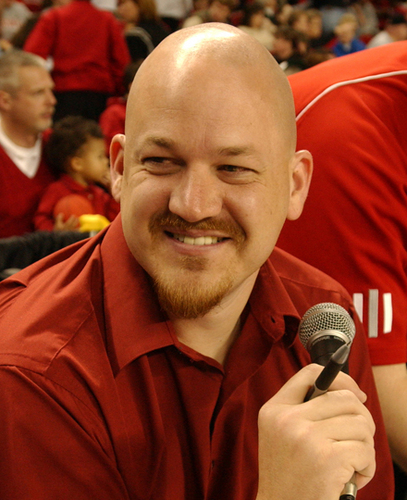
The first speaker was UofL baseball Sports Information Director Sean Moth. He calls the Cardinals baseball games on the radio and is also the PA announcer for the basketball team. Sean talked about his background in the media, discussed some of his favorite interviews, imitated Vin Scully and Harry Caray, and opined that the home run ball that ended the UofL season last year (and sent Cal State Fullerton to the College World Series) was foul. 


The second speaker was Greg Rhodes, Team Historian of the Cincinnati Reds and the former director of the Hall of Fame and Museum at Great American Ball Park. Greg is the author of half a dozen books, including two that have won top SABR research prizes.  Backed by a colorful and interesting PowerPoint presentation, he talked about the opening day tradition in Cincinnati, beginning late in the 19th century. In 2004, Rhodes published a book on this topic.  His presentation included numerous interesting anecdotes and some trivia. Did you know that Adam Dunn has hit more home runs (5) in that game than any other Reds player?

Greg focused a good deal of attention on several recent openers that I recall, including the 1994 game(s). The Monday traditional sell-out opening daytime game was played before a crowd of 55,000, but it actually followed a Sunday night game attended by only 32,000 fans. The Sunday game was not preceded by a parade or other typical hoopla. In 1995, the parade was held on the long-scheduled early April date even though the season was delayed because of labor strife. In 1996, the game was canceled after only a few pitches because of the tragic death of home plate umpire John McSherry.


The third and final speaker was UofL Assistant Professor Megan Shreffler who gave a talk on "The Socialization of Chicagoans into Baseball Fandom." Basically, her PowerPoint-backed talk addressed why some Windy City residents cheer for the Cubs, while others back the White Sox. Megan's talk included a bit of academic theory and was based on a survey of Chicago residents -- some responding via Survey Monkey and others filling out a paper form. She found that Cubs fans tend to root for their family's historic favorite team, while Sox fans are best explained by geography.

Megan is a Cubs fan and is very excited about the upcoming season.

Megan Shreffler

The event concluded with Dr. Jack Sullivan's recurring trivia contest, won by Jon Borie (14 points of 25) narrowly over Bob Sawyer (13.5) and myself (13).

Visit this blog's homepage.

For 140 character IR and foreign policy talk, follow me on twitter.

Or for basketball, baseball, movies or other stuff, follow this personal twitter account.

Saturday, January 24, 2015

SABR Day

Chris Burke
Photo credit: TJ Perreira on Flickr. 
Today was SABR Day 2015, an annual Saturday in January event featuring local SABR chapter meetings across the United States. I attended the one in Louisville at 10 this morning.

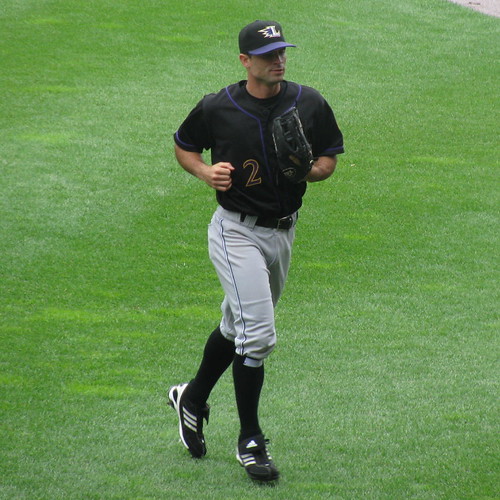
The guest speaker was former major league player Chris Burke, who delivered a worthwhile presentation.  I especially appreciated the fact that he answered our questions fairly directly, even when they involved controversial subjects such as steroid use in baseball.  Burke grew up in Louisville, played his college baseball at Tennessee (All-American SS on the runner-up College World Series finalist team) and then had a fairly significant role on a Houston Astros team that made the World Series in 2005. In the NLDS that season, he hit the series winning home run in the 18th inning of game 4.

After Burke finished and departed, I gave a presentation: "Can Small Market Teams Compete? Revisited." That link takes you to my PowerPoint. As the title suggests, this was a much updated version of a talk I gave to the same local SABR chapter in April 2000.

My 2000 presentation focused on the Oakland A's, much as Michael Lewis did in his 2003 book Moneyball. However, today's talk focused on the 2014 Kansas City Royals, the first small market team to make the World Series since Cleveland did it in 1997. For my talk, I defined the smallest handful of cities as small market: Milwaukee, Kansas City, Cleveland, Cincinnati and Pittsburgh. Oakland shares the Bay area with San Francisco, but is often viewed as small market.

While the A's of 15 years ago emphasized on-base percentage, college pitchers, and "Ken Phelps All Stars" (such as Geronimo Berroa and Matt Stairs), the 2014 Royals apparently identified new market inefficiencies: multiple hard-throwing short relievers, terrific outfield defense, fly-ball pitch-to-contact starters, and an all-star quality catcher.

Dr. Rodger Payne


Visit this blog's homepage.

For 140 character IR and foreign policy talk, follow me on twitter.

Or for basketball, baseball, movies or other stuff, follow this personal twitter account.

Tuesday, February 12, 2013

Billy Beane

Billy Beane I trekked across the state border tonight to see Oakland A's General Manager Billy Beane speak at Indiana University Southeast. Beane had been invited to deliver the keynote address for the annual Sanders Speaker Series.

The format was interview style rather than lecture. Local writer and academic Marty Rosen (yes, Neal (if you ever read this space anymore), that Marty Rosen) sat next to Beane on stage and asked engaging questions for about an hour -- and then they opened it up to audience members.

Beane proved to be an entertaining and intelligent guest for this sort of event.

The questions were diverse, triggering Beane to reveal his favorite baseball films of all time (Pride of the Yankees, The Natural and Field of Dreams -- Beane is a self-described baseball romantic, at least as  a fan), his most memorable trading experiences as GM (the 1999 mid-season trades), his appreciation for Baseball Prospectus and their former employee Nate Silver, the influence of the 1993 Phillies offense on his baseball thinking, and the background story for this unusual convergence of thinkers. 

One member of the audience asked Beane what kind of statistical metrics teams were using "behind the scenes" that fans didn't know about. He replied by referencing an old SNL skit that he has likely noted on many similar occasions (paraphrasing). A reporter at a press briefing asks a U.S. military general: "Sir, what would be the one piece of information that would be most dangerous for the Iraqis to know?" 

Good stuff.

By the way, Beane pointed out that 2013 is the 10th anniversary of Moneyball. Devoted blog readers may remember my own take on Beane's early years.


Visit this blog's homepage.

For 140 character IR and foreign policy talk, follow me on twitter.

Or for basketball, baseball, movies or other stuff, follow this personal twitter account.

Friday, March 16, 2012

Elsewhere

I wrote two posts this week for the Duck of Minerva:

"Friday Nerd Blogging: Baseball Edition" is about Duck contributor Bill Petti's growing (televised) influence as a baseball analyst.

March 14, I posted "The Selling of the Iraq War: Case Study of Presidential Persuasion?" I contributed to a debate among journalists and bloggers.

Oh, on February 22, I posted a short note about the so-called "Abusers' Peace," which is the hypothesis that human rights abusing states do not make war with one another.


Visit this blog's homepage.

For 140 character IR and foreign policy talk, follow me on twitter.

Or for basketball, baseball, movies or other stuff, follow this personal twitter account.

Sunday, December 04, 2011

Baseball Prospectus

A few days ago, the good folks at Baseball Prospectus announced that they are soon releasing a 2-volume Best of Baseball Prospectus: 1996-2011. I think it is going to include a mix of web articles and book pieces, as well as some new essays. It would likely make an excellent Christmas gift.

So far as I know, unfortunately, it will not include my two old pieces written for BP many years ago. One of those articles is still available on-line at the BP website: "Do Top Prospects Get Traded?" It was posted April 8, 1999.

However, the other one is apparently not to be found anywhere. It was a defense of then-KC Royals manager Bob Boone, written in response to a piece by Rany Jazayerli. On the Wayback Machine, I found Rany's critique of Bob Boone posted March 3, 1997: "Is There a 12-Step Program for Overmanagement?"

Rany and I are both KC fans and we co-authored the Royals team comments for the Davenport Translations published exclusively on the web (in the group rec.sports.baseball.analysis) during the 1994-1995 winter. Unfortunately, I cannot find those team comments on the web either -- though I did find them for nearly 20 other teams. And I have the February 1995 files on my hard drive.


Visit this blog's homepage.

Follow me on twitter.

Saturday, September 24, 2011

A's Moneyball followup

As an addendum to Friday's post, I found an exchange on SABR-L, from December 9, 1998. I don't know that I can quote the person I was debating, but my words should be fair game for quotation here. I had contended that "Small-market teams have won recently, and have a chance to win in the future." More specifically, I suggested that the A's would be competing for a World Series appearance by 2001.**

A skeptic in turn pointed out that the A's of 1998 had a terrible third baseman and bullpen, plus no starting pitching or right-handed power-hitting.

My response:
First, I said they'd be competitive for a playoff spot, not a sure Series winner. Second, the A's have one of baseball's top prospects at 3B in Eric Chavez. My prediction was based, in part, on the A's willingness to reward OBA in their minor leagues (this *will* pay off as it did for the Yankees in the past half-decade). RH power hitters are easy to come by for 1b/dh/lf. How much would Billy Ashley cost right now? How much was Bubba Trammell worth last year at this time? Hinch, Tejada, Grieve et al provide a great young nucleus. Pitching? You don't like Witasick (3/1 k/bb ratio in PCL with a sub 4 ERA in 1998)? I agree they need to develop some talent--but who predicted Glavine/Smoltz in 1990? Saberhagen/Gubicza/Jackson in 1983? A 2001 World Series rotation might include someone currently in college--or even high school. What if the A's offered Stairs and Rogers for Clemens? Bullpen holes are among the easiest to fill since there are plenty of hard throwers out there that find their control or develop new off-speed pitches every season.
The 2001 A's won 102 games and made the playoffs as the Wild Card (Seattle won 116 games!). Eric Chavez was the starting 3B and he hit and fielded like an MVP candidate. The rotation was led by Tim Hudson (2nd year pitcher from Auburn; a member of '97 draft class), Mark Mulder (2nd year pitcher obtained in trade, but drafted in '98 from Michigan State), and Barry Zito (2nd year pitcher drafted from UCSB in '99). Right-handed Jermaine Dye slugged almost .550 for Oakland after coming over in a mid-year trade for trinkets and beads (KC got Neifi Perez, but it was a three-way deal with the Colorado Rockies). RH Olmaedo Sáenz also had 30+ extra base hits in a limited role as a corner infielder. The A's bullpen featured a lot of no-name relievers in their late 20s and early 30s who limited walks, got strikeouts and performed perfectly well. Their closer was Jason Isringhausen who did a fine job and had been obtained by the A's in a trade for an older reliever -- Billy Taylor.

I'm not claiming any sort of clairvoyance here -- I think this set of predictions were all made conceivable by the work of Bill James and those who followed him.


** In fairness, I also mistakenly predicted a Pirates resurgence.

Visit this blog's homepage.

Follow me on twitter.

Tuesday, July 31, 2007

SABR

I was out of town for several days last week attending the annual national conference for the Society for American Baseball Research (SABR). I went to a number of interesting panels -- one of the best was by Dave Smith of Retrosheet -- and the ballgame on Friday night. It was my first visit to the new Busch stadium.

Though you might not have predicted it based upon my scholarly writing, I hung around with members of the Statistical Analysis crowd and mostly attended their panels and looked at their posters. Many in that group are academics -- like David Kaplan of Wisconsin -- but many others are not. I also attended a number of other scientific panels.

The most entertaining and enlightening talk was delivered by Dr. Mike Marshall, a former Cy Young winning pitcher who has very strong theories about how to prevent pitching injuries. He wants to completely revamp pitching motions.

Aaron Gleeman's more colorful recap of the convention is here (including a picture of my friend Neal Traven. I don't know Gleeman, but many of his friends are prominent SABR-types and I saw many of the people included in his photos.


Note: My apologies to Paul for visiting St. Louis and not giving an advance heads-up.


Visit this blog's homepage.

Saturday, November 26, 2005

References to Moneyball philosophy

One of my first blog posts was about Michael Lewis's book Moneyball, an excellent work about baseball analysis informed by relatively advanced statistics.

SABR member Dave Black posted the following to SABR-L on November 17, 2005:
Moneyball is now a descriptor of a specific philosophy for building a baseball team.

As I re-read the book, I tried to identify specific quotes that would describe the Moneyball philosophy.
And here are the handy references Black provided:
p. 33 -- The ability to control the strike zone (meaning K/BB ratio) is the best indicator of future success (for a hitter).

p. 34 -- The larger the number of pitches faced per plate appearance, the more effective an offense is likely to be.

p. 37-38 -- College stats are better for predicting the future of players than high school statistics. For high school players the competition is too weak and the sample size it too small.

p. 57 -- The number of runs a team scores correlates closely to OBP.

p. 125 -- Closers are overpriced and rarely worth the investment of a large contract.

p. 129 -- The ability to get on base is undervalued. (NOTE: Is it now overvalued because of the book?)

p. 137 -- Hitting ability contributes far more to the success of a team than defensive ability.

p. 248 -- Player development follows similar, predictable patterns.

P. 274 -- Playoff results are essentially random because of a small sample size.
By the way, economists Jahn Karl Hakes and Raymond D. Sauer have authored "An Economic Evaluation of the Moneyball Hypothesis." Hakes and Sauer conclude that any market under-valuing of OBP (on-base percentage) was history by the time Moneyball was published. This is their abstract:
Michael Lewis's book, Moneyball, is the story of an innovative manager who exploits an inefficiency in baseball's labor market over a prolonged period of time. We evaluate this claim by applying standard econometric procedures to data on player productivity and compensation from 1999 to 2004. These methods support Lewis's argument that the valuation of different skills was inefficient in the early part of this period, and that this was profitably exploited by managers with the ability to generate and interpret statistical knowledge. This knowledge became increasingly dispersed across baseball teams during this period. Consistent with Lewis's story and economic reasoning, the spread of this knowledge is associated with the market correcting the original mis-pricing.
The full paper is available for download at various sites. Just click the link for the abstract to obtain the link(s).

Saturday, February 26, 2005

Sports Central

As everyone knows, Boston is currently the center of the sports universe. Fans of the football Patriots are talking about dynasty and Red Sox enthusiasts are still teary-eyed about their first World Series championship since 1918.

Though we moved here less than two months ago, I have personally already attended a couple of off-season SABR events in Boston (and missed one). Some years, the Louisville chapter is lucky to have a single meeting during the baseball season. At the last event I attended, I sat next to a founder of sonsofsamhorn.com, which is a fairly fanatical Red Sox fan website. The guy was very excited because this off-season he was personally contacted by Red Sox owner John Henry and is now a part-time employee of the team, crunching numbers in hopes of extended future glory.

The Boston Bruins, like the rest of the NHL, are on hiatus, but there's still plenty of hockey in the area.

In fact, today I attended my first hockey game and first Harvard sporting event. Since my family includes two young girls, we decided to go to the women's hockey game versus Vermont.

We like to take the kids to high level women's sports events to show them what is possible. A few years back, we attended a game featuring Team USA soccer, with Mia Hamm and the rest of the famed bunch, when the team played a game versus Brazil in Louisville.

Unfortunately, the hockey game was not much of a contest, as the final score was 7-1 Harvard. The first period was superficially close (the score was only 1-0), but the Crimson had 24 shots-on-goal to 4 for the Catamounts.

Nonetheless, it was entertaining and my youngest especially seemed to enjoy it. She said she'd pay next time if we came back, but this was the final home game of the year (though Harvard will be in the ECAC tournament next weekend on home ice).

Harvard entered the weekend ranked 5th in the country, but they knocked off number 3 Dartmouth Friday night and will likely move up. Go Crimson.

Other sports news: Last night, my wife and I watched "Friday Night Lights," which earns a recommendation because of its realistic intensity. At times, it seems almost like a documentary about Texas high school football. I liked it and I don't even watch football.

Finally, hours ago, I received my copy of Baseball Prospectus 2005. It arrived in perfect time, because I'm about to depart on a long trip west. More on that later.

Thursday, January 13, 2005

Statheads vs. scouts

I haven't blogged much about baseball in a long time. But I'm in Boston and the Red Sox get a lot of coverage even in the offseason...

And I've just started reading The Pitch That Killed, by Oklahoman Mike Sowell. I previously read his One Pitch Away.

Plus, Saturday I intend to attend the local SABR chapter meeting at BU...it's scheduled for six hours and will feature Sports Illustrated writer Leigh Montville, among other speakers. One of the presenters is going to talk about steroids and baseball.

Finally, today I read a great piece on the Baseball America webpage featuring a discussion moderated by Alan Schwarz. Two stateheads and two scouts sit down and talk about baseball prospecting.

The discussion includes this quote by the Red Sox stathead:
VOROS McCRACKEN: Certainly, we in Boston are not antagonistic to the concepts in “Moneyball” either. Obviously they hired me as a consultant. When they promoted Theo [Epstein], basically the idea was he was going to try to meld the two approaches and get them to where they were not only getting along, but are complementing one another. The stats can help the scouts zero in on the guys they should be zeroing in on. And the scouts, once the stats are sorting things through, can tell you who exactly are the best guys to go after. The success of that can obviously be overblown because a World Series championship is a big thing, big news. How much it had to do with stats, how much it had to do with improved scouting . . . I think the point is that Boston has at least tried to reconcile the two positions.
It's a great read if you are into those sorts of things.

Friday, July 16, 2004

SABR Day 2

I was at the SABR convention in Cincinnati again today. I thought I'd note some interesting tidbits.

First, I saw a panel of several experts talking about the 1919 World Series. The moderator was Alan Schwarz, who writes for Baseball America, ESPN Magazine and the New York Times. I didn't learn that much (I've read a couple of books and watched a good movie on the Black Sox scandal), but it was interesting.

In the afternoon, I attended two presentations sponsored by the Statistical Analysis Committee. One was on the relative value of on base average versus slugging and the other was about the kinds of games really good teams win. Retrosheet President David Smith gave this outstanding talk.

I also peeked in on a panel of former Reds players. It was weird seeing Joe Nuxhall since I hear his voice so frequently on the Reds radio games. Lee May was pretty funny, and I especially liked his stories because he played for the KC Royals at the end of his career -- and later served as their hitting coach.

May told some funny anecdotes about Earl Weaver and Sparky Anderson. His best laugh lines, however, were about Leo Durocher, who apparently slept a great deal when he was the Houston manager. Inspired, I bought a used paperback copy of Nice Guys Finish Last.

Thursday, July 15, 2004

SABR in Cincy

I'm posting from the suburbs of Cincinnati at the end of a long day.

Today, I drove up I-71 in a rental car (though it wasn't a good day for that) to attend the national convention of the Society for American Baseball Research (SABR).

First, I attended a presentation on pitcher run support and then I went to another on the greatest leadoff hitters of the twentieth century. The latter was especially fun because the audience voted on the parameters of the study (determining the size of the N, metric for analysis, and even the interpretation).

Later, I headed over to the Great American Ball Park to see the local Reds take on the St. Louis Cardinals. It was my first visit to the new stadium and I had a good time. The food choices were pretty good and the beer was OK (if pricey). My greatest mistake was the softserve ice cream. After waiting in a long line, it was pretty tasteless.

In the game, Albert Pujols hit a no-doubt home run and the Cards won 7-2. Matt Morris started and pitched well for the victors.


Note: Blogspot has completely changed their blogging interface (Avery: check it out) and it might make it easier to improve the look. For instance, I can use color text.

With another vacation coming up, I may ask another reader or two to guest blog. OK?


Sunday, September 21, 2003

Cuba, Baseball and a Public Sphere

Sorry I don't have time for a lot of content or research today. It was a Sunday and I spent some time with my family -- and watching baseball. KC actually moved into a tie for second place today, but the Twins have won 10 of 11 and took the division.

In any case, I will take this opportunity to encourage readers interested in either baseball or public sphere theory to take a look at this short article in the Village Voice by Beth Kwon. She discusses Cuban baseball fans who gather regularly at the José Martí statue in Havana's Parque Central. They talk about the prior night's games and about Cuban stars playing in the US -- and about virtually anything related to baseball.

Yes, it's a public sphere, marked by the participation of locals interested in baseball, expert members of Peña (which she call's "Cuba's answer to the Society for American Baseball Research"), and visiting tourists.

Interestingly, since access to sports news is limited in Cuba, the gatherings serve to provide interested parties with information they could not otherwise obtain -- and a forum to debate the meaning of that information.

Kwon includes a quote from Kit Krieger, who organizes baseball tours to Cuba -- and is a member of SABR. In a recent post to a SABR mailing list, Krieger said that 75 people might gather at these baseball talk sessions. It is "not a single conversation but a series of discussion or arguments that break out in various spots around Jose Marti." He also posted, that it is "in fact, a gathering of very devoted and critical baseball fans whose daily lives afford more opportunity than most of us have to talk about their passion." Apparently, this kind of public debate (about anything) is pretty rare in Cuba.

Krieger also noted in the SABR posting that a picture of this gathering can be found at his commercial website.

Sunday, August 31, 2003

About me

I am a Professor of Political Science at the University of Louisville, where I have taught since 1991. 

In January-February 2026, I spent a portion of my latest sabbatical as a Visiting Professor at the Copernicus Institute of Sustainable Development at Utrecht University in the Netherlands. May-June 2019 I spent a portion of another full-year sabbatical as a Visiting Scholar at the University of Dundee in Scotland.  In fall 2018, I was Fulbright Canada Research Chair at the Norman Paterson School of International Affairs at Carleton University in Ottawa, Ontario.. I served as Acting Department Chair from July 2007 to June 2008 and then was elected as full-time chair from January 1, 2012 through December 2017. 

From 1994-2011, I directed the Grawemeyer Award for Ideas Improving World Order, which has long been the largest cash prize administered by political scientists. Decades ago, I was a Fellow at Stanford's Center for International Security and Cooperation (1987-88) and at Chicago's Program on International Political Economy and Security (1988-89). I also taught as a visiting faculty member at Northwestern for two years before arriving at Louisville. Years later, I spent a sabbatical at Harvard's Belfer Center for Science and International Security (2005).

Recent Wofford College President Nayef H. Samhat and I wrote Democratizing Global Politics; Discourse Norms, International Regimes, and Political Community, which was published by SUNY Press in March 2004. A fairly complete list of my other academic publications -- mostly about international security topics, global environmental politics, and/or political communication -- can be found here (or here or here).

For many years, I served as a member of the Provost's Sustainability Council and the Administration, Finance and Outreach (AFO) Committee of that Council. In fall 2010, the Provost named me to the University-Wide Ad Hoc Committee on Socially Responsible Investing (SRI). In fall 2012, I became the chair of the AFO committee, which was renamed the Planning and Administration Committee in August 2015. I resigned from that position in September 2017. We accomplished a good deal at Louisville and the University committed to carbon neutrality by 2050. UofL's commitment to SRI is demonstrated primarily by its decision to hire a third-party firm to vote its proxies using various social criteria.

This personal blog began in September 2003. In June 2005, I was invited to start posting regularly at the international relations group blog, Duck of Minerva, though I eventually departed in 2015. From August 2009 until late 2012, I wrote occasional blog posts on Climate Politics: IR and the Environment for e-International Relations (e-IR).

I love baseball and have been a member of the Society for American Baseball Research (SABR) since 1997. Primarily, I am a consumer, not a producer, of baseball research. My first contribution to a SABR publication appeared in December 2017.  I root for the Kansas City Royals (World Series Champions in 2015!) and compete in a couple of fantasy baseball leagues. One is the Hardy House League, which some friends invited me to join in 1989 while I was living in Chicago. It's been a 12 team AL-only league for decades. I've won the title 6 times in 36 seasons, finished second 7 times, and came in third 6 times. Most recently, my team won the 2021 post-COVID championship and was runner-up in 2023. 

The second league is the 24 team Original Bitnet Fantasy League Baseball, which I joined in 1991 and last won in the second half (or "B") season of 2023. We play head-to-head seasons with playoffs, divided by the all-star break when we do a quick redraft. It's a dynasty keeper league so most owners retain major stars for most of their careers. My first dynasty featured Greg Maddux, Pedro Martinez, Jim Thome, and Derek Jeter. In 70 championship seasons, the Louisville Sluggers have won 11 times and made 3 other World Series. My team also made the playoffs in the first halves of 2024 and 2026 and second half of 2025. The current team is headed by Gunnar Henderson, Ronald Acuna, and Will Smith, Dodger catcher. 

I also enjoy watching University of Kansas basketball, reading "hard boiled" detective fiction, listening to Americana music, viewing movies, and playing Texas Hold'em poker. I occasionally blog about these interests. More likely, you'll find me "micro-blogging" on one of my two Twitter accounts (professional and personal). I occasionally hang out on Bluesky. 

My wife reads this blog and often sends me articles or tidbits for topical consideration. Our daughters are now working-world young adults living in New York and California, respectively. 

Visit this blog's homepage.